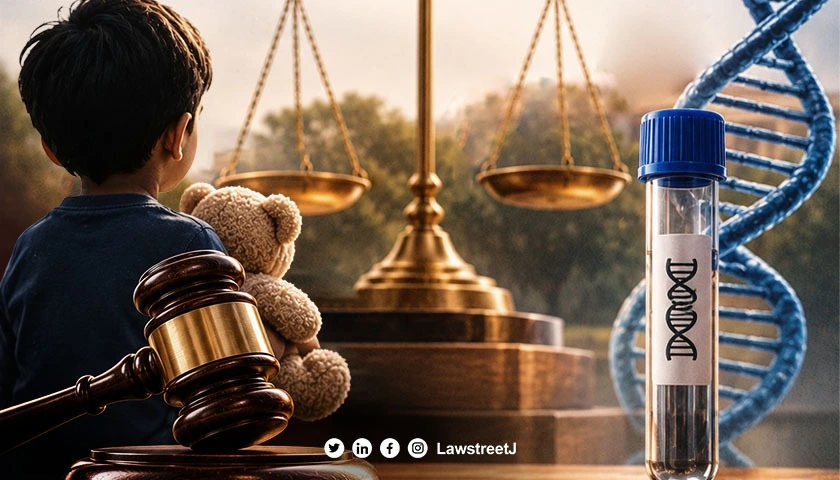
New Delhi: The Delhi High Court has held that a mother’s failure to prove her marriage in earlier proceedings does not bar her child’s independent suit to establish paternity, and upheld a Family Court order directing the alleged father to undergo a DNA test. A Division Bench said that an adverse inference from refusal cannot replace a DNA test, and that the alleged father’s right to privacy must be balanced against the child’s right to know her biological father.
A Bench of Justice Vivek Chaudhary and Justice Renu Bhatnagar, in a judgment by Justice Chaudhary, dismissed an appeal against the order of 31.08.2024 of the Principal Judge, Family Courts, Rohini. The mother, a widow, had claimed that she married the appellant in 1997, that they lived together until 2010, and that the child, born in 2011, was conceived during their cohabitation in 2009 to 2010. The appellant denied the marriage, any relationship, and the child’s paternity. Her earlier petitions for restitution of conjugal rights and maintenance were dismissed in 2012, and the Division Bench in 2012 held that she had failed to prove the marriage and that the refusal of the appellant to take a DNA test could at best lead to an adverse inference. The mother and daughter then filed the present suit seeking a mandatory injunction for a DNA test and a declaration of paternity.
The appellant argued that the marriage finding had attained finality, that there was no prima facie material or access to justify a DNA test, that a compelled test violates privacy, and that mere dispute on paternity does not justify a test, relying on Aparna Ajinkya Firodia v. Ajinkya Arun Firodia, (2024) 7 SCC 773. The respondents relied upon Narayan Dutt Tiwari v. Rohit Shekhar, (2012) 12 SCC 554.
The Court held that the earlier proceedings decided only the question of marriage, to which the child was not a party and for which no relief was claimed, and not paternity or access. The failure to prove marriage is distinct from the question whether the appellant is the biological father. With no marriage, the presumption of legitimacy under Section 112 of the Evidence Act, now Section 116 of the Bharatiya Sakshya Adhiniyam, 2023, did not arise, and there was no legitimacy to be imperilled. The Court observed that paternity was not a collateral question, but the very issue in the suit.
The Court relied on Goutam Kundu, Dipanwita Roy, Aparna Ajinkya Firodia, Ivan Rathinam and Chaturbhuj Pradhan v. Amar Pradhan, 2026 SCC OnLine SC 994, to hold that the only test is whether the result of the DNA test is directly in issue, whether any other evidence on record can substitute it, and whether it is in the best interest of the parties and justice. It distinguished Aparna Ajinkya Firodia, where a husband sought a test of a child born during marriage only to prove the wife’s adultery, whereas here paternity is the very issue and the child herself seeks the test. The mother’s testimony on cohabitation at the time of conception was neither challenged in cross-examination nor rebutted, the appellant did not enter the witness box, and the Family Court had directed the test only after evidence was led, which could not determine paternity conclusively.
Rejecting the argument that an adverse inference suffices, the Court relied on the Division Bench in Rohit Shekhar v. Narayan Dutt Tiwari, whose special leave petition was dismissed, and held:
“Once a strong and eminent need is established, a child’s right to know her parentage through the best available evidence cannot be denied by replacing scientific facts with a comparatively weak legal assumption.”
On privacy, the Court noted that, though a fundamental right under K.S. Puttaswamy v. Union of India, it is not absolute, and that compelled extraction of blood samples was held in Selvi v. State of Karnataka not to shock the conscience. The appellant’s privacy was balanced against the child’s right to know her origin and the balance tilted in her favour. His apprehension of defamation could be met by confidentiality, and if he is not the father, the test would put the matter beyond doubt in his favour.
The Court upheld the order and directed that the Family Court fix an early date for the appellant and the child to appear before the MS/HOD, Forensic Medicine, BSA Hospital, that the samples be collected in confidentiality and the report be forwarded in a sealed cover, and that the Family Court may take all steps in law to secure compliance if he fails to appear. It clarified that no opinion was expressed on Issue No. 3 or the declaration, which are to be decided on the DNA report and the evidence.
Appearances:
For the Appellant: Ms. Archana Gaur, DHCLSC, with Ms. Ridhima Gaur and Mr. Deepu Kumar, Advocates.
For the Respondents: Ms. Kamlakshi Singh, DHCLSC.
Case Title: XXX vs. XXX & Anr., MAT.APP.(F.C.) 133/2025