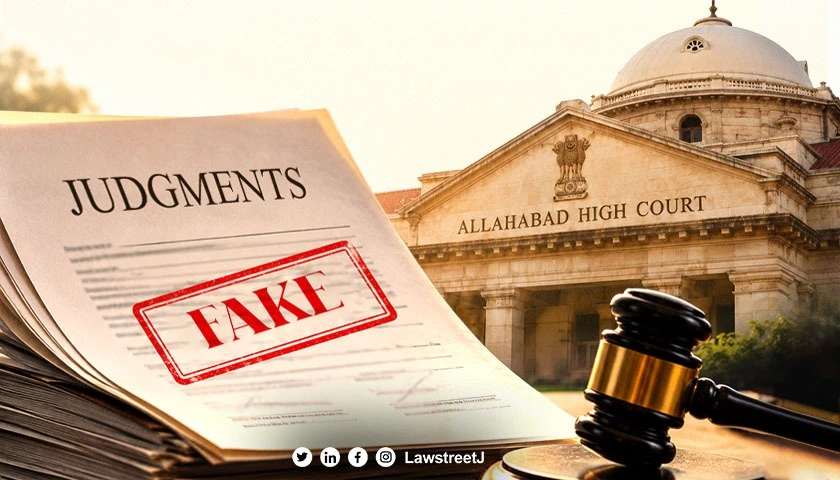
Prayagraj: The Allahabad High Court has held that citing fabricated Supreme Court judgments may amount to professional misconduct, but does not invalidate a judicial decision if it is otherwise based on sound legal principle and not on the principles drawn from the fabricated rulings.
Justice Avnish Saxena dismissed four applications in Original Suit No. 7 of 2023, one of 18 suits relating to Sri Krishna Janm Bhoomi, including an application to recall an order on who may act as next friend of the deity.
Application 132Ga2, under Section 151 CPC, was moved by plaintiffs no. 2 to 5 to recall the order of 26.9.2025, which had refused to delete Sri Kaushal Kishore Thakur Ji, also known as Kaushal Singh Tomar, as next friend of plaintiff no. 1, the deity Sri Bhagwan Sri Krishna Lala Virajman. The sole ground was that counsel for plaintiff no. 1 had cited two fabricatedSupreme Court rulings, Bal Krishna v. State of Maharashtra (AIR 1965 SC 153) and K.K. Verma v. Union of India (AIR 1970 SC 1082), in his reply, and the order recorded thoughtful consideration of the submissions. Plaintiff no. 1 argued that the Court had not relied on the principles drawn from those citations, and that re-agitating the issue would only delay proceedings.
The Court noted that the controversy was between two sets of plaintiffs, plaintiff no. 1, the deity represented by the next friend, and the trust plaintiff, which is also plaintiff no. 5 and wants its representative to act as next friend instead. It recalled that Order XXXII Rule 1 CPC, applicable to minors, also applies to a deity, who is a perpetual minor, and Rules 4 and 5 bar a person with conflicting interest from being a next friend, while Rule 9 provides for removal. It also noted that Order I Rules 1 and 2 CPC allow joinder of plaintiffs and separate trial where joinder may embarrass or delay.
The Court found that the two case laws were merely a reiteration of counsel’s arguments in the earlier order, and said:
“The citing of fabricated judgment may amount to professional misconduct, but it does not invalidate the judicial decision, if it is otherwise based on sound legal principle and not on the principles based on fabricated judgment.”
Since the discussion in paragraphs 11 to 17 of the earlier order, based on Order XXXIIRules 1, 3, 3A, 4, 9 and 10, showed that the fabricated rulings or their principles were not considered, the ground for recall was held misconceived, and the application was dismissed.
Application 114Ka2, moved by plaintiff no. 1, sought to implead the direct descendants of Thakur Keshav Dev Ji, Jadaun Clan and others as parties through the same next friend, and to recognise him as lawful custodian authorised to represent the deity and the descendants. The Court observed that the next friend already appears for the deity, and that no gainful purpose of impleading the descendants was shown, since the deity’s interest is the point of concern. It held that the application was merely to delay the trial, pending since 2023 and at a nascent stage, and dismissed it.
Application 56Ga2, under Order XXIII Rule 3 read with Section 151 CPC, sought a declaration that the compromise agreement of 12.10.1968 in Civil Suit No. 43 of 1967 was null and void, cancellation of the decrees of 1973 and 1974, and delivery of possession. The Court held that, since the same cause of action and relief arise in all the suits and in some are the main relief, this cannot be decided without a trial, and the application was misconceived and dismissed, without affecting the merits of the other suits.
Application 72Ga2, moved by plaintiffs no. 2 to 5, sought modification of the order of 1.8.2024 rejecting Order VII Rule 11 CPC applications in 15 suits, by adding paragraphs to the plaint summary and the list of documents and by inserting the name of their counsel in three paragraphs. The Court said that this was an attempt to supplement the order in counsel’s own words, under the garb of correction, and that Section 152 CPC permits correction only of clerical or arithmetical mistakes or errors from accidental slip or omission. The proposed changes were not such, and the application was dismissed as highly misconceived.
Case Title: Shri Bhagwan Shrikrishna Lala Virajman & 4 Others vs. U.P. Sunni Central Waqf Board & 3 Others, Original Suit No. 7 of 2023 (Applications 132Ga2, 114Ka2, 56Ga2 and 72Ga2)