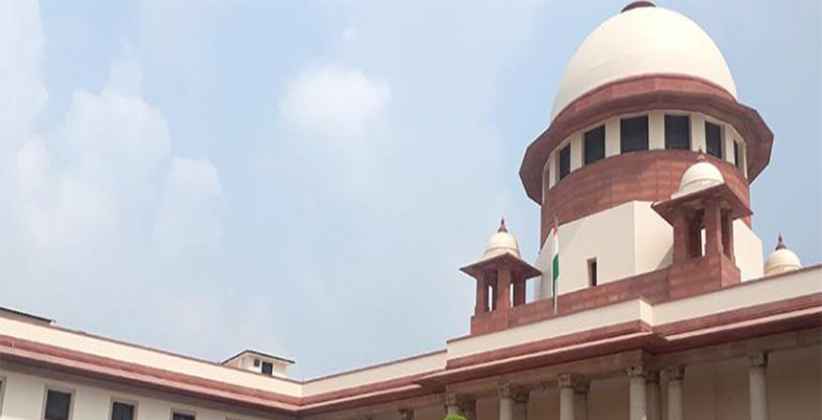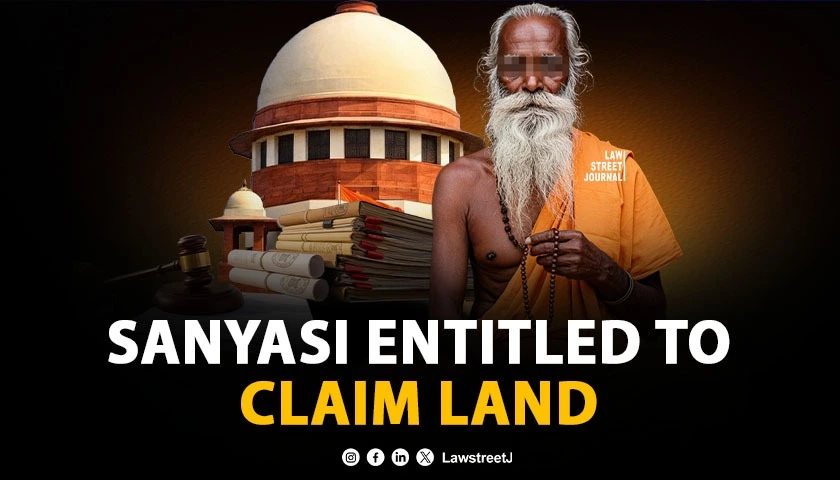
New Delhi: The Supreme Court has observed that a person’s claim for land or monetary compensation cannot be brushed aside solely because he claims to be a Sanyasi.
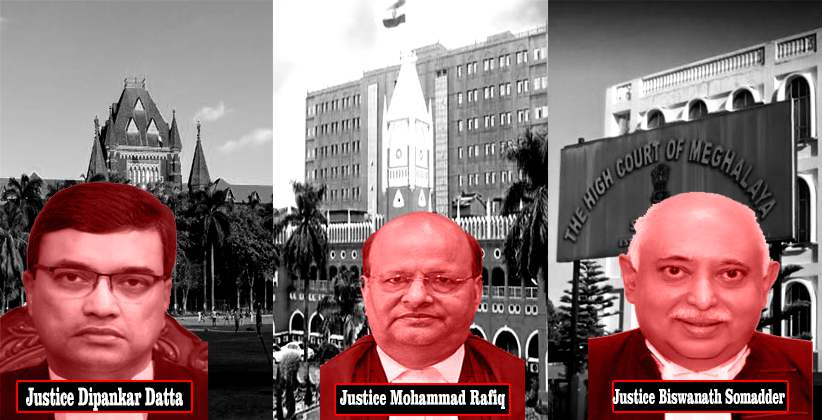
A Bench of Justice Dipankar Datta and Justice Satish Chandra Sharma made this observation while dismissing a miscellaneous application filed by a self-proclaimed Sanyasi who had been repeatedly approaching the Court despite having already received both alternative land and financial compensation for his acquired plot.
The Court noted that Sanyas is the fourth and final stage in the traditional Hindu system of life stages, typically characterised by renunciation of material desires, family ties, and worldly ambitions. However, the mere fact that a person holds himself out as a Sanyasi does not deprive him of his legal entitlement to claim land or compensation and, equally, such a claim cannot be perpetuated indefinitely once it has been duly remedied.
The applicant’s land had been encroached upon in 2002 when the Gram Panchayat of village Badel constructed a public contact road over it. The applicant had initially approached the Allahabad High Court by way of a first appeal and subsequently the Supreme Court by filing SLP (C) No. 9085 of 2016, where an Amicus Curiae was appointed to assist the Court. The SLP was dismissed by the Supreme Court, recording that the applicant had already been allotted an alternative plot of 0.202 hectares of agricultural land in village Malauli in 2005.
In addition to the land allotment, the applicant received total monetary compensation of Rs. 7,58,575/-, disbursed across three tranches between 2005 and 2023. The undisputed facts, as noted by the Court, were that the applicant’s original plot measured approximately 11,000 sq. ft., while the alternative plot allotted to him admeasured approximately 21,000 sq. ft., nearly double the original area. The applicant had, in fact, constructed an Ashram and temple on the allotted land and was exercising full ownership over it, a fact he did not deny before the Court.
Despite this, the applicant continued to litigate the matter through successive proceedings: a recall application in 2021, a writ petition before the Allahabad High Court in 2023, a contempt petition in 2024 (which he withdrew), a review petition in 2024 (which was dismissed), and finally the present miscellaneous application filed in 2025 seeking to challenge a Registrar’s order.
The Allahabad High Court, while disposing of the 2023 writ petition, had itself observed that the Supreme Court had rejected the claim for further compensation and had granted liberty to the applicant to approach the Supreme Court by way of contempt if the earlier order had been passed on any incorrect statement.
While dismissing the present miscellaneous application, the Supreme Court held that the applicant’s repeated filing of applications despite the full redressal of his grievance amounted to a sheer wastage of the Court’s precious time and deserved to be dismissed with heavy costs. However, the Bench refrained from imposing costs, having regard to the fact that the applicant had appeared in person and had now become a Sanyasi.
Significantly, the Court went further and held that no litigation in respect of the present subject matter shall be entertained by any court in future, observing that the applicant had become a chronic litigant merely because indulgence had been shown to him by the Court on earlier occasions.
The miscellaneous application was accordingly dismissed with no order as to costs, and all pending applications were disposed of.
Case Title: Satya Narayan Shukla v. The State of Uttar Pradesh & Ors., Miscellaneous Application No. 1666 of 2026 [@ M.A. Diary No. 68849 of 2025 in SLP (C) No. 30380 of 2024].