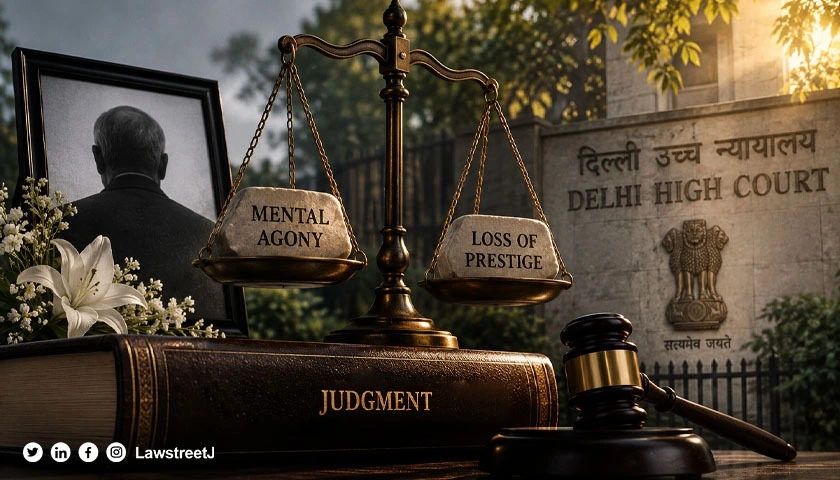
New Delhi: The Delhi High Court has partly allowed an appeal by Bharat Petroleum Corporation Limited against a decree awarding Rs.15,30,000 to a retired General Manager forcibly evicted from company-allotted accommodation, upholding the finding that BPCL was negligent, but setting aside the awards for mental agony and for loss of cash and jewellery, leaving only Rs.50,000 towards repair of damaged household goods and the costs of the suit intact.
Justice Mini Pushkarna was hearing a Regular First Appeal under Section 96 of the Code of Civil Procedure against a judgment and decree passed by the Additional District Judge-03 (Central), Tis Hazari Courts, which had decreed a suit filed by Mr. D.P. Dhall for damages arising out of his coercive eviction, awarding Rs.10,00,000 for mental agony, loss of prestige and inconvenience, Rs.4,80,000 for loss of cash, jewellery and household valuables, and Rs.50,000 towards repair of damaged goods, with interest and costs.
The plaintiff had been allotted a flat at South Extension-II, New Delhi, which BPCL held on lease. After the owner obtained a decree for possession against BPCL in proceedings to which the plaintiff was never a party, the bailiff executed the warrant of possession on 25.10.2004 by breaking open the locks in the family's absence and removing their belongings onto the road, where they remained for two to three days before being shifted to a makeshift godown and alternate accommodation. The plaintiff, who died during the pendency of the suit in 2016, was substituted by his wife, son and daughter as legal representatives.
BPCL contended that it had extended all possible assistance, including alternate accommodation, a guest house, security guards and a valuer's assessment, that the losses claimed were exaggerated and unsubstantiated, that the owner/lessor was a necessary party who had not been impleaded, that the suit was barred by res judicata in view of a dismissed objection petition in the execution proceedings, and, critically, that the suit had abated on the plaintiff's death under Section 306 of the Indian Succession Act and the principle actio personalis moritur cum persona. The legal representatives countered that BPCL had been negligent in never informing the plaintiff of the eviction decree or the impending execution, that the family's belongings were damaged and valuables stolen in the course of the eviction, and that the decretal amount formed part of the deceased's estate and passed to his heirs.
On negligence, the court upheld the Trial Court's finding, holding that BPCL owed the plaintiff a duty of care arising from the proximity of their relationship, that it ought to have communicated the eviction decree and impending execution proceedings in clear terms and arranged alternate accommodation in advance, and that its failure to do so resulted in the plaintiff suffering injury and damage. The award of Rs.50,000 towards repair of damaged household goods was accordingly sustained, the court noting that BPCL's own valuer had assessed the damage at Rs.1,43,000, while the bills produced by BPCL related largely to work done at the alternate accommodation rather than to repairs of the plaintiff's goods.
The award of Rs.4,80,000 towards loss of cash and jewellery was, however, set aside, the court noting that the FIR lodged by the plaintiff's wife did not record any claim relating to the alleged loss of Rs.48,000 in cash or jewellery worth Rs.4,00,000, and that the plaintiff had himself admitted in cross-examination that the police complaint made no mention of these losses.
On the question of abatement, the court held that the expression 'other personal injuries not causing the death of the party' in Section 306 of the Succession Act must be read ejusdem generis with 'defamation' and 'assault', so as to cover injury to a person's dignity, reputation and mental agony, and that such claims do not survive the death of the person concerned.
Relying on the Supreme Court's decision in Kumud Lall v. Suresh Chandra Roy (Dead) Through LRs and Others and the distinction drawn there between proprietary and personal rights, the court held that "the compensation of Rs. 10,00,000/- awarded by the Trial Court towards mental agony, loss of prestige and inconvenience caused to the respondent/plaintiff, are not tangible as to form a part of his estate," and that such compensation could not have been granted in favour of the legal representatives, the right to sue having abated on the plaintiff's death.
The appeal was accordingly allowed in part, with the awards of Rs.10,00,000 towards mental agony, loss of prestige and inconvenience, and Rs.4,80,000 towards loss of cash, jewellery and valuables, both set aside, while the award of Rs.50,000 towards repair of damaged household goods, together with interest, and the costs of the suit of Rs.22,278, were upheld.
Appearances:
For the Appellant: Mr. Anil Kumar Batra, Ms. Shashi Bala and Mr. Dhruv Kumar, Advocates.
For the Respondent: Ms. Sonia Mathur, Senior Advocate with Ms. Aditi Gupta, Ms. Shubhi Bhardwaj, Ms. Safeena Khan, Ms. Manasi Sridhar, Ms. Nikita Gill, Mr. Akashdeep, Ms. Lavanya Bhardwaj and Mr. Amandeep Joshi, Advocates.
Case Title: BPCL vs. D.P. Dhall (Through His Legal Heirs), RFA 937/2017


![Delhi High Court Sets Aside Arbitral Tribunal's Award Against NHAI in Highway Project Delay Case [Read Judgment]](/secure/uploads/2023/07/lj_9605_23374c2e-392c-4491-a2fe-f2f12fc5272f.jpg)
![Delhi Court Rejects Stay Request in Defamation Case Against Rajasthan CM Ashok Gehlot [Read Order]](/secure/uploads/2023/08/lj_5208_80de1ddc-d76a-4f7f-b180-408e3ae14fb4.jpg)