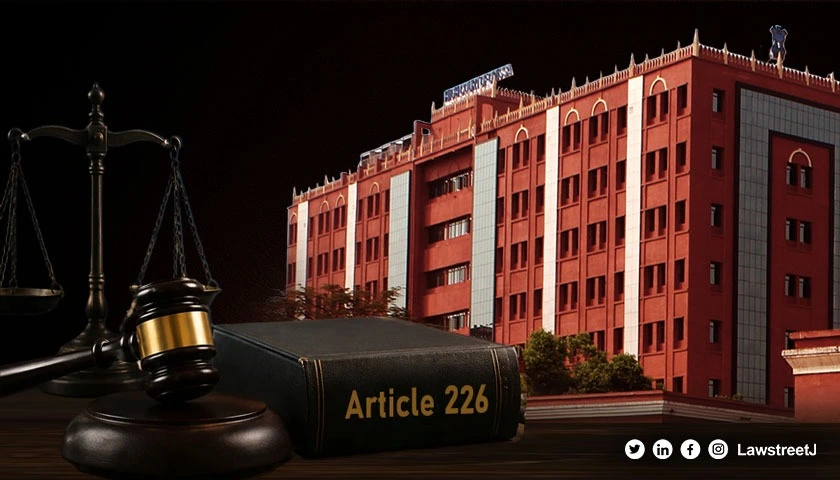
Cuttack: The Orissa High Court has held that orders passed by Commercial Courts carry “all the trapping of a civil Court” and, therefore, cannot be challenged by way of a writ of certiorari under Article 226 of the Constitution, setting aside a Single Judge's order that had entertained such a challenge.
A Division Bench comprising Chief Justice Harish Tandon and Justice Murahari Sri Raman was hearing a writ appeal filed by M/s. Rashmi Metaliks Limited against an order of a learned Single Judge who had set aside a Commercial Court's conditional stay of execution of an arbitral award running into several hundred crores of rupees.
The appellant had obtained an arbitral award in its favour, which the Union of India challenged before the Senior Civil Judge (Commercial Court), Bhubaneswar. The Commercial Court disposed of the Union's application under Section 36(2) of the Arbitration and Conciliation Act, 1996 by granting a conditional stay of execution, directing deposit of Rs. 69,05,00,000/- by demand draft and a bank guarantee of Rs. 1638,24,00,000/- for the balance.
The Union of India challenged this order by filing a composite application under Articles 226 and 227 of the Constitution, which was registered as a writ petition under Article 226 alone. The Single Judge set aside the Commercial Court's order and granted an unconditional stay of execution pending disposal of the Section 34 application.
The Bench first flagged a procedural concern: composite applications under Articles 226 and 227 are frequently registered under a single classification, which then goes before whichever Bench holds that roster, even though the Chief Justice alone is the master of the roster and assigns categories of cases to specific Benches. The Court held that exercising jurisdiction not assigned by the roster is an usurpation of power and renders the resultant order one “without jurisdiction,” reaffirming its earlier ruling in NKC Projects Pvt. Ltd. v. Chief Engineer (Roads-1), Bhubaneswar, 2026 ILR-CUT ONLINE 1081.
Turning to the core question whether an order of a Civil Court is amenable to a writ of certiorari under Article 226 the Bench traced the law from Surya Dev Rai v. Ram Chander Rai, AIR 2003 SC 3044, which had permitted such challenges, to its subsequent overruling by a three-Judge Bench in Radhey Shyam v. Chhabi Nath, (2015) 5 SCC 423. The Court quoted the settled position:
“Judicial orders of the civil court are not amenable to writ jurisdiction under Article 226 of the Constitution. Jurisdiction under Article 227 is distinct from jurisdiction under Article 226. Contrary view in Surya Dev Rai is overruled.”
Examining whether a Commercial Court constituted under the Commercial Courts Act, 2015 carries the character of a civil Court, the Bench noted that Section 6 of the Act empowers Commercial Courts to try suits of specified commercial value by applying Sections 16 to 20 of the CPC, and that adjudications made by such courts culminate in a decree executable under the Code. On this basis, the Court held that a Commercial Court has all the trapping of a civil Court, and proceedings before it are “civil proceedings” for the purposes of the embargo laid down in Radhey Shyam.
Consequently, the Bench held that the writ petition under Article 226 challenging the Commercial Court's order was not maintainable, though the remedy under the supervisory jurisdiction of Article 227 remained available. The impugned order of the Single Judge was accordingly set aside, and the application was restored and directed to be re-registered as an application under Article 227, to be placed before the Bench holding that roster and decided independently on merits, uninfluenced by the observations in the impugned order or in the present judgment, and disposed of expeditiously.
Appearances:
For the Appellant: Mr. Kishore Datta, Senior Advocate, assisted by Mr. Alok Ranjan Mohanty, Ms. Sumita Shaw and Mr. Chetan Kabra, Advocates.
For the Respondent: Mr. N. Venkatraman, Additional Solicitor General, with Mr. P.K. Parhi, Deputy Solicitor General, and Mr. Biswajit Maharana, Senior Panel Counsel.
Case Title: M/s. Rashmi Metaliks Limited vs. Union of India, through General Manager, East Coast Railway, Bhubaneswar, W.A. No. 408 of 2026


![Orissa HC awards Rs 10 lakh to father who lost child to stray dog attack [Read Judgment]](/secure/uploads/2023/12/lj_3371_Stray_dog_menace.jpg)
![Orissa HC rules in favour of BJDs Lok Sabha MP Anubhav Mohanty in divorce plea [Read Judgment]](/secure/uploads/2024/01/lj_2524_Anubhav_Mohanty.jpg)
![Indian Courts this Week: Law Street Journal's Weekly Round-Up of SC & HCs [Jan 1 - Jan 6]](/secure/uploads/2024/01/lj_9050_WhatsApp_Image_2024-01-06_at_12.07.10_PM.jpeg)