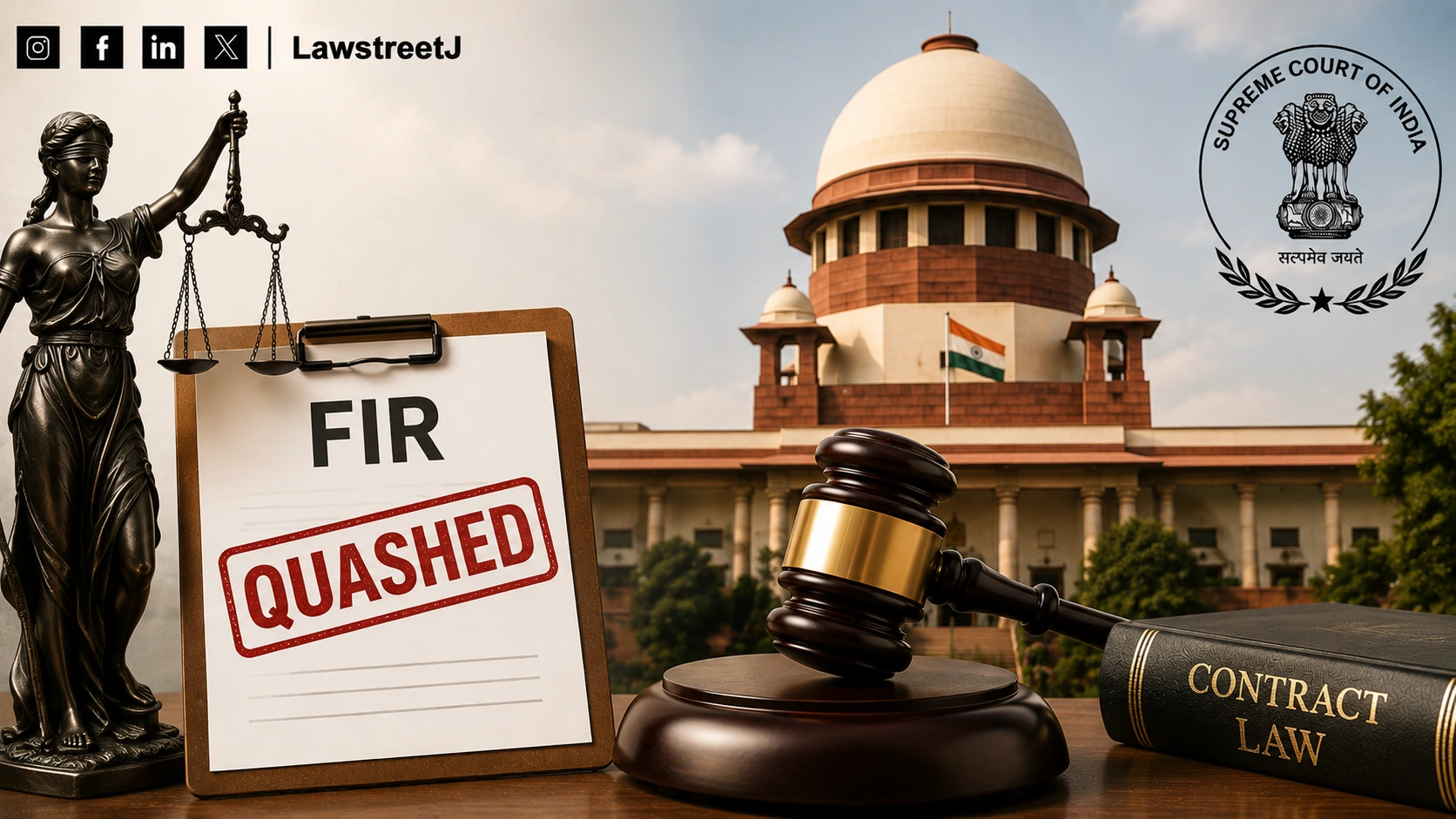
New Delhi: The Supreme Court has quashed a first information report registered for cheating and criminal breach of trust arising out of a camphor distributorship arrangement, holding that a dispute over price, supply and accounts under a written commercial contract cannot be prosecuted as a crime in the absence of allegations establishing dishonest intention at the inception.
The Bench of Justice Sanjay Karol and Justice Augustine George Masih was dealing with appeals against a common judgment of the Jharkhand High Court, which had declined to quash the FIR registered at Kotwali Police Station, Ranchi.
The complainant, sole proprietor of a firm dealing in wholesale camphor trade, was offered the distributorship of 'Saraswati' camphor for Jharkhand by Oriental Aromatics Limited for a three-year term from 1 April 2024, against a payment of Rs. 20 lakh over that period, in return for various gifts and benefits. He paid Rs. 52,000 as token money in December 2023, and an agreement was executed on 29 March 2024 for the full term, which he signed and returned on 4 May 2024. Between 4 April and 26 June 2024, he remitted a total of Rs. 73 lakh in advance, against which goods worth Rs. 31,49,167 were supplied under four bills. He alleged that upon questioning the rate at which goods were supplied to him as compared to other distributors, the Company stopped supplies, demanded further money, and neither supplied the remaining goods nor refunded the balance of Rs. 41,50,833. An FIR was registered against the Company's Chairman and Managing Director, Executive Director, Chief Executive Officer, Chief Operations Officer and a clerk, for offences under Sections 316(2), 318(4) and 3(5) of the Bharatiya Nyaya Sanhita, 2023, corresponding to criminal breach of trust and cheating under the erstwhile Indian Penal Code.
The accused persons had approached the High Court under Article 226 and Section 482 of the Code of Criminal Procedure seeking quashing of the FIR, contending that even taken at face value, it disclosed nothing beyond a commercial dispute dressed up with a criminal overtone. The High Court, by judgment dated 19 February 2025, declined to quash the proceedings and dismissed the writ petitions, leading to the appeals before the Supreme Court.
The Court framed two questions for consideration: whether the FIR, taken at face value, disclosed the offences alleged, and whether a civil or commercial dispute had been given an impermissible criminal colour. Noting that Section 318(4) BNS corresponds to cheating under Section 420 IPC and Section 316(2) BNS to criminal breach of trust under Section 406 IPC, the Bench examined the essential ingredients of both offences, drawing on its recent decision in Delhi Race Club (1940) Ltd. v. State of U.P.
"Mere breach of contract cannot give rise to a criminal prosecution for cheating unless fraudulent or dishonest intention is shown right from the beginning of the transaction i.e. the time when the offence is said to have been committed. Therefore, it is this intention, which is the gist of the offence."
Applying this test, along with the principle from Hridaya Ranjan Prasad Verma v. State of Bihar that a culpable intention cannot be presumed from mere failure to keep a promise, and the guiding categories laid down in State of Haryana v. Bhajan Lal for quashing proceedings that do not disclose an offence even on their own showing, the Court found the FIR wanting in the essentials of cheating. It noted that the complaint contained no averment that the offer of distributorship was made without intention of conferring it, no assertion that any representation as to an existing fact was false to the knowledge of its maker, and no particulars of when, where or by whom any deceitful representation was made.
The Court observed that the promise of gifts and benefits in exchange for Rs. 20 lakh was, at best, a promise as to the future, which becomes deception only if made without any intention of performance, an absence nowhere pleaded. It further noted that the FIR was, in effect, its own answer on the question of dishonest inception: the distributorship had in fact been conferred, an agreement had in fact been executed and signed by the complainant, goods worth over Rs. 31 lakh had in fact been supplied, and bills had in fact been raised. Part performance of this kind, the Bench held, was inconsistent with a design to deceive from the outset, rendering the allegation of an initial fraudulent intent a matter of speculation rather than of pleaded fact.
The Court also weighed attendant circumstances, applying the principle from Mohammad Wajid v. State of U.P. that a court examining frivolous or vexatious prosecutions may look beyond the bare averments to the surrounding record. It noted that the legal notice and further communication sent by the complainant within weeks of the agreement's termination made no mention whatsoever of the Rs. 73 lakh advance or the Rs. 41,50,833 said to be wrongfully withheld, the grievance there being confined to differential pricing; the claim regarding the unreturned advance surfaced for the first time in the FIR, lodged more than two months after the Company had rejected the complainant's demands.
On the charge of criminal breach of trust, the Court held that entrustment, the foundational requirement of the offence, was neither pleaded nor made out. Money paid as consideration under a contract of sale passes to the recipient as his own and is not held in trust for the payer; a failure to deliver against such payment is a breach of contract, not a breach of trust. The Bench further noted that alleging both cheating and criminal breach of trust on an identical set of facts was itself telling, since the two offences are conceptually antithetical, the former requiring deception preceding the parting of property and the latter requiring property to have come lawfully into the accused's hands before being dishonestly dealt with.
"If the respondent No. 2 is right that Rs. 41,50,833/- is due to him, the law affords him a remedy, and an effective one. What it does not afford him is the use of the criminal process to compel its payment."
Holding that the allegations, even taken at their entirety and face value, fell within the first category enumerated in Bhajan Lal for quashing of proceedings, the Court set aside the High Court's judgment and quashed the FIR along with all proceedings arising from it. It clarified that nothing in the judgment would be construed as an expression of opinion on the merits of any civil, arbitral or other proceeding, pending or future, between the parties. Both appeals were allowed.
Case Title: Parag Kishore Satoskar and Others v. State of Jharkhand and Another, with connected appeal, Criminal Appeal Nos. arising out of SLP (Crl.) No. 3933 of 2025 and SLP (Crl.) No. 3996 of 2025







.jpeg)