New Delhi, India  
Judiciary

Compromise Decree Passed Without Impleading A Necessary Party Is A Nullity: Supreme Court

By Saket Sourav      01 October, 2026 03:01 AM      0 Comments
Compromise Decree Passed Without Impleading A Necessary Party Is A Nullity Supreme Court

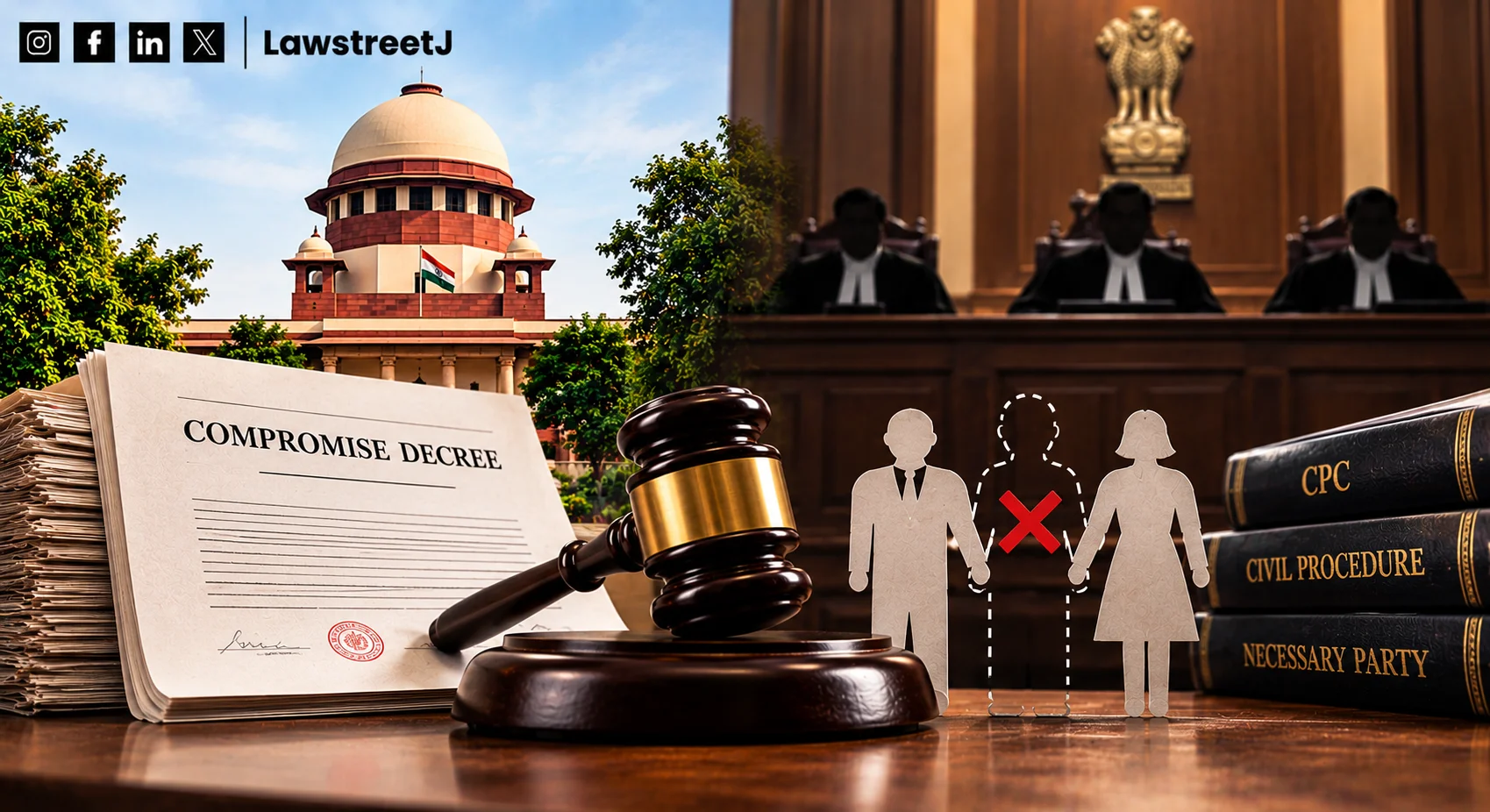
New Delhi: The Supreme Court has set aside a Telangana High Court order that had rejected, as not maintainable, applications seeking recall of a compromise decree in a partition suit, holding that a decree passed without impleading a necessary party is “a nullity in the eyes of law.”

A Bench of Justice Vikram Nath and Justice Sandeep Mehta, allowing the appeal of Geeta Bai and others against K. Arjun Singh and others arising out of SLP (Civil) Nos. 20008-20010 of 2026, was examining a challenge to the High Court's order dated 28th May, 2025 dismissing three Interlocutory Applications seeking recall of a compromise decree dated 23rd September, 2020, impleadment as proper and necessary parties, and an injunction against alienation of the suit property.

The Court noted that the appellants were the legal heirs of Late Smt. Ballo Bai, daughter of the original propositus, who, by virtue of Section 6 of the Hindu Succession Act, 1956 as amended by Act 39 of 2005, was “entitled to stake a claim for 1/4th share in the suit schedule property and hence, was undoubtedly a necessary party to the proceedings,” yet had never been impleaded in the partition suit or the subsequent appeal in which the compromise was recorded.

The Court held that the High Court had erred in treating the appellants' remedy as confined to a separate suit or a fresh appeal with leave, and that the compromise decree obtained by the other legal heirs “without impleading Late Smt. Ballo Bai or her legal heirs, despite her being a necessary party . . . was a nullity in the eyes of law.”

Rejecting any suggestion that the appellants were barred under Order XXIII Rule 3A of the CPC, the Court held that they could not “by no stretch of imagination . . . be treated as strangers to the lis,” and were therefore entitled to challenge the compromise and seek recall of a decree obtained behind their back.

Setting aside the impugned order, the Court remitted the three Interlocutory Applications to the High Court for fresh consideration in light of its observations, directed that its earlier interim order dated 27th May, 2026 continue for two weeks, and clarified that this extension would not influence the High Court's independent decision on the stay application. 

The parties, along with any third parties who had filed impleadment or intervention applications before the Supreme Court, were directed to appear before the High Court on 5th October, 2026.

Case Title: Geeta Bai & Ors. vs. K. Arjun Singh & Ors.



Share this article:

About:

Saket is a law graduate from The National Law University and Judicial Academy, Assam. He has a keen ...Read more

Follow:
Linkedin


Leave a feedback about this
Related Posts
View All

Another CBI Officer Investigating Rakesh Asthana Moves SC Against Transfer, Makes Startling Revelations Another CBI Officer Investigating Rakesh Asthana Moves SC Against Transfer, Makes Startling Revelations

After A.K. Bassi, another CBI officer who was investigating corruption allegations against Special Director Rakesh Asthana moved the Supreme Court.

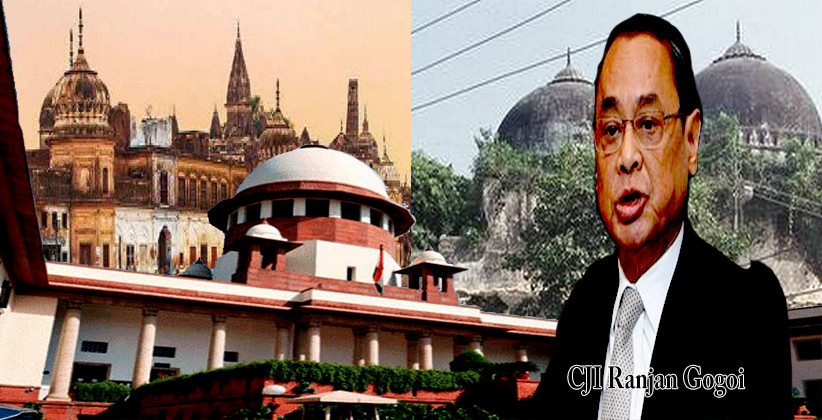
Ayodhya verdict: SC rules in favour of Ram Lalla, Sunni Waqf Board gets alternate land Ayodhya verdict: SC rules in favour of Ram Lalla, Sunni Waqf Board gets alternate land

SC bench led by CJI Ranjan Gogoi has allotted the dispute site to Ram Janmabhoomi Nyas, while directing the government to allot an alternate 5 acre land within Ayodhya to Sunni Waqf Board to build a mosque.

Supreme Court: Money Spent On Judiciary Less Than 1% In All States Except Delhi Supreme Court: Money Spent On Judiciary Less Than 1% In All States Except Delhi

The court guided all states to document their response to the commission's report within four weeks. If any of the states fail to file a response, it will be presumed that they have no objections to the recommendations made by the commission, the court said.

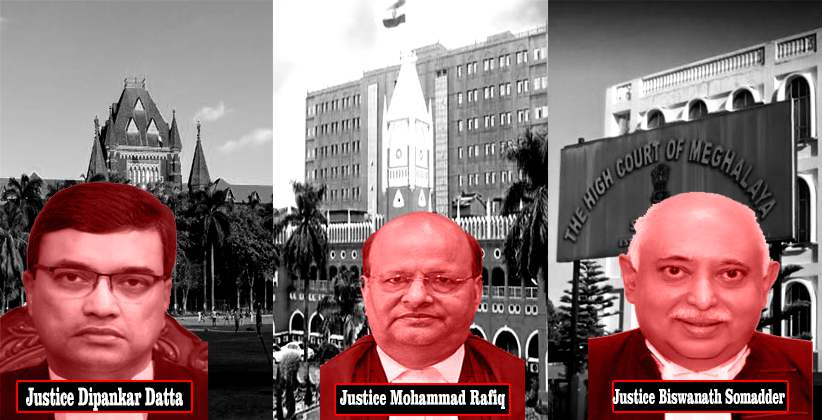
Supreme Court Top Panel Names Chief Justices for Bombay, Orissa and Meghalaya High Courts Supreme Court Top Panel Names Chief Justices for Bombay, Orissa and Meghalaya High Courts

On April 18, 2020, the Supreme Court Collegium recommended new Chief Justices for three High Courts. Justice Dipankar Datta was proposed as Chief Justice of the Bombay High Court, succeeding Justice B.P. Dharmadhikari. Justice Biswanath Somadder was nominated as Chief Justice of Meghalaya High Court, while Justice Mohammad Rafiq was recommended for transfer as Chief Justice of Orissa High Court.

New Release

Senior Citizens Rights Handbook

The Senior Citizen Rights Handbook is a comprehensive guide designed to empower elderly citizens with clear and accessible knowledge of their legal and social rights in India.

Join Group

Signup for Our Newsletter

Get Exclusive access to members only content by email