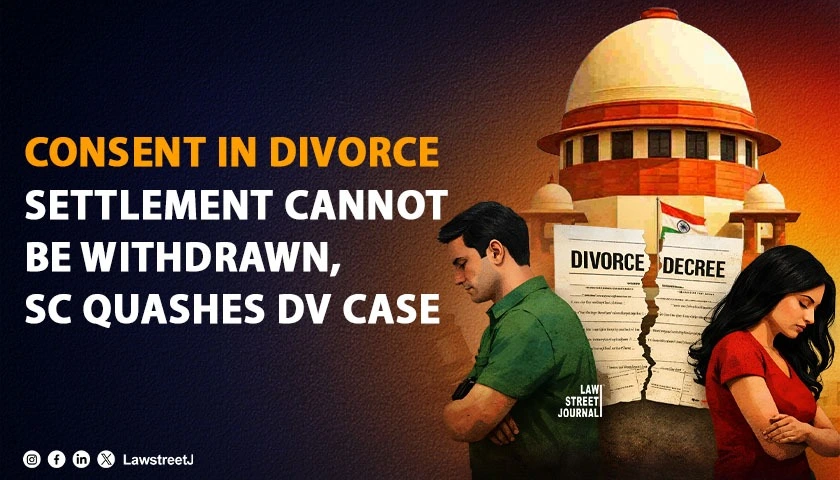
New Delhi: The Supreme Court of India has held that while a spouse is legally entitled to withdraw consent for the grant of divorce by mutual consent, such withdrawal is not permissible where the parties had earlier entered into a comprehensive Settlement Agreement resolving all matrimonial disputes and one party has already performed its obligations thereunder.
The Bench comprising Justice Rajesh Bindal and Justice Vijay Bishnoi further quashed the domestic violence proceedings initiated by the wife against the husband as an abuse of the process of law and dissolved the marriage under Article 142(1) of the Constitution of India on the ground of irretrievable breakdown.
The appeal arose from the order dated 07.01.2026 passed by the High Court of Delhi in Crl. M.C. No. 116 of 2026, wherein the High Court, while issuing notice in a petition seeking quashing of a domestic violence complaint, directed the respondent-wife to deposit ₹89,00,000/- before the Registrar General of the High Court and permitted the DV proceedings to continue subject to such deposit. Aggrieved, the appellant-husband preferred the present appeal before the Supreme Court.
The marriage between the appellant-husband and the respondent-wife was solemnized on 19.02.2000, and from their wedlock, a daughter and a son were born, both of whom have since attained majority. Due to temperamental differences, the parties began living separately from 2022–23. Thereafter, the appellant-husband filed a divorce petition bearing H.M.A. No. 275/2023 before the Court of the Principal Judge, Family Court, Saket Court Complex, Delhi, on grounds of cruelty and adultery under Sections 13(1)(i-a) and 13(1)(ia) of the Hindu Marriage Act, 1955.
The Family Court referred the matter to mediation. During mediation, the parties arrived at a comprehensive Settlement Agreement dated 16.05.2024. The key terms included dissolution of marriage by mutual consent under Section 13B of the Act; payment of ₹1,50,00,000/- by the appellant-husband as full and final settlement of all claims, to be paid in two instalments; execution of a Gift Deed by the respondent-wife for ₹2,52,38,794/- in favour of the appellant-husband to validate business accounts; relinquishment of properties, shares, and policies by the respondent-wife; and a complete bar on future civil and criminal litigation by both parties and their family members.
Pursuant to the Settlement Agreement, the appellant-husband withdrew the fault-based divorce petition, and the parties jointly filed a petition for divorce by mutual consent, registered as H.M.A. No. 1185/2024. The Family Court, vide order dated 14.08.2024, allowed the First Motion. In compliance, the appellant-husband paid ₹75,00,000/- as the first instalment along with ₹14,00,000/- for the purchase of a car and returned all jewellery items to the respondent-wife as per Appendix A to P of the Settlement Agreement. The respondent-wife, correspondingly, transferred ₹2,52,38,794/- to the appellant-husband at the time of the First Motion.
Subsequently, the respondent-wife withdrew her consent for the second motion petition. She thereafter filed DV Complaint No. 3186/2025 on 16.10.2025 before the Chief Metropolitan Magistrate, Saket Courts, Delhi, under Section 12 of the Protection of Women from Domestic Violence Act, 2005 against the appellant-husband and his mother. The respondent-wife contended that she had signed the Settlement Agreement based on assurances made by the appellant-husband that he would return jewellery worth ₹120 crores and gold biscuits worth ₹50 crores before the Second Motion, which were not included in the Settlement Agreement at his insistence to avoid alerting the Income Tax Department.
The Supreme Court framed three issues for consideration: (i) whether the DV proceedings should be quashed; (ii) whether a party can resile from a Settlement Agreement arrived at in mediation proceedings, and if so, under what circumstances; and (iii) whether the Court should exercise its powers under Article 142(1) to dissolve the marriage on the ground of irretrievable breakdown.
On the first issue, the Court found no specific allegations of domestic violence in the complaint and observed that it was filed only after notice in the contempt petition, making it an evident afterthought. The Court noted that the parties had been living separately since 2022–23 and that this was the first such allegation in over 23 years of marriage. Relying on Ruchi Agarwal v. Amit Kumar Agarwal, (2005) 3 SCC 299, the Court held that continuation of such proceedings would amount to an abuse of process.
On the second issue, the Court reiterated that a party cannot resile from a mediation settlement except upon proof of force, fraud, undue influence, or non-fulfilment of agreed conditions. Reliance was placed on Gimpex Private Limited v. Manoj Goel, (2022) 11 SCC 705 and Anurag Vijaykumar Goel v. State of Maharashtra, 2025 SCC OnLine SC 1611.
The Court rejected the respondent-wife’s contention regarding alleged oral assurances, noting their absence in the Settlement Agreement and lack of supporting material. It termed the argument regarding non-disclosure to evade tax liability as “egregious” and expressed strong disapproval of such submissions.
On the third issue, invoking Article 142(1), the Court relied on Shilpa Sailesh v. Varun Sreenivasan, (2023) 14 SCC 231, and held that the marriage had irretrievably broken down, with no possibility of reconciliation.
Accordingly, the Court:
- allowed the appeal and quashed the DV proceedings;
- dissolved the marriage subject to payment of the remaining settlement amount;
- closed the contempt proceedings;
- directed refund of ₹89,00,000/- with interest;
- barred all future litigation; and
- directed execution of relinquishment deeds within the stipulated time.
Case Title: Dhananjay Rathi v. Ruchika Rathi, Criminal Appeal No(s). 1924 of 2026 (Arising out of SLP (Crl) No(s). 1878 of 2026)
Appearances:
For the Appellant-Husband: Mr. Prabhjit Jauhar, Advocate
For the Respondent-Wife: Mr. Prashant Mendiratta, Advocate