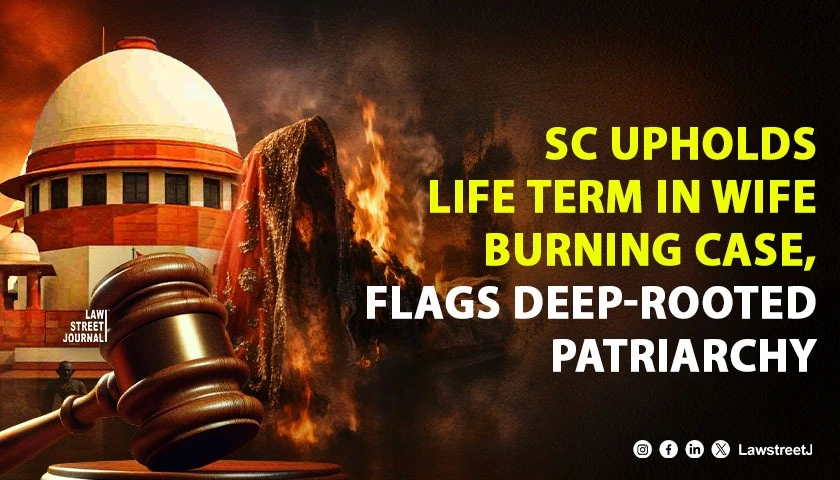
New Delhi: The Supreme Court of India has upheld the life imprisonment of a man from Rajasthan who beat his wife, locked her in a room, poured kerosene over her, and set her on fire barely a month after their marriage.
Dismissing his appeal against the concurrent findings of conviction by the trial court and the High Court, the Bench of Justice Sanjay Karol and Justice Nongmeikapam Kotiswar Singh also penned a pointed postscript on the persistence of patriarchy and violence against women in India despite decades of legal reform.
The case concerned Shankar, a resident of Dhaneshwar in Bundi district, whose wife, Sugna Bai, was barely 20 years old at the time of her death on 19.10.2012. The couple had married about a month before the incident, and within roughly twenty days, Shankar had begun subjecting her to daily beatings, often after consuming alcohol.
On 15.10.2012, he demanded that she return from her parents’ house and cook for him. When she complied and began preparing food, he came home drunk, beat her, locked the room from inside, poured kerosene on her from a half-filled plastic bottle, and set her on fire with a matchstick. He then fled, though he returned briefly and threw a blanket over her after her screams drew attention. Sugna Bai succumbed to her burn injuries four days later at a hospital in Kota.
Before her death, Sugna Bai gave a dying declaration to a Magistrate at the hospital, clearly identifying her husband as the person who had poured kerosene on her and set her on fire. She also stated that he used to suspect her of looking at other men and would pick fights on that account. The declaration was recorded in a question-and-answer format after the duty doctor certified that she was in a condition to make the statement.
The trial court convicted Shankar under Sections 302 and 342 of the Indian Penal Code and sentenced him to life imprisonment. The Rajasthan High Court confirmed the conviction and sentence, following which Shankar approached the Supreme Court.
Before the Supreme Court, Shankar sought to assail the dying declaration on multiple grounds. It was argued that the Magistrate had noted that the deceased was not in a good mental condition and was not in a position to give a statement, and that the medical certificate had been obtained on blank paper. The Court rejected both contentions.
Upon examining the Magistrate’s deposition, the Court found that he had clearly stated that Sugna Bai was conscious and in a fit condition to give her statement when it was recorded. The argument regarding the blank paper was also dismissed, with the Court reasoning that the doctor had examined her condition before issuing the certificate, and the fact that it appeared on the reverse side of the same sheet did not affect its sanctity.
Another argument advanced on behalf of Shankar was that the deceased’s parents had tutored her into naming him. The Court dismissed this as a bald assertion unsupported by evidence.
Although two eyewitnesses had turned hostile during the trial, which might ordinarily benefit the accused, the Court held that their departure from the prosecution case made no difference in the present case, given the consistency between the dying declaration and the medical evidence. Both doctors confirmed that the deceased had died of septicaemia arising from burn injuries, which was entirely consistent with her dying declaration.
Finding no manifest error in the approach of the courts below, no misdirection in the appreciation of evidence, and no crucial piece of evidence having been overlooked, the Supreme Court dismissed the appeal and upheld the conviction and sentence.
Before concluding, however, the Court recorded observations that went beyond the facts of the case. It noted that the offence occurred in 2012, sixty-four years after India’s independence, and that the Constitution’s promises of equality, non-discrimination on the basis of sex, and the right to life and liberty remain elusive for many women even today.
Surveying the legislative and judicial landscape, the Court referred to a series of reforms, including the Dowry Prohibition Act, Section 498A of the IPC, the Protection of Women from Domestic Violence Act, the Sexual Harassment of Women at Workplace Act, and landmark judgments ranging from Shayara Bano to Vineeta Sharma. It also noted several government welfare programmes aimed at improving the lives of women and girls.
Despite these measures, the Court observed that the data presents a troubling picture. Over 4.48 lakh crimes against women were recorded in 2023 alone. Dowry-related violence continues to claim more than 6,000 lives annually, while domestic violence remains one of the most frequently reported grievances before the National Commission for Women.
The Court further noted that while economic growth, rising literacy, and increased workforce participation have brought visible change at a macro level, patriarchy continues to shape everyday life—particularly in rural and semi-urban settings—where household authority remains overwhelmingly male and women’s autonomy continues to be conditional and constrained.
The Court concluded by posing a question it left unanswered: after decades of laws, schemes, reforms, and judicial recognition of equality across workplaces, homes, personal relationships, and even the armed forces, why does control over women’s bodies, choices, and lives still persist so deeply within society? It observed that perhaps the answer lies only with “We, the People of India”.
For the Appellant: Ms. Kaveeta Wadia, Senior Advocate
For the Respondent-State: Mr. Divynk Panwar, Advocate
Case Title: Shankar v. State of Rajasthan, Criminal Appeal No. of 2026 (@ SLP (Crl.) No. 13899 of 2025), 2026 INSC 315