


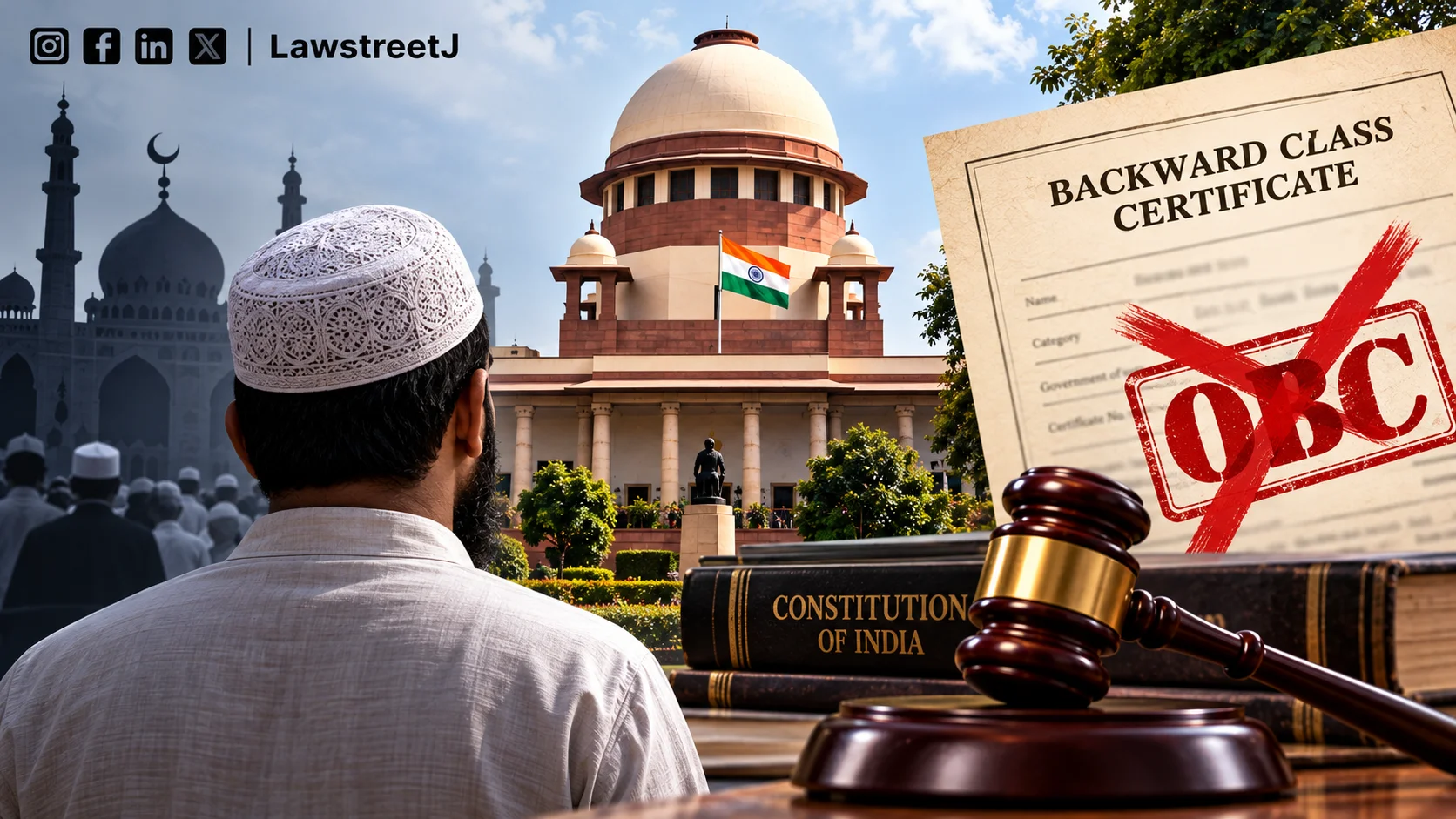
New Delhi: The Supreme Court has dismissed a special leave petition filed by the Tamil Nadu Government, holding that a person who converts from Hinduism to Islam cannot claim Backward Class Muslim status merely on the strength of the backwardness suffered in the pre-conversion social order, and affirming the Madras High Court's decision to strike down a State order that allowed such certificates.
A Bench of Justice Prashant Kumar Mishra and Justice Shree Chandrashekhar was hearing the State's challenge in The Secretary to Government v. Sameer Ahamed N. and Others. The dispute began when Sameer Ahamed N., born in 1993 to Hindu parents in Tuticorin as Paramasivara, embraced Islam in 2015 and changed his name, a change notified in the Tamil Nadu Government Gazette in 2016. His application for a Backward Class (Muslim) community certificate as a “Muslim Labbai” was rejected on 13.11.2020, on the ground that he had “only converted to religion and not to the caste.” He moved the Madras High Court under Article 226.
While the writ petition was pending, the State issued G.O. (Ms.) No. 314 dated 09.03.2024, following a recommendation of the Tamil Nadu Backward Class Commission. It provided that converts to Islam from Backward Classes, Most Backward Classes and Denotified Communities, who were already availing reservation, could be issued Backward Class Muslim certificates upon conversion into any of seven recognised Muslim communities covered by a 3.5% quota. As the petitioner relied on the G.O., the High Court impleaded the concerned Secretary and, by judgment dated 25.06.2026, declared the G.O. unconstitutional and dismissed the writ petition.
Senior Advocates Mukul Rohatgi and Sidharth Luthra, appearing for the State, argued that the High Court travelled beyond the pleadings, as the G.O.'s validity was never challenged and the State was not effectively heard despite State-wide consequences. On merits, the State accepted that conversion alone cannot confer membership of a community such as Labbai, Rowther or Deccani Muslim, but contended that the G.O. merely preserved an existing backward-class entitlement. It relied on Indra Sawhney and argued that decisions on Scheduled Caste status under Article 341 operate in a distinct field.
The Court rejected the jurisdictional objection. It held that the fairness principle requires notice and a meaningful opportunity to respond, which the State had, since it was impleaded after the High Court's prima facie view, filed a counter affidavit and was heard through the Additional Advocate General. The Bench added that the G.O.'s validity was inseparable from the relief sought, because the claimant's very right rested on it.
On merits, the Court noted that while Islam is egalitarian in its foundational conception, Muslim society in India has displayed hereditary, caste-like stratification, though the Ashraf, Ajlaf and Arzal categories cannot be treated as three homogeneous castes. Turning to Indra Sawhney, it observed that the decision did not consider the effect of a change of religion on an existing claim founded on backwardness within the Hindu social order. Such backwardness, the Court held, arises from disabilities produced by that structure, and its foundational basis ceases to operate on conversion to a religion that does not recognise caste as the basis of social status.
The Court distinguished between continuance of a disadvantage and acquisition of membership of a particular backward class. Endorsing the Madras High Court's old ruling in G. Michael v. S. Venkateswaran, it held that a convert ceases to belong to his original caste. It noted that Labbai, Rowther and Marakkayar are historically evolved social communities, constituted by common ancestry, endogamy and traditional occupation, rather than religious denominations that may be entered by belief alone. The Bench stated that “a change of religion cannot, by itself, establish a new birth-based community identity.”
The Bench found that the G.O. identified no common nexus between a person's pre-conversion community and the seven notified Muslim communities, and proceeded on mere presumption, offending Article 14. For former Scheduled Caste members, the Court said paragraph 3 of the Constitution (Scheduled Castes) Order, 1950 bars persons professing religions other than Hinduism, Sikhism or Buddhism from being deemed Scheduled Castes, and an executive order cannot override this constitutional position, relying on its recent ruling in Chinthada Anand v. State of Andhra Pradesh. It termed the distinction between “preserving” and “acquiring” reservation artificial, since a community certificate is a statutory recognition of present community status. The Commission's recommendation could not cure the defect, as an expert recommendation is not legislation.
The Court also found it untenable that the State had left determination of community status to the Jamath, with revenue authorities expected not to question it. Relying on Kumari Madhuri Patil and Vishwa Lochan Madan, it held that a private religious body cannot conclusively determine statutory backward-class status, though it may certify that a person has embraced Islam.
Summarising its postulates, the Court held that pre-conversion backwardness cannot by itself be carried into the new religion, that conversion does not confer membership of any notified Backward Class community, and that a community certificate is declaratory and cannot be created or enlarged by an executive instruction. It added that, in case of reconversion to the Hindu social order, entitlement under Article 16(4) requires an independent, fact-specific determination by the competent authority on whether the original identity has genuinely revived.
Affirming the High Court's central conclusion, though on its own constitutional reasoning, the Bench held that the G.O. created an artificial route into a notified Muslim backward class and was rightly quashed. The Special Leave Petition was accordingly dismissed, and pending applications, including those seeking intervention, were disposed of.
Case Title: The Secretary to Government vs. Sameer Ahamed N. and Others, SLP (C) No. 25507 of 2026



.jpeg)

.jpeg)

