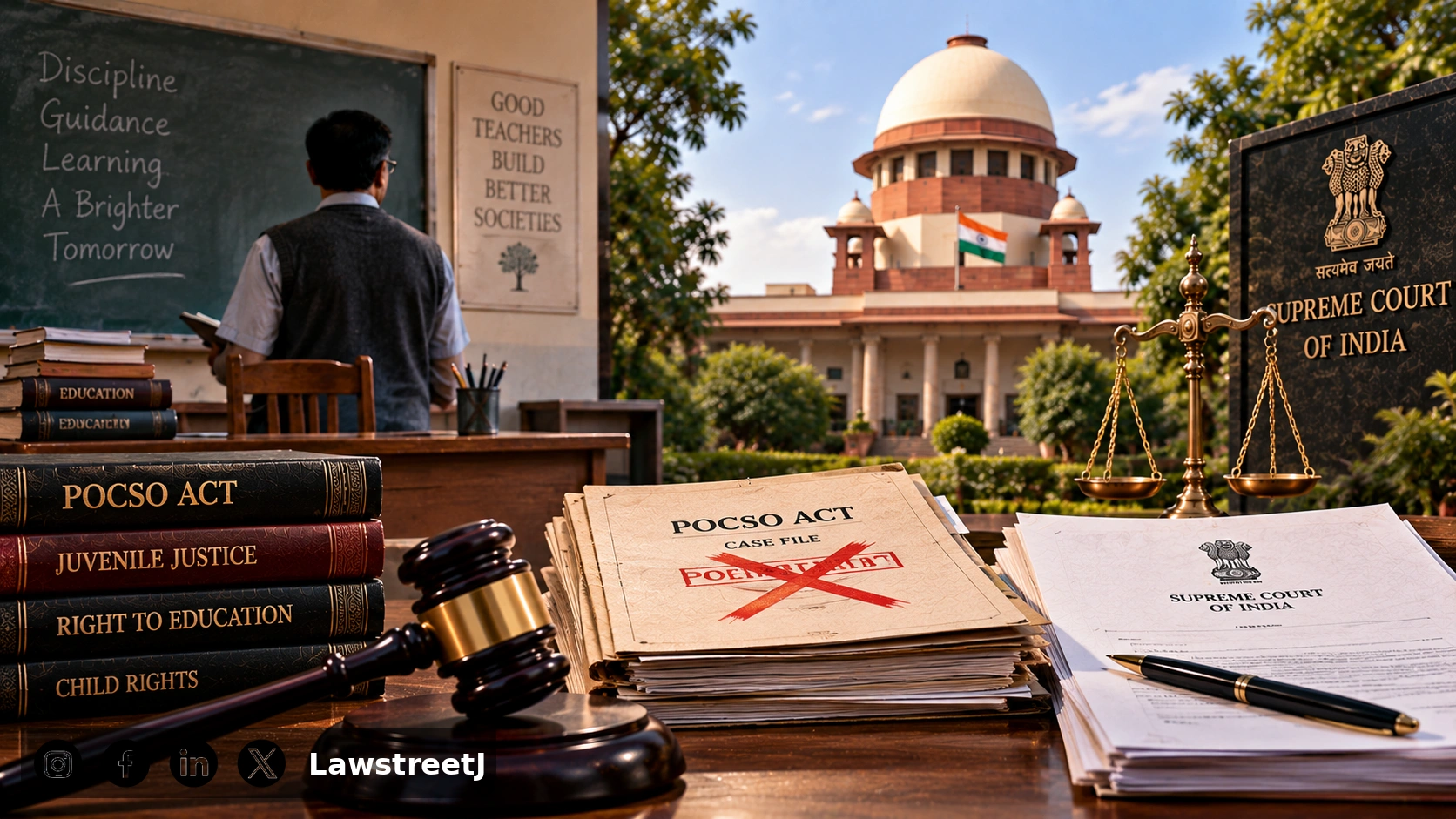
New Delhi: The Supreme Court has quashed a POCSO prosecution launched against a school teacher in West Bengal, holding that his act of beating two minor girl students with his hands for failing to complete their lessons did not amount to ‘aggravated sexual assault’ under Section 10 of the Protection of Children from Sexual Offences Act, 2012, in the absence of any sexual intent.
A Bench of Justice Ujjal Bhuyan and Justice Atul S. Chandurkar was hearing a criminal appeal filed by the teacher against an order of the Calcutta High Court, Circuit Bench at Jalpaiguri, which had dismissed his revision application under Section 528 of the Bharatiya Nagarik Suraksha Sanhita, 2023 seeking quashing of Special Case No. 83 of 2025 pending before the Special Court, Alipurduar.
The appellant’s counsel submitted that the appellant was a geography teacher at the school and that the case arose from allegations by two girl students, both minors, that he had beaten them on the back and waist when they failed to complete their lessons. It was argued that a reading of the statements made by the victim girls before the Magistrate under Section 183 of the BNSS did not disclose any act that could remotely be treated as sexual assault, and that prosecuting the appellant under Section 10 of the POCSO Act was without justification and an abuse of the process of law.
Counsel for the State of West Bengal opposed the plea, submitting that the FIR, the Counselling-cum-Enquiry Report and the First Information disclosed sexual intent on the part of the appellant while dealing with the minor girl students, and that his culpability could only be examined at trial. It was submitted that not only the two girl students but also the lady teachers and the Headmaster of the school had made similar statements regarding the appellant’s conduct, and that no case for quashing was made out.
The facts, as recorded by the Court, show that lady teachers of the school had informed the Headmaster that the appellant had physically touched some Class-X girl students, following which the District Child Protection Unit was informed and a Counselling-cum-Enquiry Report was prepared. Based on this report, the police suo motu registered an FIR under Section 10 of the POCSO Act, additionally alleging that the appellant had looked at some students in an inappropriate manner.
Examining the statements of the two victim girls recorded before the Magistrate, the Court noted that both students had described being beaten with the appellant’s hand, on the back and waist, for failing to answer questions in class, with one of them stating that the appellant had merely held her hand on one occasion. The Court explained that Section 10 of the POCSO Act penalises ‘aggravated sexual assault’, which under Sections 9(f) and 7 of the Act requires an act done with sexual intent involving physical contact, such as touching specified body parts or any other act with sexual intent.
The Court held that while the appellant’s conduct as a teacher, particularly his resort to corporal punishment and lack of sensitivity towards girl students, was not appropriate, it could not be said on a careful reading of the victims’ own statements that he had committed an offence under Section 10 of the POCSO Act. The Court observed that a POCSO allegation and trial could amount to a virtual condemnation of a teacher’s entire career and life, and that even an eventual acquittal would not undo the damage caused by the severity of such a trial.
The Court further noted the delay in lodging the FIR and observed that the statements of the Headmaster and the lady teachers, who had not personally witnessed the alleged conduct, were hearsay in nature, adding to the reasons for doubting the prosecution case.
Holding that allowing the prosecution to continue would amount to an abuse of the process of law and cause extreme prejudice to the appellant, the Court set aside the High Court’s order and quashed the entire proceedings in Special Case No. 83 of 2025 arising out of Samuktala P.S. Case No. 187 of 2025, pending before the Special Court, Alipurduar. The appeal was accordingly allowed and the appellant was set at liberty, with no order as to costs.
Appearances:
For the Appellant: Dr. Arjun Chowdhary, Adv., Mr. Irshad Ahmad, AOR.
For the Respondent: Mr. Nishant Awana, AOR.
Case Title: Bhaskar Paul vs. The State of West Bengal, Criminal Appeal No. 4278 of 2026 (@ Special Leave Petition (Crl.) No. 13021 of 2026)