Chhatisgarh: Affirming the conviction in a rape case involving a hearing and speech-impaired victim, the Chhattisgarh High Court has held that testimony expressed through gestures, signs, or demonstrative methods by a witness who cannot speak is legally valid and carries the same weight as substantive oral evidence.
The Division Bench of Chief Justice Ramesh Sinha and Justice Ravindra Kumar Agrawal further held that a forensic report detecting seminal stains and human spermatozoa on the vaginal slides of the victim and on the underwear of the accused, read together with the consistent gestural testimony of the victim, constitutes sufficient scientific corroboration to sustain a conviction for rape.
The appeal arose out of the judgment of conviction and order of sentence dated 28.03.2023 passed by the Sessions Judge, Balod, Chhattisgarh, in Sessions Case No. 28/2020, whereby the appellant was convicted under Section 450 of the IPC and sentenced to rigorous imprisonment for five years with a fine of Rs. 1,000/-, and under Section 376(2)(j)(l) of the IPC, sentenced to imprisonment for life till natural death with a fine of Rs. 20,000/-, both sentences to run concurrently.
The prosecution’s case was that the complainant lodged a written report at Police Station Arjunda stating that her daughter, the victim, who is deaf and mute since birth, was alone at home on 29.07.2020 at about 09:00 AM when the complainant and her husband had gone to work as agricultural labourers. During this time, the accused, Neelam Kumar Deshmukh, who is the son of the complainant’s brother-in-law, entered the house and forcibly committed rape upon the victim. On the complainant’s return in the evening, the victim was found crying and, through gestures, conveyed that the accused had committed forcible sexual intercourse with her. On the basis of the complaint, Crime No. 130/2020 was registered under Sections 450 and 376(2)(c)(d) of the Indian Penal Code.
During investigation, the statement of the deaf and mute victim was recorded with the assistance of a teacher trained in sign language. A spot map was prepared, the victim was medically examined, her statement under Section 164 Cr.P.C. was recorded before a Magistrate, relevant articles were seized, and the accused was arrested. After completion of investigation, a charge-sheet was filed before the competent Court, charges were framed, and the accused pleaded not guilty. After appreciation of the evidence, the trial Court convicted and sentenced the accused, giving rise to the present appeal.
Before the High Court, learned counsel for the appellant submitted that the impugned judgment was illegal, perverse, and contrary to the evidence on record. It was contended that the prosecution had not adduced cogent, reliable, and convincing evidence to establish the allegation of forcible sexual intercourse; that the victim’s statement had not been properly appreciated in the correct perspective; that the conviction had been recorded in a mechanical manner; that the explanation furnished by the appellant under Section 313 Cr.P.C. had not been considered; and that medical evidence did not lend corroboration to the prosecution case. On an overall appreciation, it was submitted that the prosecution had failed to prove the charges beyond reasonable doubt. The State, on the other hand, submitted that the prosecution had proved its case beyond reasonable doubt and that the trial Court had rightly convicted and sentenced the appellant.
The High Court, after careful scrutiny of the entire record, noted that the victim is admittedly hearing and speech-impaired since birth and that her evidence was recorded in Court with the assistance of a trained deaf-mute teacher acting as an interpreter. The trial Court, before recording her statement, satisfied itself regarding her ability to understand questions and communicate answers through gestures and signs. Through gestures and body language, the victim indicated that she was in her house on the date of the incident; that in the absence of her parents, the accused had entered the house; that he had removed her clothes and committed forcible sexual intercourse with her. She identified the accused when his photograph attached to the arrest memo was shown to her.
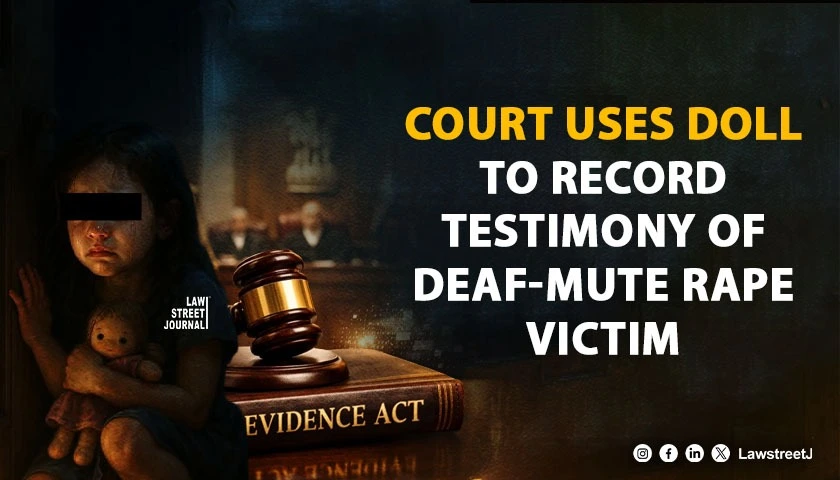
The Court noted the significant method adopted by the trial Court to facilitate communication. Since the victim was unable to clearly understand certain questions, the Court brought a plastic doll to demonstrate and facilitate communication. On being asked through such demonstration, the victim again indicated by gestures that the accused had forcibly committed sexual intercourse with her. The High Court held that such demonstrative methods are entirely appropriate and indeed necessary to ensure fairness and clarity in recording the testimony of a witness who is unable to speak.
“Since the victim was not able to clearly understand certain questions during her examination, the Court adopted an appropriate demonstrative method by bringing a plastic doll to facilitate communication. On being asked through such demonstration, the victim again indicated by gestures that the accused had forcibly committed sexual intercourse with her.”
The Court further observed that the victim’s prompt disclosure of the incident to her mother immediately after its occurrence, when she was found in a disturbed and crying condition upon the mother’s return from the agricultural fields, formed an important circumstance lending assurance to the truthfulness of her testimony. The victim’s gestures and narration in Court remained consistent with the version recorded in the FIR as well as with her earlier statement recorded during investigation.
On the competency of the victim as a witness, the Court held that although the victim is deaf and mute, there is no material to suggest that she suffers from any mental abnormality that would prevent her from understanding the occurrence or communicating the same. Her ability to convey relevant facts through gestures, her identification of the accused, and her demonstration of the act alleged against him clearly indicated that she was competent to depose, and her testimony therefore constituted substantive evidence.
The Court placed reliance on the Supreme Court’s judgment in State of Rajasthan v. Darshan Singh, (2012) 5 SCC 789, which held that a deaf and mute person is a competent witness; that if the witness can read and write, it is desirable to record the statement in that manner; and that if the witness cannot read or write, the statement can be recorded in sign language with the aid of an interpreter. The Court further noted the Supreme Court’s ruling in Meesala Ramakrishan v. State of Andhra Pradesh, (1994) 4 SCC 182, which held that a witness who is unable to speak can give evidence by signs or gestures; that such evidence is admissible and can form the basis of conviction; and that such communication by signs, nods, or gestures amounts to a verbal statement within the meaning of Section 3 of the Evidence Act and falls within the scope of Section 119 of the Evidence Act.
On the medical and forensic evidence, the Court noted that the victim was examined at Community Health Centre, Arjunda, where no external injuries were noticed on her body and no fresh signs of violence were found on her private parts. However, the examining doctor opined that in cases of alleged sexual assault, particularly where some time has elapsed between the incident and examination or where the victim is physically disabled and unable to offer resistance, the absence of injuries does not rule out the possibility of sexual intercourse. The Forensic Science Laboratory report (Exhibit P-26) was found to be of crucial significance, as it detected seminal stains and human spermatozoa on the vaginal slides of the victim. In addition, seminal stains and human sperm were also detected on the underwear of the accused, in respect of which he furnished no plausible explanation. These forensic findings provided strong scientific corroboration to the prosecution case.
The Court also found substantial corroboration from the testimony of the victim’s mother (PW-01), who deposed that on returning from the fields, she found the victim in a disturbed and crying condition, whereupon the victim, through gestures, named the accused and conveyed that he had entered the house, forcibly thrown her down, removed her clothes, and committed a wrongful act with her. The mother’s testimony regarding the prompt disclosure, the naming of the accused at the earliest opportunity, and the immediate steps taken to lodge the report were held to lend strong corroboration to the victim’s account. The father of the victim (PW-04) similarly deposed that on returning from the fields, the victim, by gestures, indicated towards the accused and narrated the occurrence, and that the accused reacted aggressively when questioned about the incident.
On the charge under Section 450 IPC for house-trespass, the Court found that the prosecution had led cogent and reliable evidence establishing that the accused entered the victim’s dwelling house without permission and with the intention of committing an offence punishable with imprisonment for life. The defence plea that the accused was working in the agricultural field throughout the day was not substantiated by any cogent defence evidence, and no witness was examined on behalf of the accused to establish his continuous presence in the field.
The Court held that, upon the cumulative effect of the victim’s consistent testimony, corroborated by the evidence of her parents, the forensic report, and the surrounding circumstances, the prosecution had successfully proved that the accused committed forcible sexual intercourse with the victim. The findings of the trial Court were affirmed in their entirety, and the criminal appeal was dismissed as lacking merit. The appellant was directed to serve out the sentence as ordered by the trial Court.
For the Appellant: Mr. Prasoon Agrawal, Advocate
For the Respondent/State: Mr. S.S. Baghel, Government Advocate
Case Title: Neelam Kumar Deshmukh v. State of Chhattisgarh Through Police Station Arjunda, District Balod, CRA No. 786 of 2023 [Neutral Citation: 2026:CGHC:12396-DB]



![SC sets free man from case under SC/ST Act as offence not committed due to caste [Read Judgment]](/secure/uploads/2024/01/lj_4809_5ccb3cf2-6198-4e45-bb33-bfaa9b67a897.jpg)
![SC to consider forming guidelines on trial for deaf-dumb people [Read Order]](/secure/uploads/2024/04/lj_3160_483df315-842c-414c-9d28-65634ae6e806.webp)