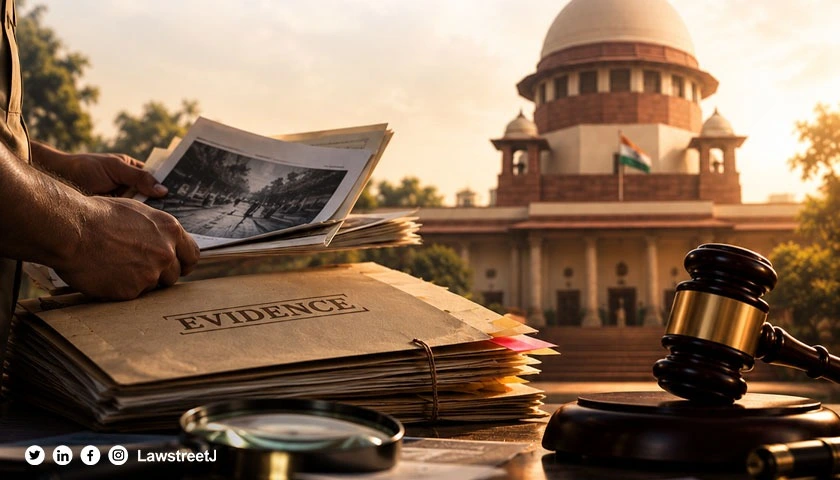
New Delhi: The Supreme Court has set aside a judgment of the Allahabad High Court that had directed the Uttar Pradesh Public Service Commission to re-evaluate answer scripts of the preliminary examination for the combined State/Upper Subordinate Services (General Recruitment) Examination, 2016 and the combined State/Upper Subordinate Services (Special Recruitment) Examination, 2016, holding that a writ court exceeds its jurisdiction of judicial review when it substitutes its own assessment for that of academic experts.
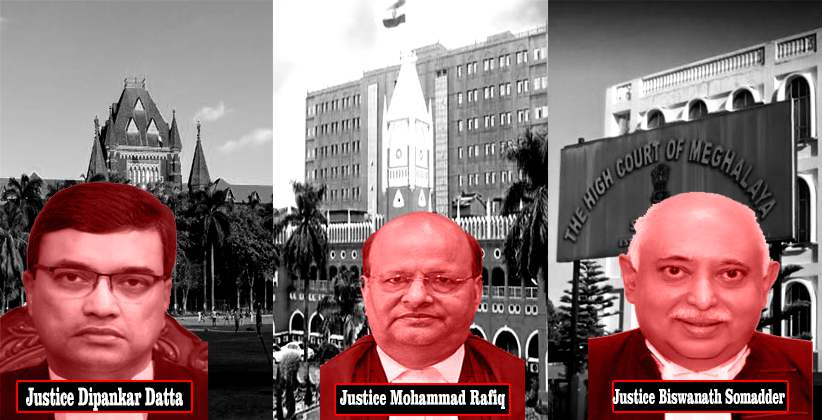
The Division Bench of Justice Dipankar Datta and Justice Sheel Nagu was hearing a civil appeal filed by the Commission against the judgment and order dated December 9, 2016, of the High Court, whereby a writ petition instituted by the respondent-candidates had been allowed.
By the impugned order, the High Court had directed the Commission to re-evaluate the answer scripts of all candidates by deleting three questions and by granting full marks for another question to candidates who had opted for either of two specified answer choices. Candidates found to have qualified the preliminary examination as a result of this re-evaluation were to become entitled to appear in the main examination, which the Commission was directed to conduct at the earliest. The High Court had further directed that if the results of the main written examination, already held, had not been declared, they would be withheld until the main examination of the re-evaluated candidates was also held and declared, and that if the results had already been declared, no further exercise would be undertaken in respect of such candidates until the main examination for the re-evaluated candidates was conducted. The Commission was also directed to prepare a merit list on the basis of both sets of main examination results for the purpose of interviews, and candidates who had originally qualified but failed to do so after re-evaluation were to have their candidature cancelled.
The High Court had additionally taken note of the statutory scheme under the Uttar Pradesh State Public Service Commission (Regulation of Procedure) Act, 1985, and the procedure followed by the Commission in finalising the provisional answer key and dealing with objections, and had expressed displeasure at the number of discrepancies found in the design of the question paper and answer key, recommending that the Commission enhance the remuneration paid to experts to avoid similar errors in future.
Appearing for the appellant-Commission, counsel submitted that the directions issued by the High Court ran contrary to a catena of decisions of the Supreme Court and could not be sustained in law, placing reliance on Ran Vijay Singh v. State of Uttar Pradesh, reported in (2018) 2 SCC 357. The Court extracted the principles laid down therein governing re-evaluation of answer sheets:
“The court should not at all re-evaluate or scrutinise the answer sheets of a candidate—it has no expertise in the matter and academic matters are best left to academics; the court should presume the correctness of the key answers and proceed on that assumption; and in the event of a doubt, the benefit should go to the examination authority rather than to the candidate.”
Having perused the impugned order in light of the law laid down in Ran Vijay Singh, the Supreme Court held that the High Court had exceeded the jurisdiction of a judicial review court by interfering with the decision of experts in an academic field, observing that the manner in which the High Court had examined the so-called dubious questions, as though it were an expert of experts, and the directions issued as a consequence, were clearly indefensible.
The Court also noted that operation of the impugned order had been stayed while granting leave on April 7, 2017, and that the directions were, therefore, never implemented. It further observed that since the writ petition concerned the 2016 recruitment examinations, fresh examinations must have been conducted by the Commission over the intervening nine years, and, in the absence of appearance by the respondents, presumed that they had lost interest in the matter.
Accordingly, the Supreme Court set aside the impugned order of the High Court and allowed the civil appeal, along with any pending interlocutory applications.
Case Title : U.P. Public Service Commission through its Chairman & Anr. v. Sunil Kumar Singh & Ors.