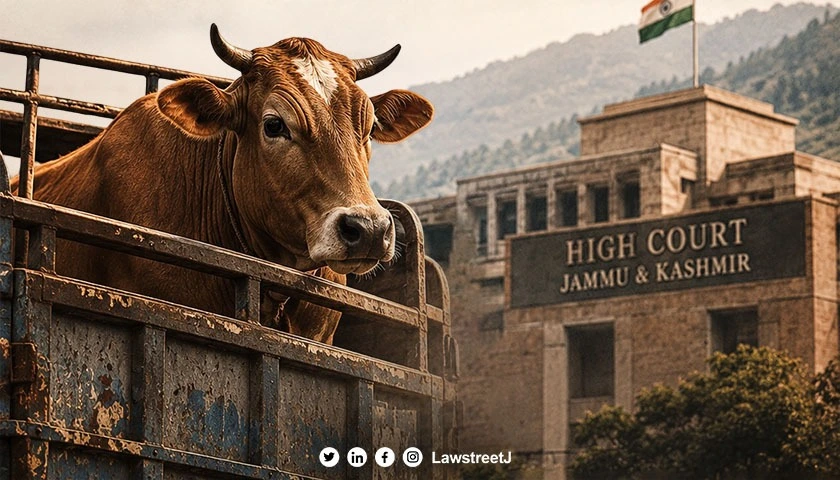
Jammu: The High Court of Jammu & Kashmir and Ladakh has dismissed a habeas corpus petition challenging a preventive detention order under the Public Safety Act, holding that where a person is alleged to have transported bovine animals, including cows, for slaughter, the detaining authority has a reasonable basis to apprehend a disturbance of public order, and that its subjective satisfaction cannot be reviewed unless it rests on flimsy or irrational grounds.
Justice Sanjay Dhar was hearing HCP No. 34/2026 filed by Aslam Khan, through his father, against the UT of J&K and others. The petition challenged Order No. 01-PSA of 2026 dated 24.01.2026 of the District Magistrate, Udhampur, detaining him to prevent him from acting in a manner prejudicial to the maintenance of public order.
The petitioner contended that the order was passed mechanically, the grounds being a verbatim reproduction of the police dossier, that the alleged activities did not endanger public order or cause communal tension, that the grounds and documents were not supplied in a language he understood, and that he was not told of his right to make a representation. The detaining authority responded that the entire record was examined, that the petitioner, by establishing a nexus with other criminals and organising bovine smuggling, had disturbed public order, and that despite two convictions he had shown no remorse.
The grounds of detention referred to FIR No. 24/2023 and FIR No. 98/2025 of Police Station Chenani and FIR No. 110/2023 of Police Station Batote, all concerning the transportation of bovine animals towards Kashmir for smuggling or slaughter. The petitioner stood convicted in FIR Nos. 24/2023 and 110/2023, while the challan in FIR No. 98/2025 had been filed before the competent court. The Court noted that the seizure memos showed that the animals included cows, which are held in reverence by a particular religious community.
The detaining authority had recorded that the petitioner’s activities had the potential to incite religious hatred and provoke retaliatory violence, and to disturb communal harmony. The Court held that this apprehension “cannot be termed imaginary, particularly in view of the allegation that the petitioner was transporting bovine animals, including cows, for slaughtering purposes”. It then held:
“It is a settled law that the subjective satisfaction of the detaining authority cannot ordinarily be a subject matter of judicial review unless the same is based on flimsy grounds or appears to be irrational or extraneous to the object sought to be achieved.”
The petitioner relied on the coordinate Bench rulings in Din Mohd Wani v. UT of J&K (HCP No. 35/2026, decided on 06.10.2026), Makhan Lal @ Makhni v. UT of J&K (HCP No. 91/2025, decided on 13.02.2026) and Hamid Mohd v. UT of J&K (HCP No. 4/2024, decided on 06.08.2024), to argue that bovine smuggling can be dealt with under ordinary criminal law. The Court distinguished them as having been delivered on their peculiar facts, since in those cases the animals were not being transported for slaughter, whereas here there were specific allegations of transporting bovine animals, including cows, for slaughter.
On the procedural grounds, the Court found from the detention record that the petitioner was supplied 34 leaves, comprising the grounds of detention, the PSA warrant, the notice of detention and the dossier with FIRs and other documents, and that, as recorded in his signed receipt and an undertaking of the executing officer, PSI Ravinder Singh, the contents were explained to him in Urdu and Dogri. The notice of detention also informed him of his right to make a representation to the District Magistrate and the Government. The contentions to the contrary were held to be against the record.
Finding no ground to interfere, the Court dismissed the petition and directed return of the detention record.
Appearances:
For the Petitioner: Mr. Rajnesh Singh Parihar, Advocate.
For the Respondents: Mr. Sumeet Bhatia, Government Advocate.
Case Title: Aslam Khan vs. UT of J&K & Ors., HCP No. 34/2026