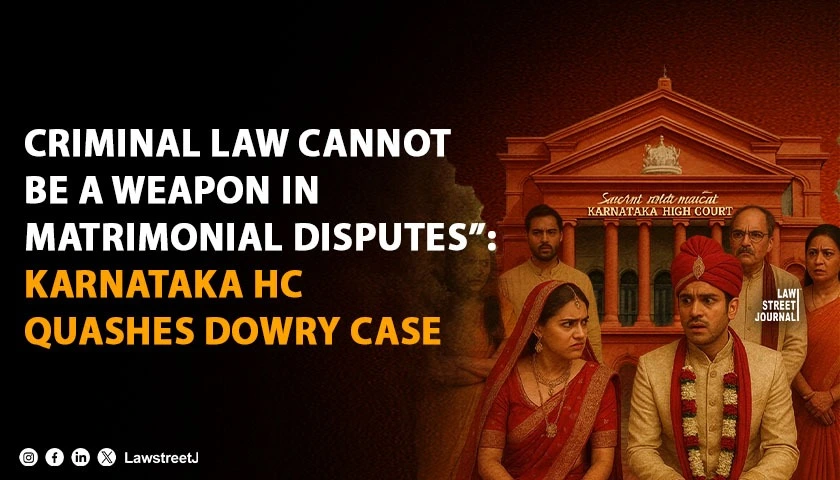
Karnataka: The Karnataka High Court has quashed criminal proceedings against the mother-in-law, father-in-law, and sister-in-law of a woman who had alleged dowry harassment and cruelty. The Court held that the complaint and charge sheet contained only vague, omnibus allegations devoid of specific particulars, which could not sustain prosecution under Section 498A of the Indian Penal Code or the Dowry Prohibition Act, 1961.
A Bench of Justice M. Nagaprasanna further observed that permitting the proceedings to continue against the petitioners would amount to an abuse of the process of law, subjecting them to the ordeal of a protracted trial without any foundational basis, ultimately resulting in a miscarriage of justice.
In the present case, the petitioners were the mother-in-law, father-in-law, and sister-in-law of the complainant. The marriage between Accused No. 1 (the husband, son of Petitioners 1 and 2) and the complainant took place on 20.04.2018. Barely six months into the marriage, the relationship deteriorated, leading the complainant to register a complaint at Basaveshwaranagara Police Station, Bengaluru. She alleged cruelty under Section 498A read with Section 34 of the IPC, along with offences under Sections 3 and 4 of the Dowry Prohibition Act, 1961. The complaint was registered as Crime No. 333 of 2018.
Following the investigation, the police filed a charge sheet against four accused persons, including the present petitioners. The matter was pending before the XXIV Additional Chief Metropolitan Magistrate, Bengaluru, as C.C. No. 23089 of 2021. The petitioners approached the High Court under Section 482 of the CrPC, seeking quashing of the proceedings.
Before the High Court, counsel for the petitioners contended that they, not residing with the complainant, had been unnecessarily drawn into criminal proceedings without any justification. It was argued that the complaint lacked even an iota of the ingredients of the alleged offences against them, and that the husband, who was not before the Court, was the appropriate person to answer the allegations. Reliance was placed on multiple Supreme Court judgments to argue that continuation of the trial would amount to an abuse of process.
On the other hand, counsel for the complainant refuted these submissions, contending that the charge sheet disclosed all the ingredients of the offences against all accused persons, including the petitioners. It was further argued that the sister-in-law, even during her visits to the matrimonial home, had instigated the husband and participated in dowry demands. The State Public Prosecutor also opposed the petition, submitting that the charge sheet had been filed after due investigation and that the petitioners should face trial.
Upon a close examination of the complaint and the charge sheet summary, the High Court found that they reflected only commonplace domestic discord and minor skirmishes, which had been elevated to the level of criminality. The allegations were largely general and omnibus in nature, lacking specific particulars such as time, date, or overt acts. Even with respect to dowry demands, the narration primarily pertained to pre-marital discussions between December 2017 and February 2018 in the context of marriage expenses. The Court held that such expenditure incurred during marriage ceremonies could not, in the absence of cogent material, be retroactively construed as dowry demands to implicate all family members.
The Court emphasized that Section 498A IPC contemplates cruelty of such a nature as is likely to drive a woman to suicide or cause grave injury, or harassment aimed at coercing unlawful demands for property. The sine qua non of the offence is not mere marital discord, but cruelty of a grave character linked to unlawful demands. The complaint and charge sheet, when read together, failed to satisfy these essential ingredients against the petitioners.
The Court extensively relied on recent Supreme Court precedents cautioning against the growing tendency to implicate all members of the husband’s family in matrimonial disputes. It referred to Rajesh Chaddha v. State of Uttar Pradesh (2025 SCC OnLine SC 1094), where the Apex Court observed that Section 498A is often misused against aged parents, distant relatives, and married sisters living separately. Similarly, in Ghanshyam Soni v. State (Government of NCT of Delhi) (2025 SCC OnLine SC 1301), the Supreme Court stressed the need for courts to carefully scrutinize allegations, especially where relatives are implicated based on sweeping and vague accusations, cautioning against allowing criminal law to be used as a weapon to entangle entire families in matrimonial discord.
Further reliance was placed on Maram Nirmala v. State of Telangana (2025 SCC OnLine SC 2913) and Dr. Sushil Kumar Purbey v. State of Bihar (2026 SCC OnLine SC 338), which reiterated that general allegations without specific overt acts cannot sustain prosecution under Section 498A IPC, and that mere strained relations or quarrels do not amount to cruelty within the meaning of the provision.
Viewed in light of these precedents, the Court concluded that the present case was a classic instance of trivial domestic discord being amplified into criminal prosecution. Accordingly, the criminal petition was allowed, and the entire proceedings in C.C. No. 23089 of 2021 pending before the XXIV Additional Chief Metropolitan Magistrate, Bengaluru, were quashed insofar as Petitioners 1 to 3 (Accused Nos. 2 to 4) are concerned.
Appearances:
For the Petitioners: Smt. Keerthi Krishna Reddy, Advocate
For Respondent No. 1 (State): Sri B.N. Jagadeesha, Additional State Public Prosecutor
For Respondent No. 2: Smt. Desiree M. Pais, Advocate (for Sri Vivek Holla, Advocate)
Case Title: Smt. Sumithra & Ors. v. State of Karnataka & Anr., Criminal Petition No. 12989 of 2024


![Karnataka High Court: Cabinet Rank Status Not Equivalent to Ministerial Position [Read Order]](/secure/uploads/2023/09/lj_2318_fc1b99b7-aeed-472b-836e-33750bedb394.jpg)


![Woman living in adultery cannot claim maintenance: Karnataka High Court [Read Order]](/secure/uploads/2023/10/lj_3083_Women_living.jpg)