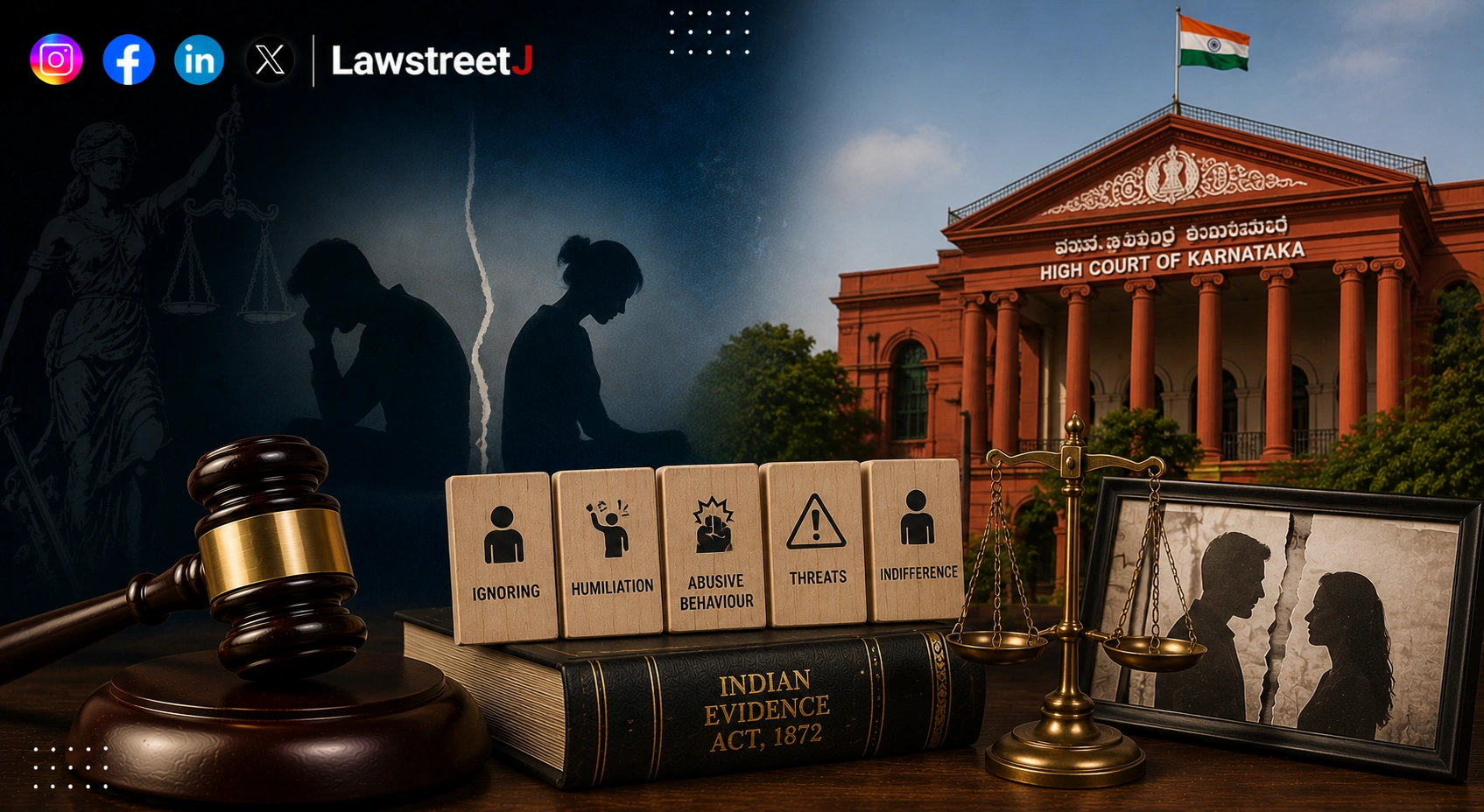
Bengaluru: The Karnataka High Court has dismissed a husband's appeal against a Family Court decree dissolving his marriage on the ground of cruelty, holding that a prolonged course of matrimonial discord, separation within the same premises, and a failed attempt at reconciliation, viewed cumulatively, established mental cruelty within the meaning of Section 13(1)(ia) of the Hindu Marriage Act, 1955.
The Division Bench of Justices D.K. Singh and H. Shanthi Bhushan was hearing an appeal filed under Section 19(1) of the Family Courts Act, 1984, against the judgment and decree passed by the Principal Judge, Family Court, Bengaluru, whereby the wife's petition for divorce was allowed and the appellant was directed to pay permanent alimony of ₹25,000 per month.
As per the wife's case, the marriage was solemnised in 2001 and the parties have two children. She alleged that the appellant subjected her to physical, verbal and emotional cruelty, neglected her and the children, displayed an over-possessive and suspicious attitude, and distanced her from her family. She further alleged that the appellant was addicted to certain habits despite her efforts to persuade him otherwise, that the parties eventually began occupying separate rooms within the same premises, and that she was ultimately compelled to leave the matrimonial home with the children.
It was also her case that an earlier complaint under Section 498-A of the IPC against the appellant and his family had been withdrawn following an assurance from the appellant that he would mend his ways, and that an earlier divorce proceeding instituted by the appellant himself had been given up when the parties attempted reconciliation, an attempt that ultimately failed.
The appellant denied the allegations as false and exaggerated, contending that the wife herself was responsible for the discord, that she was instigated by her relatives, and that the criminal complaint under Section 498-A, in which he was acquitted, was itself evidence of cruelty on her part. He admitted to occasionally consuming alcohol, chewing tobacco and smoking, but denied addiction or any resulting matrimonial discord. He also contended that the Family Court could not have relied on desertion or irretrievable breakdown, since the petition had been filed only under Section 13(1)(ia) and not Section 13(1)(ib).
On appreciating the evidence, the Court noted that the appellant himself had admitted that the parties resided separately within the same premises for a considerable period, occupying different rooms, and had also admitted his habits of consuming alcohol, chewing tobacco and smoking. The Court observed that while such separate living, by itself, would not amount to cruelty, it could not be viewed in isolation from the larger matrimonial history of repeated disputes, an earlier divorce proceeding withdrawn after reconciliation, and the eventual failure of that reconciliation.
Rejecting the appellant's contention that the criminal complaint under Section 498-A ought to be treated as an act of cruelty merely because it ended in acquittal, the Court held that criminal and matrimonial proceedings operate in different fields with different standards of proof, and that the complaint, made against the backdrop of prolonged discord and later withdrawn after an assurance from the appellant, could not be viewed in isolation as an independent act of cruelty.
Summarising its approach to the concept of matrimonial cruelty, the Court observed that "cruelty is essentially a question of fact and degree."
The Court held that a spouse could not be expected to endure, for an indefinite period, conduct causing sustained mental pain and destroying the basic elements of companionship, trust and matrimonial security. Listing eight circumstances emerging from the evidence including the repeated disputes, the admitted habits, the earlier withdrawn proceeding, the failed reconciliation and the prolonged separation the Court held that their cumulative effect went beyond the ordinary wear and tear of married life.
Accordingly, the Court held that "the cumulative effect of these circumstances is sufficient to establish mental cruelty."
On the appellant's contention regarding the ground of divorce, the Court clarified that the decree had been granted solely under Section 13(1)(ia) on the ground of cruelty, and that the fact of the parties living separately had been considered only as a circumstance bearing on the nature and effect of the matrimonial conduct, and not as an independent ground of desertion or irretrievable breakdown.
On the question of permanent alimony, the Court noted that the appellant's salary particulars showed a gross monthly salary of over Rs. 4,13,000 and a net salary of over Rs. 2,77,000, demonstrating sufficient means to pay alimony, while the wife, educated up to the 10th standard, earned only about ₹24,000 per month working at a pre-school. Holding that her own income could not, by itself, disentitle her to permanent alimony, and finding the Family Court's assessment of ₹25,000 per month neither arbitrary nor disproportionate, the Court declined to interfere with the direction.
Finding no perversity, illegality or infirmity warranting interference, the Court dismissed the appeal, affirmed the judgment and decree of the Family Court, confirmed the decree of divorce under Section 13(1)(ia) of the Hindu Marriage Act, and upheld the direction to pay permanent alimony of ₹25,000 per month, subject to adjustment of any amount already paid. The Court clarified that its observations were confined to the matrimonial dispute and would not prejudice either party in any independent proceedings, and directed that there be no order as to costs.
Appearances:
For the Appellant: Sri. S.G. Muniswamy Gowda, Advocate.
For the Respondent: Sri. Swaroop S., Advocate.
Case Title: B.V. Raghavendra vs. Smt. Sridevi, Miscellaneous First Appeal No. 8362 of 2025 (FC)


![Karnataka High Court: Cabinet Rank Status Not Equivalent to Ministerial Position [Read Order]](/secure/uploads/2023/09/lj_2318_fc1b99b7-aeed-472b-836e-33750bedb394.jpg)


![Woman living in adultery cannot claim maintenance: Karnataka High Court [Read Order]](/secure/uploads/2023/10/lj_3083_Women_living.jpg)