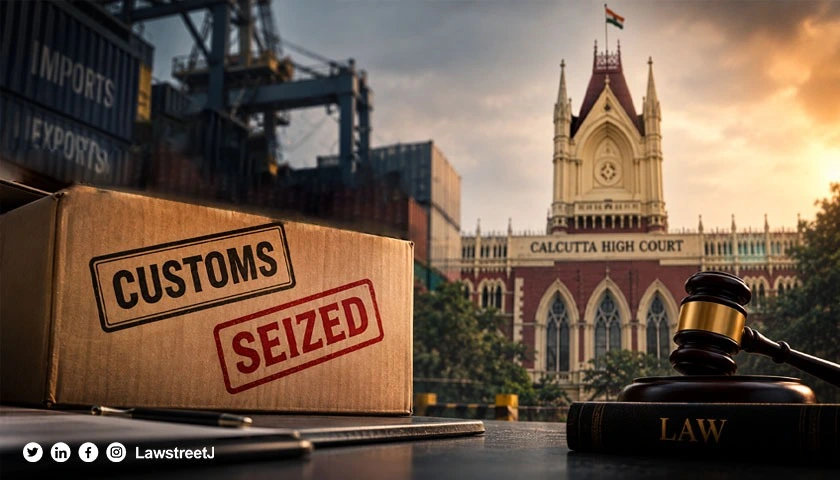
Calcutta: The Calcutta High Court has rejected a preliminary objection raised by the Revenue and held that a writ petition challenging a customs order is maintainable, notwithstanding the availability of a statutory appeal, where the authority is alleged to have stepped outside objective law into the realm of subjective morality in treating imported goods as prohibited.
Justice Smita Das De was hearing a writ petition under Article 226 of the Constitution filed by M/s. Pracha Aalloy Private Limited assailing an order dated 22.07.2026 passed by the fourth respondent, in which the goods in question were described as 'obscene adult sex toys' and treated as prohibited, with Section 292 of the Indian Penal Code, 1860 and Section 111(m) of the Customs Act, 1962 being invoked.
Counsel for the Revenue raised a strong preliminary objection to maintainability, contending that the Customs Act is a self-contained code providing a complete machinery for departmental appeals, that the impugned order was appealable under Section 128 before the Commissioner of Customs (Appeals) on payment of the statutory pre-deposit under Section 129E, and that the petitioner had deliberately bypassed that efficacious alternative remedy. Reliance was placed on the Supreme Court's decision in Radha Krishan Industries v. State of Himachal Pradesh, setting out the exceptions to the rule of alternative remedy, and on Securities and Exchange Board of India v. Mangalore Stock Exchange, for the proposition that maintainability must be decided at the threshold before any consideration on merits.
Per contra, counsel for the petitioner submitted that the existence of an alternative remedy does not oust writ jurisdiction but is a self-imposed rule of judicial discretion governing entertainability, relying on Whirlpool Corporation v. Registrar of Trade Marks and Godrej Sara Lee v. Excise and Taxation Officer, and contended that the adjudicating authority had created an unlegislated category of prohibition out of subjective moral biases, rendering the order a nullity and engaging the petitioner's fundamental right to trade.
The court held that while the availability of an alternative remedy is ordinarily a ground for restraint under Article 226, it is not an absolute bar, and that the petition raised a specific question as to whether the description 'obscene adult sex toys' and the alleged applicability of Section 292 of the Indian Penal Code, absent identification of any specific statutory or notification-based prohibition, could by themselves render the goods 'prohibited goods' under Section 11 of the Customs Act.
The court observed that "when a statutory authority acts completely outside the boundaries of objective law and enters the realm of subjective morality thereby severely affecting a citizen's fundamental right to trade, the High Court will not shut its doors."
Noting that the case involved an alleged systematic misrepresentation of trade regulations across various custom houses, which called for an authoritative judicial pronouncement rather than a routine departmental appeal, and that the precise statutory basis for the alleged prohibition and for invoking Section 111(m) required consideration, the court held the writ petition to be maintainable and fit to be heard on merits, while expressly refraining from expressing any opinion on the merits.
The matter was directed to be listed on 09.10.2026, with the respondents to file a short affidavit-in-opposition within two weeks and the petitioners to reply within one week thereafter. In a connected application, the court also allowed certain typographical corrections to its earlier order dated 21st August, 2026, with the remaining portions of that order left unaltered.
Appearances:
For the Petitioner: Ms. Gunjan Bahety, Mr. Dhiraj Tiwari and Mr. Khushal Mittal, Advocates.
For the Customs Authority: Mr. Kaushik Dey and Mr. Tapan Bhanja, Advocates.
For the Union of India: Mr. Amit Sharma and Mr. Abhishek Kr. Agrahari, Advocates.
Case Title: M/s. Pracha Aalloy Private Limited vs. Union of India and Ors., WPO/370/2026 with IA Nos. GA/1/2026 and GA/2/2026



![Calcutta High Court conducts late-evening hearing, orders release of lawyer arrested inside court [Read Order]](/secure/uploads/2023/12/lj_4146_Court_lawyers_arrest.jpg)
![Indian Courts this Week: Law Street Journal's Weekly Round-Up of SC & HCs [Jan 1 - Jan 6]](/secure/uploads/2024/01/lj_9050_WhatsApp_Image_2024-01-06_at_12.07.10_PM.jpeg)