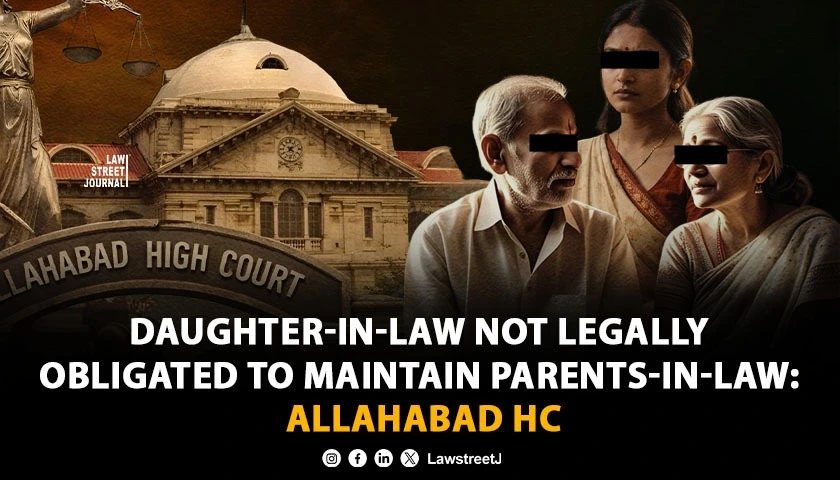
Allahabad: The Allahabad High Court has held that a daughter-in-law cannot be fastened with a legal obligation to maintain her parents-in-law under Section 144 of the Bharatiya Nagarik Suraksha Sanhita, 2023, as parents-in-law do not fall within the categories of persons entitled to claim maintenance under the said provision.
The Court of Justice Madan Pal Singh further held that a moral obligation, however compelling it may appear, cannot be enforced as a legal obligation in the absence of a statutory mandate. The criminal revision filed by the parents-in-law was accordingly dismissed.
The revision was filed against an order passed by the learned Principal Judge, Family Court, Agra, whereby the application filed by the revisionists seeking maintenance from their daughter-in-law under Section 144 of the Bharatiya Nagarik Suraksha Sanhita, 2023 was rejected.
The revisionists, who are the father-in-law and mother-in-law of opposite party no. 2, contended that they are old, illiterate, and indigent parents of their deceased son, late Pravesh Kumar, upon whom they were wholly dependent during his lifetime. The marriage of the deceased with opposite party no. 2 was solemnized on 26.04.2016, and he passed away on 31.03.2021. The revisionists submitted that opposite party no. 2 is employed as a Constable in the Uttar Pradesh Police, has sufficient independent income, and has also received all service and retiral benefits of the deceased. It was urged that the moral obligation of a daughter-in-law to maintain her aged parents-in-law ought to be treated as a legal obligation.
Opposite party no. 2 opposed the revision and submitted that the order passed by the Family Court is strictly in accordance with law and does not warrant any interference.
The High Court, upon consideration of the rival submissions, reaffirmed the settled legal position that the right to claim maintenance under Section 125 of the Code of Criminal Procedure—and now under the corresponding provisions of the Bharatiya Nagarik Suraksha Sanhita, 2023—is a statutory right confined only to the categories of persons expressly mentioned therein. The legislature, in its wisdom, has not included parents-in-law within the ambit of the said provision. It is, therefore, not the legislative scheme to fasten liability of maintenance upon a daughter-in-law towards her parents-in-law under the said provision.
The Court also noted that there was nothing on record to indicate that the employment secured by opposite party no. 2 was on compassionate grounds. It further observed that the submission regarding succession to the property of the deceased did not fall for consideration in proceedings under Section 125 Cr.P.C. or the corresponding provision, as such issues are beyond the scope of summary maintenance proceedings.
On the argument of moral obligation, the Court held that however compelling such an obligation may appear, it cannot be enforced as a legal obligation in the absence of a statutory mandate. Maintenance under the said provision can be claimed only by persons falling within the categories specifically enumerated therein.
Finding no illegality, perversity, or infirmity in the order of the Family Court, the High Court dismissed the criminal revision as lacking merit.
For the Revisionists: Ms. Monika Pal, Advocate
For the Opposite Party: Mr. Rajesh Kumar Yadav, Advocate; learned A.G.A. for the State
Case Title: Rakesh Kumar and Another v. State of U.P. and Another, Criminal Revision No. 6502 of 2025



!["No Loudspeakers For Azan, No Fundamental Right To Create Noise," Says Allahabad HC To Two Mosques [Read Judgment]](/secure/uploads/2020/01/lj_4995_Allahabad_HC_AZAN.jpg)