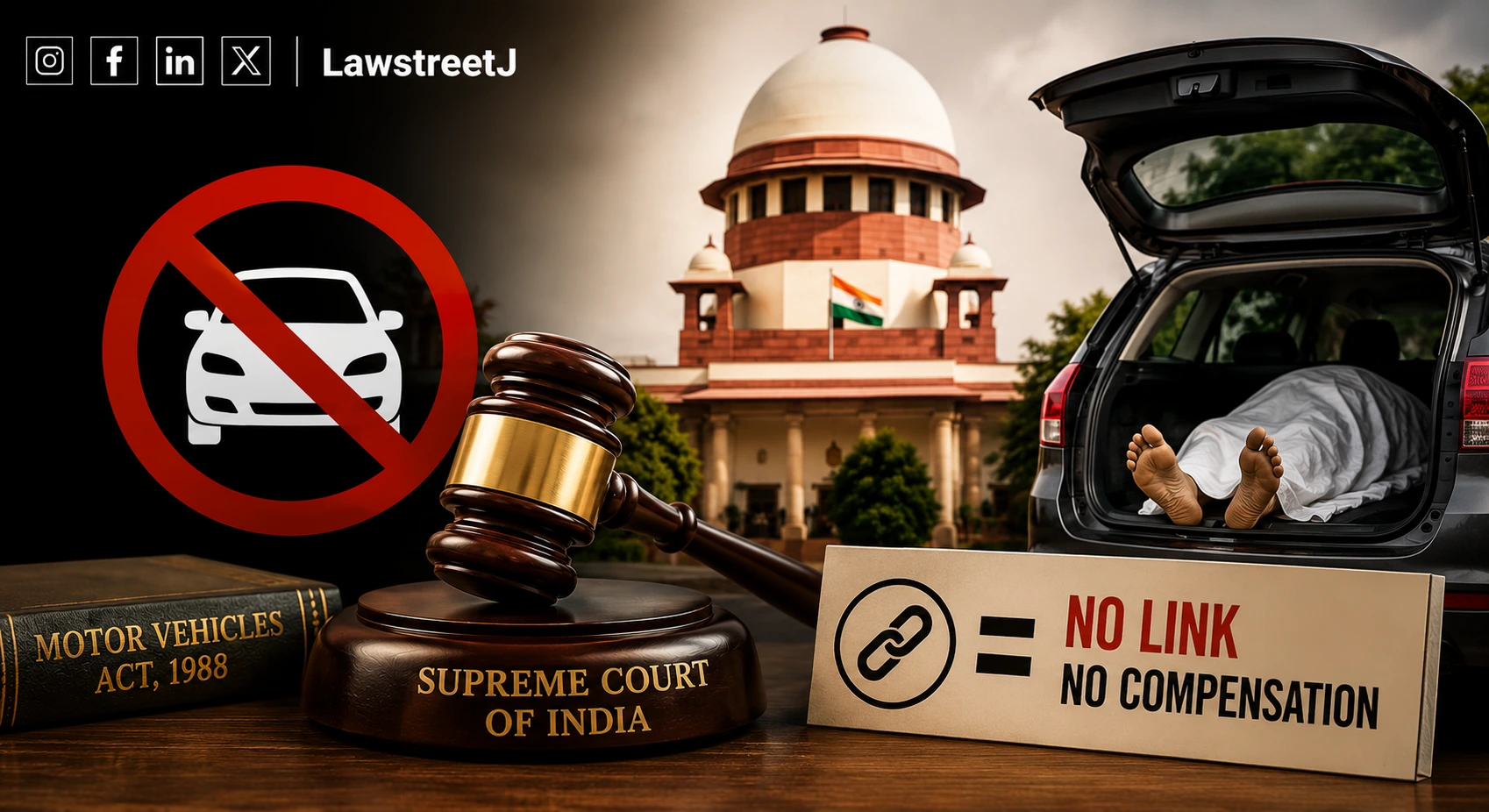
New Delhi: The Supreme Court has held that compensation under the Motor Vehicles Act, 1988 cannot be awarded merely because a vehicle happened to be involved somewhere in the chain of circumstances leading to a person's death, and that a causal link between the use of the vehicle and the death must be established even on the lower civil standard of preponderance of probabilities.
A Bench of Justices Sanjay Karol and Augustine George Masih was hearing an appeal filed against a judgment of the High Court which had enhanced, to Rs.8,60,832 with 6% interest, compensation awarded by the Motor Accident Claims Tribunal, Raigarh, to one Rajshri Agarwal and her three children over the death of her husband Anand.
Anand had been riding in a vehicle driven by his friend Dilip on 29.11.2009, and was found dead near Binjkot village three days later. Rajshri's FIR led to a chargesheet alleging that three accused, in furtherance of a conspiracy, had kidnapped, killed and disposed of Anand. Dilip was convicted by the Sessions Court under Sections 302, 365, 201 and 120B of the Indian Penal Code, but was acquitted by the High Court on the ground that the prosecution's last-seen theory could not be proved. Parallelly, Rajshri and her children had filed a claim petition under Section 166 of the Motor Vehicles Act, contending that Anand was killed inside Dilip's vehicle.
The Tribunal, while finding that rashness or negligence could not be proved, nevertheless held the death to be covered under the Motor Vehicles Act on the reasoning that the injuries were inflicted while the two men were in the vehicle, and awarded Rs.5,64,000 with 7% interest, a finding the High Court affirmed and enhanced.
Examining whether Anand's death could be said to have ‘arisen out of’ the use of the vehicle, the Court surveyed precedent on the phrase, including its own recent ruling in Bruhat Bangalore Mahanagara Palike v. K.K. Umesh Kumar, and considered the doctrine in Rita Devi v. New India Assurance Co. Ltd. distinguishing an accidental murder, where death results from a felonious act originally aimed at something else, from a murder simpliciter, where the killing itself was the object. The Bench held that this distinction could not assist the claimants, since the circumstances of Anand accompanying his friend Dilip were, on the record, entirely innocuous, and the last-seen theory relied upon by the prosecution had itself been found to be weak evidence and was not proved.
Applying the lighter civil standard of preponderance of probabilities rather than the criminal standard of proof beyond reasonable doubt, the Court still found no material connecting the vehicle to the death. It noted that no forensic evidence including the blood, skin cells or hair had been recovered from the car, and that no collision was even alleged. The Court observed that “some link whatsoever between the car, and the death has to be established.” Absent such a link, the mere presence of a motor vehicle somewhere in the sequence of events could not fasten liability under the Act.
Holding that an alleged accidental murder and the presence of a motor vehicle, without a demonstrated relationship between the two, could not sustain liability under the Motor Vehicles Act, the Court set aside the judgments of the Tribunal and the High Court and allowed the appeal.
It directed that any compensation already paid to the respondents would not be subjected to recovery.
Case Title: Dilip Agarwal vs. Rajshri Agarwal & Ors., Civil Appeal Nos. of 2026 (arising out of SLP(C) Nos.9002-03 of 2026)


.jpeg)