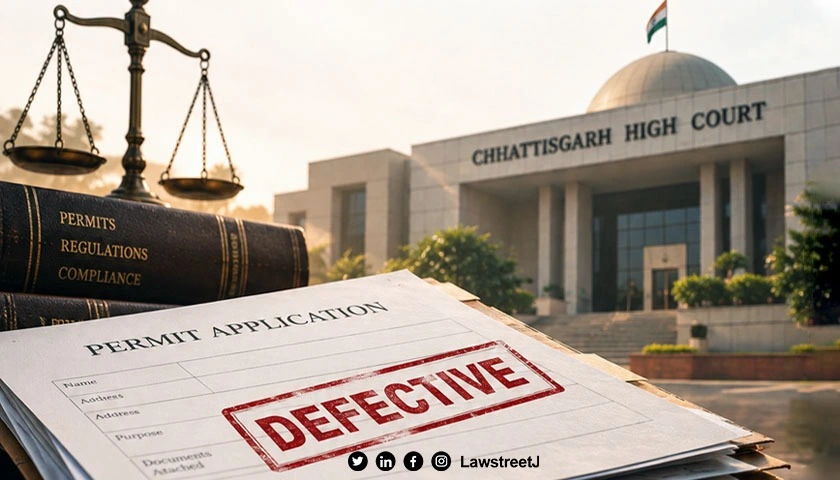
Bilaspur: The High Court of Chhattisgarh has set aside an order of the State Transport Appellate Tribunal (STAT) that, after finding a stage carriage permit application incomplete, had remanded the matter to the Regional Transport Authority (RTA) with liberty to the applicant to cure the defects and be heard afresh, holding that once an application is found defective on the date of its consideration, the only consequence permissible in law is rejection, not an opportunity for subsequent rectification.
A Single Bench of Justice Amitendra Kishore Prasad was hearing a writ petition filed by Royal Travels under Article 226 of the Constitution, challenging an order dated 19.12.2025 passed by the State Transport Appellate Tribunal, Chhattisgarh, Raipur, in Revision Case No. 10/2025, against the State of Chhattisgarh, the State Transport Authority, and Mohd. Shahbuddin, a rival bus operator.
The petitioner, a stage carriage permit holder on the Durg-Trishuli route, objected before the Regional Transport Authority to an application filed by respondent No. 3 for a permanent stage carriage permit on an overlapping route, on the ground that the application was incomplete and did not meet statutory requirements. The RTA nonetheless allowed the application by order dated 27.12.2024. On revision by the petitioner, the STAT recorded a categorical finding that respondent No. 3's application was indeed incomplete and not in accordance with law, relying on Shailesh Vijayvargia v. State of M.P., but instead of rejecting the application, set aside the RTA's order and remanded the matter with a direction that respondent No. 3 be allowed to cure the defects and have the application reconsidered. Aggrieved that a finding of incompleteness had been followed by an opportunity to rectify rather than rejection, and that objections regarding clashing timings and overlapping routes had not been properly addressed, the petitioner approached the High Court.
Counsel for the petitioner, Mr. B.L. Dembra, submitted that the STAT's order suffered from patent illegality, since having categorically found the application incomplete and non-compliant with statutory requirements, the Tribunal could not have permitted respondent No. 3 to rectify the defects and be reconsidered; the only legally permissible consequence was rejection of the application. He argued that the legality of an application must be tested as on the date it is taken up for consideration, so that rights crystallise on that date and cannot later be validated by curing defects, relying on Shailesh Vijayvargia v. State of M.P. He further submitted that once the RTA's order stood set aside, there was no justification for remand at all, relying on the Full Bench decision in Surendra Mohan Chaurasiya v. State Transport Appellate Tribunal, which held that remand of permit matters to the RTA is ordinarily impermissible, and contended that the STAT, as the final fact-finding appellate authority, ought to have finally adjudicated the dispute rather than abdicating its jurisdiction. Lastly, he submitted that the Tribunal erred in holding that the petitioner's and respondent No. 3's routes did not conflict, when in fact the routes substantially overlapped and their proposed timings clashed in violation of Section 70 and the applicable Rules, a factor the Tribunal had failed to properly examine.
Learned Deputy Government Advocate for respondents No. 1 and 2 opposed the petition, submitting that the permit process had strictly followed the Motor Vehicles Act, 1988 and the Chhattisgarh Motor Vehicles Rules, 1994, that objections had been duly invited and considered, that proposed timings had been suitably modified under Rule 70-B(4) to avoid impermissible clashes, and that mere route overlap did not bar grant of a permit. It was submitted that Section 90 of the Act conferred wide revisional powers on the STAT, including the power to remand for fresh consideration where reconsideration of certain aspects was warranted, and that the STAT had rightly chosen this course rather than finally adjudicating disputed factual issues itself, since only timing-related objections, and no other substantial objection, had been raised before the RTA.
Counsel for respondent No. 3, adopting the State's submissions, argued that the application had been processed transparently, that the STAT was fully competent under Section 90 to remand the matter to ensure adjudication on complete materials, that no prejudice was caused to the petitioner since all objections remained open before the RTA, and that the petitioner was seeking to resist healthy competition under the guise of technical objections. Reliance was placed on Harikrishna Ogare v. Regional Transport Authority and M/s Rainbow Travels v. Regional Transport Authority to support the wide scope of the STAT's revisional powers, and it was submitted that questions of actual timing clash were factual matters for the transport authorities and not amenable to re-appreciation in writ jurisdiction.
Examining Sections 72, 80(2) and 90 of the Motor Vehicles Act, 1988 and Rule 70-B of the Chhattisgarh Motor Vehicles Rules, 1994, the Court held that while the statutory scheme adopts a liberal approach to grant of permits, it nonetheless requires strict compliance with prescribed procedure, including proper consideration of objections and timing conflicts on the basis of the record as it stood when the application was taken up.
The Court held that once the STAT had recorded a categorical finding that respondent No. 3's application was incomplete and non-compliant, the course it adopted, remanding the matter with liberty to cure the defects, was legally unsustainable, since rights of the parties must be adjudged on the application as it existed on the date of consideration, and permitting subsequent rectification would allow an applicant to fill up lacunae to the prejudice of objecting operators. It further held that the STAT, having set aside the RTA's order, ought to have finally adjudicated the revision on the existing record rather than remanding it, and that it had failed to render any conclusive finding on the effect of the incompleteness or on the objections regarding overlapping routes and timing conflicts, thereby failing to properly exercise its jurisdiction. The Court found that the precedents cited by respondent No. 3 on the scope of the STAT's revisional powers did not support the specific course adopted in this case.
Accordingly, the Court allowed the writ petition, set aside the STAT's order dated 19.12.2025 in Revision Case No. 10/2025, and remanded the matter to the STAT for fresh adjudication of the revision petition on its own merits, strictly on the basis of the material that was before the RTA at the time of its original consideration, without respondent No. 3 being permitted to supplement or rectify the application. The Tribunal was directed to independently examine all contentions, including the effect of the incompleteness and the objections on overlapping routes and timings, without being influenced by its earlier order, and to decide the revision expeditiously, preferably within three months. The Court clarified that it had not expressed any opinion on the merits, leaving all questions of fact and law open before the Tribunal, with no order as to costs.
Appearances:
For the Petitioner: Mr. B.L. Dembra, Advocate.
For the State/Respondents No. 1 & 2: Mr. Shobhit Mishra, Deputy Government Advocate.
For Respondent No. 3: Mr. Subodh Pandey, Advocate.
Case Title: Royal Travels vs. State of Chhattisgarh & Ors., WPC No. 386 of 2026


![Abduction of minor not automatically an offence under section 366 IPC; intent must be proven: Chhatisgarh HC [Read Judgment]](/secure/uploads/2024/08/lj_9406_hc.webp)
![SC holds M/s Hindustan Motors liable for compensation in accident during test drive [Read Judgment]](/secure/uploads/2024/09/lj_8185_Accident_driving_test.webp)
![Chhattisgarh HC rules rape of dead body not punishable under existing rape laws, emphasises need for legislative change [Read Judgment]](/secure/uploads/2024/12/lj_5168_Rape_of_dead_body_not_punishable_under_law_Chhattisgarh_HC.jpg)
![Chhattisgarh High Court Rules Pension is a “Property” Right Protected Under Constitution [Read Order]](/secure/uploads/2025/04/lj_4673_Pension_Is_a_Property_Right.webp)