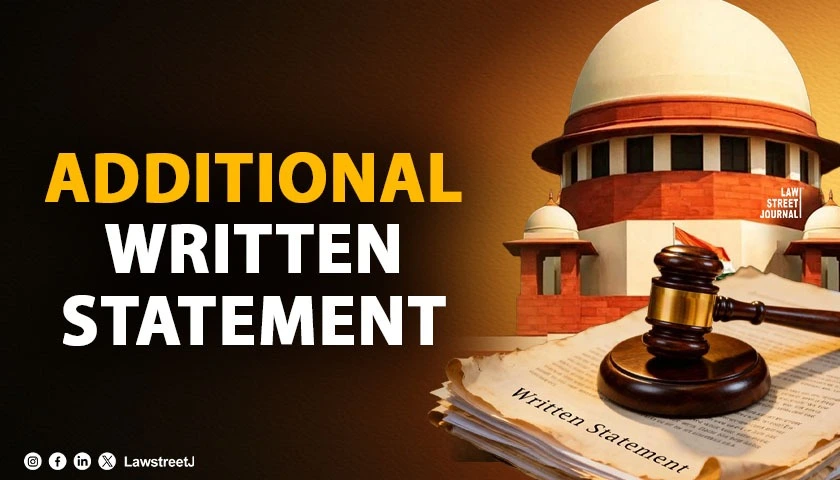
New Delhi: The Supreme Court has ruled that a defendant in a civil suit cannot be permitted to completely change the defence through an additional written statement once the trial has commenced, especially when the new plea directly contradicts the stand taken in the original written statement.
The Court held that such a move amounts to an abuse of process and is contrary to the Code of Civil Procedure, 1908.
A bench of Justice Sanjay Kumar and Justice K. Vinod Chandran delivered the judgment while setting aside an order of the Calcutta High Court that had allowed the defendant to file such an additional written statement on payment of costs of Rs. 15,000.
The dispute arose out of Title Suit No. 1527 of 2022 filed by the plaintiff, Mondira Ghosh, before the City Civil Court at Calcutta, seeking a declaration that the defendant was in unlawful possession of the suit premises and praying for her eviction along with damages. In her written statement filed in December 2022, the defendant claimed to be a bona fide co-sharer of the premises and sought dismissal of the suit. Issues were framed in May 2023, and the trial commenced, with the plaintiff’s first witness being cross-examined on three separate dates.
After the trial was well underway, the defendant applied under Order VIII Rule 9 of the CPC seeking leave to file an additional written statement along with a counterclaim. In the proposed additional written statement, the defendant sought to abandon her earlier claim of being a co-sharer and instead assert that she was a tenant under the plaintiff. The Trial Court rejected this application, finding that the defendant was attempting to retract her earlier stand and introduce an entirely inconsistent case. It relied on Order VI Rule 7 CPC, which prohibits any pleading from raising a new ground or containing allegations inconsistent with a party’s earlier pleadings.
The Calcutta High Court, exercising supervisory jurisdiction under Article 227 of the Constitution, set aside the Trial Court’s order in part. It refused to permit the counterclaim but allowed the additional written statement, observing that certain facts had inadvertently not been included in the original written statement and that the delay had been satisfactorily explained.
However, the High Court itself acknowledged that allowing an additional written statement to bypass the bar under the proviso to Order VI Rule 17 CPC, which restricts amendments after the commencement of trial, was impermissible.
The Supreme Court found this reasoning contradictory. It observed that the High Court, having correctly stated the law, had then proceeded to permit the very thing it found impermissible. The Court held that this was not a case of facts being inadvertently omitted from the original written statement. On the contrary, the defendant was seeking to do a complete volte-face, abandoning her claim of being a co-sharer and replacing it with the wholly inconsistent claim of being a tenant. Such a reversal, the Court said, directly violated Order VI Rule 7 CPC.
The Court further noted that the defendant had not sought amendment of her written statement at the proper stage. Having missed that opportunity, she had resorted to filing an application under Order VIII Rule 9, which the Court characterised as a deliberate attempt to circumvent the restrictions imposed by the proviso to Order VI Rule 17. This, the Court held, constituted a clear abuse of process.
The Supreme Court allowed the appeal, set aside the Calcutta High Court’s order, and restored the Trial Court’s order rejecting the application. The parties were directed to bear their own costs.
Case Title: Mondira Ghosh v. Chaitali Ghosh