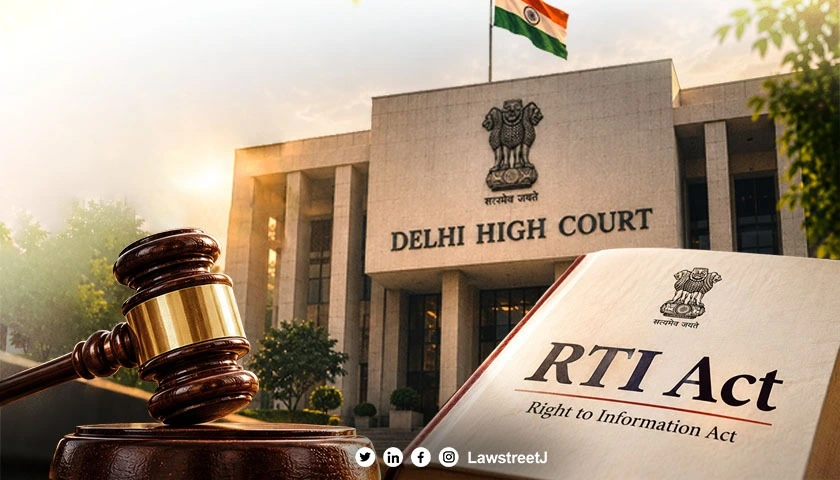
New Delhi – The Delhi High Court on Thursday disposed of a writ petition seeking to have the Delhi High Court Bar Association declared a public authority under the Right to Information Act, 2005, holding that the Association is not amenable to writ jurisdiction and that no relief could be granted.
Justice Amit Mahajan passed the order on 26 November 2026 in W.P.(C) 17076/2024, filed by advocate Shashank Deo Sudhi, who appeared in person.
The petitioner had sought a writ or direction declaring the Bar Association a public authority for the purposes of the RTI Act, and a direction to appoint a Central Public Information Officer (CPIO) in terms of the Act. He also prayed for any other appropriate writ the Court deemed fit. The Delhi High Court Bar Association was Respondent No. 1, while the Bar Council of Delhi and the Bar Council of India were also arrayed as respondents.
Rejecting the plea, the Court relied on a Division Bench decision dated 16 January 2026 in LPA 368/2024, where the same petitioner had challenged an action of the New Delhi Bar Association. The Single Judge reproduced the Division Bench’s findings, which noted that a Bar Association is a body of private individual lawyers that does not perform a public function in the normal discharge of its duties. Describing it as “a purely private entity”, the Division Bench held that it cannot be termed ‘State’ or its instrumentality, agency or authority within the meaning of Article 12 of the Constitution.
The Division Bench had further reasoned that, in the absence of any public function, no mandamus can be issued to a Bar Association under Article 226. It also observed that a person seeking a writ of mandamus must first approach the concerned authorities, and may seek the writ only on failure to discharge statutory duties, a failure that must be established. The Court noted that Bar Councils, as statutory bodies regulating the legal profession, are the forum for disciplinary action against advocates.
Applying that ruling, Justice Mahajan held that Respondent No. 1 is not amenable to writ jurisdiction. The Court concluded that “no relief can be granted to the petitioner in the present proceedings”, and the petition was disposed of with those observations.
Appearances:
For the Petitioner: Petitioner in person.
For Respondent No. 1 (Delhi High Court Bar Association): Mr. N. Hariharan, Mr. Sacchin Puri, Mr. Rakesh Tiku and Ms. Prem Lata Bansal, Senior Advocates, with Mr. Vikram Singh Panwar, Ms. Kanika Singh, Mr. Kunal Malhotra, Mr. B.S. Dhir, Ms. Kajal Chandra, Ms. Vidhi Gupta, Mr. Amit Choudhary, Ms. Chandrika Gupta, Mr. Shrey Sharawat, Mr. Nitesh Mehra, Mr. Lakshy Kaushik, Mr. Jai Girdhar, Ms. Manya Talwar, Mr. Monu, Mr. Swastik Bhuchar, Mr. Sunil Kumar and Mr. Sandeep Kumar, Advocates.
For Respondent No. 2 (Bar Council of Delhi): Mr. T. Singhdev, Senior Advocate, with Mr. Tanishq Shrivastava and Mr. Abhijit Chakrwarty, Advocates.
For Respondent No. 3 (Bar Council of India): Mr. Preet Pal Singh and Mr. Viraj Raj Mishra, Advocates.
Case Title: Shashank Deo Sudhi v. Delhi High Court Bar Association and Ors., W.P.(C) 17076/2024