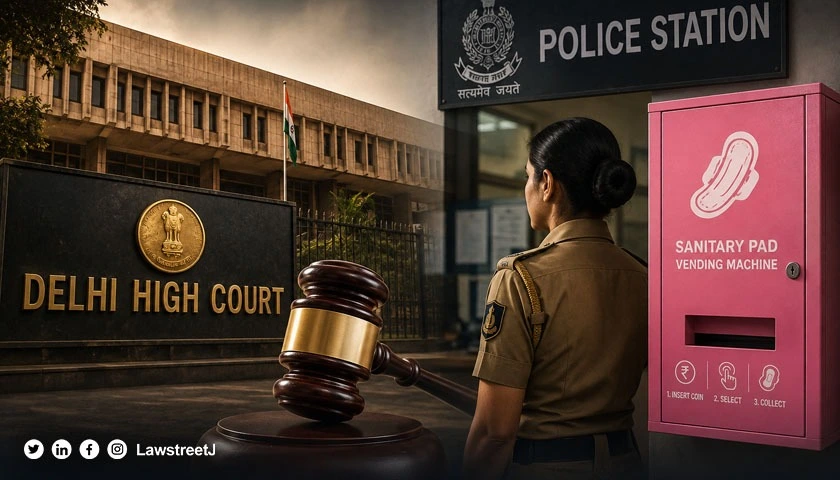
New Delhi: The Delhi High Court on Wednesday directed the Commissioner of Delhi Police to conduct a comprehensive survey of all police stations in the national capital to assess the availability of functional sanitary pad vending machines and exclusive washrooms for women police personnel.
The division bench, comprising Chief Justice Devendra Kumar Upadhyaya and Justice Tejas Karia, ordered that this survey must be completed within a strict timeline of six weeks.
Additionally, court mandated that the police administration must take appropriate steps to ensure that every police station in Delhi is equipped with a sanitary pad vending machine and an exclusive, clean washroom for female personnel. The High Court also issued formal notices to the Union of India through the Ministry of Home Affairs, the Delhi Police, and the Government of NCT of Delhi, seeking their official responses to the issues raised.
The matter has been scheduled for further hearing on September 23, by which date the Delhi Police must file an affidavit detailing the specific compliance steps taken.
The judicial directions were issued during the hearing of a Public Interest Litigation (PIL) filed by the non-governmental organisation Justice for Rights Foundation, represented through Muskan Singh Bankura, the representative of its Women Cell. The petition highlights a persistent and critical lack of basic menstrual hygiene infrastructure and dedicated sanitation facilities for female police personnel deployed across various police stations and units in Delhi. The petitioner argued that this lack of facilities also deeply affects female complainants, victims, and witnesses who visit police stations.
According to the petition, the legal action was prompted by district-wise information obtained through a series of Right to Information (RTI) Act applications filed in July and August 2025. The RTI responses, received from all 18 districts and units of the Delhi Police, allegedly revealed a near-total absence of functional sanitary pad vending machines and menstrual waste incinerators. Furthermore, the RTI replies disclosed that there was a complete absence of any dedicated policy, circular, standard operating procedure, or earmarked budgetary allocation for maintaining menstrual hygiene infrastructure across hundreds of police stations.
Additionally, the petitioner argued that the absence of sanitary napkins, vending machines, incinerators, and clean washrooms for women police personnel violates their rights under Articles 14, 15, and 21 of the Constitution, as well as the Directive Principles under Articles 42 and 47.
The PIL highlighted that women officers are often deployed for prolonged field duties, making it difficult to access menstrual hygiene products, thereby affecting their health, privacy, and dignity. Citing similar facilities provided by the CRPF, Mumbai Police, and Ladakh Police, the petitioner sought time-bound installation of menstrual hygiene infrastructure, binding SOPs, and dedicated budgetary support. Following the High Court's direction, the Delhi Police and the Central Government will now conduct a survey and submit a concrete action plan before the court.
Case Title: Justice For Rights Foundation and Anr v. GNCTD & Ors


![Delhi High Court Sets Aside Arbitral Tribunal's Award Against NHAI in Highway Project Delay Case [Read Judgment]](/secure/uploads/2023/07/lj_9605_23374c2e-392c-4491-a2fe-f2f12fc5272f.jpg)
![Delhi Court Rejects Stay Request in Defamation Case Against Rajasthan CM Ashok Gehlot [Read Order]](/secure/uploads/2023/08/lj_5208_80de1ddc-d76a-4f7f-b180-408e3ae14fb4.jpg)