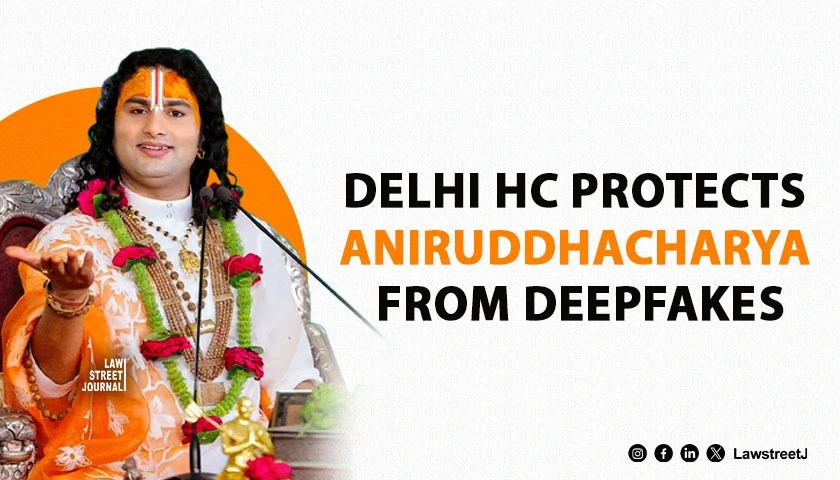
New Delhi: The Delhi High Court has granted an ex-parte ad-interim injunction protecting the personality and publicity rights of Mr. Anil Kumar Tiwari, widely known as Aniruddhacharya Ji Maharaj, restraining unknown persons as well as major social media platforms from creating, circulating, or hosting deepfake videos, AI-generated content, morphed images, and unauthorised meme-style content that misappropriates his name, voice, image, likeness, and persona.
The order was passed by Justice Tushar Rao Gedela on March 30, 2026, in CS(COMM) 336/2026, a commercial suit filed by the plaintiff against a set of John Doe defendants as well as named platforms, including Meta, X (formerly Twitter), and Google.
The Court noted that the plaintiff is a Hindu spiritual preacher and religious orator whose discourses attract large congregations of devotees across India. Through years of religious teachings and public engagement, he has built a substantial digital presence, claiming 1.64 crore subscribers on YouTube and 5 million followers on Instagram. He has also been recognised in the London World Book of Records for having the most YouTube subscribers for spiritual discourses. Beyond his spiritual role, the plaintiff is engaged in charitable activities, including the establishment of a gaushala, an old age home, daily free meal distribution, and a gurukul providing education to over 300 students.
The plaintiff asserted that his name, voice, image, physical appearance, mannerisms, signature catchphrases, and even the meme-cultural identity of ‘Pookie Baba’—an internet sobriquet exclusively associated with him—constitute protectable personality and publicity rights under Indian law with significant commercial value. He claimed that his distinctive style of discourse, including his characteristic blend of Braj-Avadhi Hindi, scriptural recitation cadence, and wit, is uniquely identifiable and instantly recognisable to the public.
The plaintiff alleged that multiple social media accounts across Instagram and YouTube had been creating and disseminating manipulated content using advanced AI and deepfake technologies to digitally replicate his voice, facial expressions, and overall persona. The impugned content ranged from AI-generated videos depicting him reciting romantic poetry inconsistent with his stature as a spiritual leader, to morphed reels superimposing his face and voice onto unrelated interactions, to wholly fabricated songs falsely attributed to him. Several accounts were additionally found to have been commercially monetising this content by soliciting paid promotions and falsely suggesting the plaintiff’s endorsement of third-party products and services, including, in one instance, an online gaming and betting website.
The plaintiff further contended that meme-style content extracting excerpts from his sermons out of context and synchronising them with unrelated clips was diminishing the seriousness and sanctity of his spiritual discourse, resulting in a demonstrable loss of goodwill among his devotees. He submitted that such content violates the Copyright Act, 1957, in addition to infringing his personality rights, as his works were being reproduced, distributed, and communicated to the public without authorisation.
The Court, after perusing the plaint and the documents filed therewith, was of the opinion that an ex-parte ad-interim injunction was warranted. It held that the plaintiff had established a prima facie strong case and that, having regard to his well-known and widely accepted public personality, the balance of convenience tilted firmly in his favour. The Court further observed that, in the absence of interim protection, irreparable loss and injury to his image and personality rights would occur, which could not be compensated in monetary terms. It also noted that the impugned content, as identified in the list of infringing links placed before it, did not appear to constitute mere parody but was disparaging and infringing of the plaintiff’s personality rights.
Accordingly, the Court passed the following directions:
The John Doe defendants were restrained from directly or indirectly using, reproducing, misappropriating, or exploiting the plaintiff’s name, voice, image, likeness, mannerisms, or persona through any means, including artificial intelligence, deepfake technology, or any other form of digital manipulation. They were further restrained from creating, publishing, uploading, sharing, or disseminating any videos, images, memes, thumbnails, or audio recordings that contain or imitate the plaintiff’s voice, likeness, or persona and falsely represent or misappropriate his identity.
Meta, X, and Google were directed to remove, disable access to, and permanently take down all impugned content identified by the plaintiff in the list appended to the order, including videos, reels, posts, accounts, and channels that unlawfully use or imitate the plaintiff’s persona. A dynamic injunction was also granted, permitting the plaintiff to notify these platforms of additional infringing URLs and content discovered after the filing of the suit, with the platforms required to remove or disable access to the same without requiring the plaintiff to institute fresh proceedings each time.
The defendants have been directed to file their reply within four weeks of service, with a rejoinder to follow within two weeks thereafter. The matter has been listed before the Joint Registrar (Judicial) on July 8, 2026, for completion of service and pleadings, and before the Court on September 23, 2026.
For the Plaintiff: Mr. Ankur Snehi, Ms. Yashika Kaushik, and Ms. Radhika Agarwal, Advocates
For the Defendants: Ms. Mamta Rani Jha, Mr. Rohan Ahuja, Ms. Shruttima, and Ms. Vareesha, Advocates
Case Title: Anil Kumar Tiwari (Aniruddhacharya) v. John Doe & Ors., CS(COMM) 336/2026


![Delhi High Court Sets Aside Arbitral Tribunal's Award Against NHAI in Highway Project Delay Case [Read Judgment]](/secure/uploads/2023/07/lj_9605_23374c2e-392c-4491-a2fe-f2f12fc5272f.jpg)
![Delhi Court Rejects Stay Request in Defamation Case Against Rajasthan CM Ashok Gehlot [Read Order]](/secure/uploads/2023/08/lj_5208_80de1ddc-d76a-4f7f-b180-408e3ae14fb4.jpg)