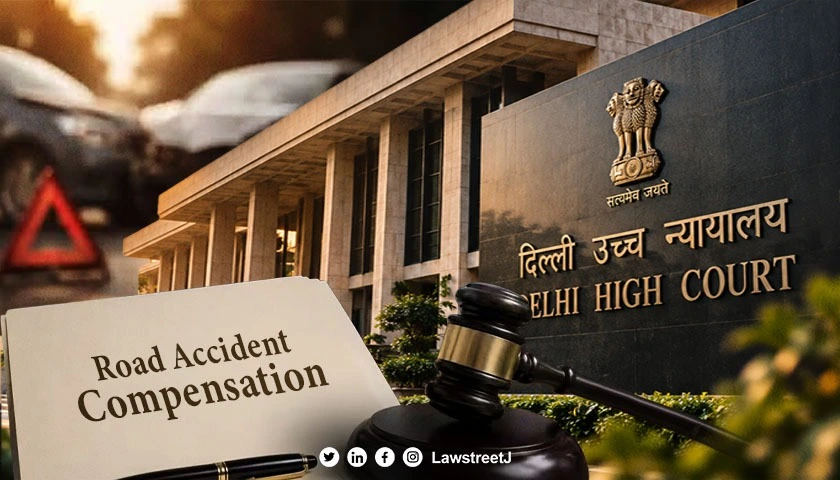
New Delhi: The Delhi High Court has enhanced the compensation payable to a 39-year-old man left in a permanent comatose state after a road accident from ₹1,52,76,996 to ₹4,26,09,147, holding that the amount received under a Mediclaim policy cannot be deducted from compensation under the Motor Vehicles Act, 1988, and that benchmark income of a self-employed claimant should be the average of his last three ITRs. The Court, however, declined to award loss of consortium, holding it is payable only where the victim has died.
Justice Anish Dayal was hearing MAC.APP. 374/2026, filed by Bharat Ghai, through his wife and next friend Harpreet Kaur, against the Motor Accident Claims Tribunal’s award of 16.03.2026 (MACT No. 620/2022, Dwarka Courts), which carried interest at 7.5% per annum. The respondents were the owner of the offending Maruti Swift (Raju Grover, since deceased, through his legal representatives) and Bajaj Allianz General Insurance Company Ltd.
On 11.02.2022, Ghai was opening the rear door of his parked car near the BSF Camp, Chhawala, Najafgarh Road, when the Swift struck him; his head hit the windshield and he was dragged 20–30 feet. He was diagnosed with severe hypoxic brain injury, bed-bound with bowel and bladder involvement, and certified as 100% permanently impaired, with his condition “not likely to improve”. His family includes his wife, two school-going children and an 80-year-old mother.
Income: The Tribunal had taken only the ITR for AY 2021-22 (₹2,48,153), and drew an adverse inference from the non-filing of a return for AY 2022-23. The High Court found this “completely unfair, unjust and illogical”, as the claimant became comatose towards the end of FY 2021-22 and his family could not be expected to piece together his financial records after such a tragedy. Relying on the Supreme Court’s decision in Rashmirekha Tripathy v. Sriram General Insurance Co. Ltd. (2026 SCC OnLine SC 1256), the Court averaged the incomes in the ITRs of AY 2019-20, 2020-21 and 2021-22 (₹7,36,053, ₹5,03,623 and ₹2,48,153) to arrive at ₹4,95,943 per annum. With 40% future prospects, a multiplier of 15 and 100% functional disability, loss of future income was assessed at ₹1,04,14,800.
Mediclaim: Following New India Assurance Company Ltd. v. Dolly Satish Gandhi (2026 SCC OnLine SC 861), the Court set aside the deduction of ₹9,95,015 made on account of the Mediclaim payout. It noted the two amounts stand on different footings, one statutory and the other contractual, the latter being “only a sequitur of premiums having been paid in the past”, and the statutory entitlement under a beneficial legislation “stands on a higher pedestal”.
Medical and care costs: The Tribunal had restricted pharmacy bills of ₹19,76,382 to a lump sum of ₹3,00,000 for want of prescriptions. At the Court’s direction, the claimant’s counsel, Senior Advocate Sanjeev Ralli, furnished a tabulation linking each bill to the medical advice of the treating doctor, Dr. Rana Patir. Satisfied that the invoices were corroborated by that advice, the Court allowed the pharmacy claim in full. Bills from Amazon were not separately allowed because they formed part of continuing expenses covered under future medical expenses, while the Ayurvedic bills and photocopied bills, which were unproved, were rejected.
Observing that the actual and future expenses of a person in a comatose or vegetative state cannot always be “precisely ascertained” and that compensation “cannot be awarded on account of pittance”, the Court applied the multiplier method, following Kajal v. Jagdish Chand (2020) 4 SCC 413 and other Supreme Court rulings. It awarded ₹90 lakh for future medical expenses (₹50,000 x 12 x 15), ₹54 lakh for physiotherapy (₹30,000 x 12 x 15), ₹54 lakh for a full-time trained nurse (₹30,000 x 12 x 15) and ₹35,05,140 for a regular attendant, assessed at the minimum wage of a skilled worker of ₹19,473 per month rather than that of an unskilled worker, with a multiplier of 15.
Loss of consortium: Placing reliance on Maya Singh v. Oriental Insurance Co. (2025 INSC 161), the claimant argued that his coma amounted in practice to a loss of consortium for his family. The Court rejected this. Referring to Pranay Sethi, Nanu Ram and Sameem Begum v. K. Venkat Swamy (2026 SCC OnLine SC 1577), it held:
“A conjoint reading of the aforesaid judgements elucidates the settled position of law that compensation towards loss of consortium is payable in cases involving the ‘death’ of a person.”
Although “deeply sympathetic”, the Court held it would not be appropriate to depart from the principles laid down by the Supreme Court. The claims for loss of amenities, pain and suffering enhancement, homeopathic consultation and future contingent expenses were not pressed.
The enhanced amount of ₹2,73,32,151, with 7.5% interest from the date of filing of the petition, is to be deposited before the MACT within six weeks. Of this, ₹25 lakh with accrued interest is to be released to the claimant within two weeks thereafter, and the balance is to be placed in staggered FDRs of ₹2 lakh each for periods of one month, two months, three months and so on, with the interest credited monthly to the claimant’s savings account. Any balance of the original award is to be released in a lump sum to enable Harpreet Kaur to discharge the borrowing she had incurred, as recorded in the order of 26.05.2026.
Appearances:
For the Appellant: Mr. Sanjeev Ralli, Senior Advocate, with Mr. Chetanya Baweja, Mr. Ravi Kant Yadav and Ms. Nivedita Sharma, Advocates.
For Respondent No. 2 (Insurance Company): Ms. Sunanda Nimisha, Advocate.
Case Title: Bharat Ghai (through his wife Harpreet Kaur) vs. Raju Grover (since deceased) through his LRs & Anr., MAC.APP. 374/2026