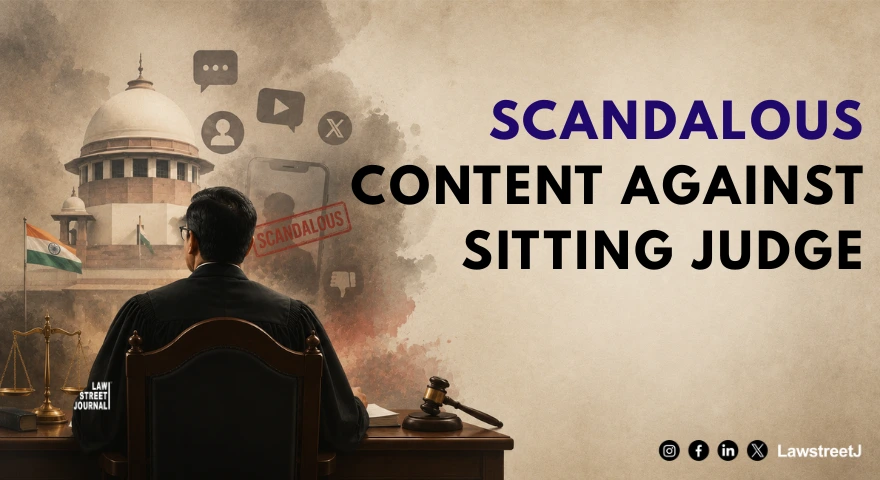
New Delhi: The Delhi High Court has ordered the takedown of videos and posts on social media platforms making scandalous and contumacious allegations against a sitting Judge of the Court, holding that social media intermediaries cannot be silent spectators when content hosted on their platforms is used to interfere with the independence of the judiciary or malign its institutions and individuals.
A Division Bench of Justice Neena Bansal Krishna and Justice Madhu Jain passed the order in a contempt petition filed by the Delhi High Court Bar Association against Dr. Kapil Kakar and others, including Meta Platforms, Google LLC, and LinkedIn.
The petition was filed under Article 215 of the Constitution of India read with Sections 12 and 15 of the Contempt of Courts Act, 1971, seeking initiation of criminal contempt proceedings and immediate takedown of the impugned material.
The Bar Association alleged that Respondent No. 1 had published and circulated videos and posts on Instagram, Facebook, YouTube, and X/Twitter making grave imputations against a sitting Judge of the Court, alleging, inter alia, corruption, collusion, criminality, murder, quid pro quo, and improper motives in relation to judicial proceedings and orders.
The Court noted that the impugned publications did not constitute fair criticism of a judicial order, were ex facie scandalous and contumacious, and were calculated to lower the authority of the Court, undermine public confidence in the administration of justice, and interfere with the independent discharge of judicial functions. It was further alleged that Respondent No. 1 had used the publications to promote his web series, demonstrating that they formed part of a sustained campaign to scandalise the judiciary.
Balancing the right to free speech against the need to protect the dignity of judicial institutions, the Court observed that while any restraint on publication must be exercised with caution given the constitutional guarantee of free speech, that guarantee does not extend to publications which prima facie scandalise the Court, undermine public confidence in the administration of justice, or interfere with the independent discharge of judicial functions.
The Court relied on the Supreme Court’s observations in Morgan Stanley Mutual Fund v. Kartick Das, (1994) 4 SCC 225, Bloomberg Television Production Services India Pvt. Ltd. v. Zee Entertainment Enterprises Ltd., SLP (C) No. 6696/2024, and Amish Devgan v. Union of India, (2021) 1 SCC 1, noting that an ex parte restraint is warranted where material is shown to be ex facie malicious or palpably false, and that the dignity of constitutional institutions is as significant a constitutional value as freedom of expression.
On the liability of intermediaries, the Court invoked Section 79(3)(b) of the Information Technology Act, 2000, which withdraws the safe harbour protection available to intermediaries once they receive actual knowledge that information on their platforms is being used to commit an unlawful act and they fail to expeditiously remove or disable access to such material.
The Court made it clear that as soon as an intermediary gains such knowledge, it comes under a legal obligation to act immediately and cannot wait for directions from courts before doing so.
Counsel for Meta, Google, and LinkedIn appeared on advance notice and undertook to remove all the impugned material forthwith and ensure that similar material is not reposted on their respective platforms.
Additional Solicitor General Mr. Chetan Sharma submitted that such conduct warrants the sternest response as it undermines the dignity of courts and the entire justice delivery system, and that the role of intermediaries in such cases also requires attention, a question under consideration in a writ petition pending before the Chief Justice of the Court.
The Court directed Respondent Nos. 2 to 5 to immediately take down, remove, and disable access to all identified URLs on YouTube, Instagram, X/Twitter, LinkedIn, and Google Drive, as well as the accounts and handles of Respondent No. 1, within 24 hours of receipt of the order.
The platforms were also directed to submit, in a sealed cover, all available subscriber information, including names, email addresses, contact numbers, IP logs, and registration details pertaining to the accounts responsible for uploading the material, within seven days.
The directions further required the platforms to take down any subsequently discovered URLs containing identical, mirrored, or substantially similar content within 24 hours of notification by the Registrar General.
Notice of the contempt petition was directed to be issued to Respondent Nos. 1 and 4, who had failed to appear despite service, returnable on July 9, 2026.
Case Title: Delhi High Court Bar Association v. Dr. Kapil Kakar & Ors. [CONT.CAS.(CRL.) 9/2026]


![Delhi High Court Sets Aside Arbitral Tribunal's Award Against NHAI in Highway Project Delay Case [Read Judgment]](/secure/uploads/2023/07/lj_9605_23374c2e-392c-4491-a2fe-f2f12fc5272f.jpg)
![Delhi Court Rejects Stay Request in Defamation Case Against Rajasthan CM Ashok Gehlot [Read Order]](/secure/uploads/2023/08/lj_5208_80de1ddc-d76a-4f7f-b180-408e3ae14fb4.jpg)