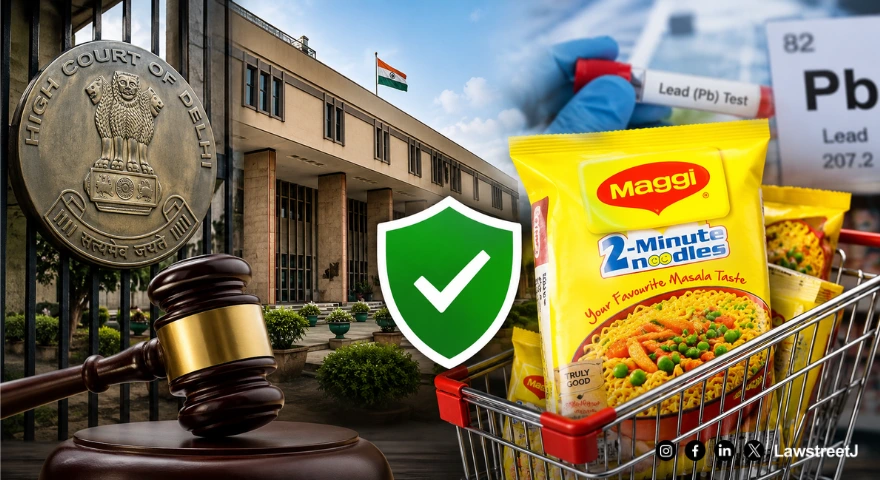
New Delhi: The Delhi High Court has quashed criminal complaints instituted against retailers and other persons in the supply chain of Maggi Noodles over allegedly excess lead content detected during a nationwide sampling exercise in May 2015, holding that permitting the prosecutions to continue would serve no useful purpose after the original test reports were subsequently invalidated by higher judicial scrutiny.
A single-judge bench of Justice Madhu Jain was hearing petitions filed under Section 482 of the Code of Criminal Procedure by Dharmendra Hansraj Kotak and others, seeking quashing of complaints instituted by the Department of Food Safety, Government of NCT of Delhi, along with the orders taking cognizance, issuing summons, and dismissing their discharge applications. The complaints arose after Food Safety Officers collected samples of Maggi Noodles from retail outlets in Delhi in May 2015, which the Food Analyst declared "unsafe" on the ground that lead content in the masala tastemaker exceeded the prescribed limit of 2.5 ppm, with one complaint also alleging misbranding over a "No Added MSG" label.
The petitioners argued that the foundation of the prosecution had collapsed in light of the Bombay High Court's 2015 judgment setting aside the nationwide ban on Maggi Noodles, which had found that the laboratories relied upon were neither NABL-accredited nor notified under Section 43 of the Food Safety and Standards Act. Fresh testing directed by the Supreme Court through the Central Food Technological Research Institute (CFTRI), Mysore a notified Referral Food Laboratory had found lead content within permissible limits, a finding later accepted as conclusive by the National Consumer Disputes Redressal Commission. The State opposed the petitions, contending that the Delhi laboratory was permitted to function under a transitional dispensation pending formal notification, and that the subsequent judgments arose in a different factual context that could not automatically nullify independent local prosecutions.
The Court held that although the power under Section 482 Cr.P.C. must be exercised sparingly, it is well settled that where the "very foundation of the prosecution has ceased to exist," the High Court is justified in quashing criminal proceedings. Noting that the complaints before it arose from the very same nationwide sampling exercise, and that the prosecution did not rely on any independent evidence beyond the Food Analyst's original reports, the Court observed that "once the original analytical reports became the subject matter of judicial scrutiny and fresh testing was directed through a Referral Food Laboratory recognized under the statute, the evidentiary value of the earlier reports necessarily stood diluted."
The Court also relied on subsequent decisions of the Himachal Pradesh and Uttarakhand High Courts, which had taken a similar view in quashing prosecutions arising from the same 2015 sampling exercise once the CFTRI findings were placed on record. Rejecting the State's submission that the criminal complaints must be allowed to proceed independently to trial, the Court held that continuation of the complaints would merely compel the petitioners to undergo a protracted criminal trial despite the scientific foundation of the case having substantially eroded, and that this would amount to an abuse of the process of court.
Accordingly, the Court allowed the petitions and quashed the complaints, the summoning orders dated 06.11.2015 and 11.01.2016, and all consequential proceedings arising therefrom.
Appearances:
For the Petitioners: Mr. Rajesh Batra, Ms. Sonia Kukreja, Mr. Rohit Chandra and Ms. Sadhika Kochhar, Advocates.
For the State: Mr. Digam Singh Dagar, APP.
Case Title: Dharmendra Hansraj Kotak & Ors. vs. State of Delhi & Anr., CRL.M.C. 7013/2022 and CRL.M.C. 328/2023


![Delhi High Court Sets Aside Arbitral Tribunal's Award Against NHAI in Highway Project Delay Case [Read Judgment]](/secure/uploads/2023/07/lj_9605_23374c2e-392c-4491-a2fe-f2f12fc5272f.jpg)
![Delhi Court Rejects Stay Request in Defamation Case Against Rajasthan CM Ashok Gehlot [Read Order]](/secure/uploads/2023/08/lj_5208_80de1ddc-d76a-4f7f-b180-408e3ae14fb4.jpg)