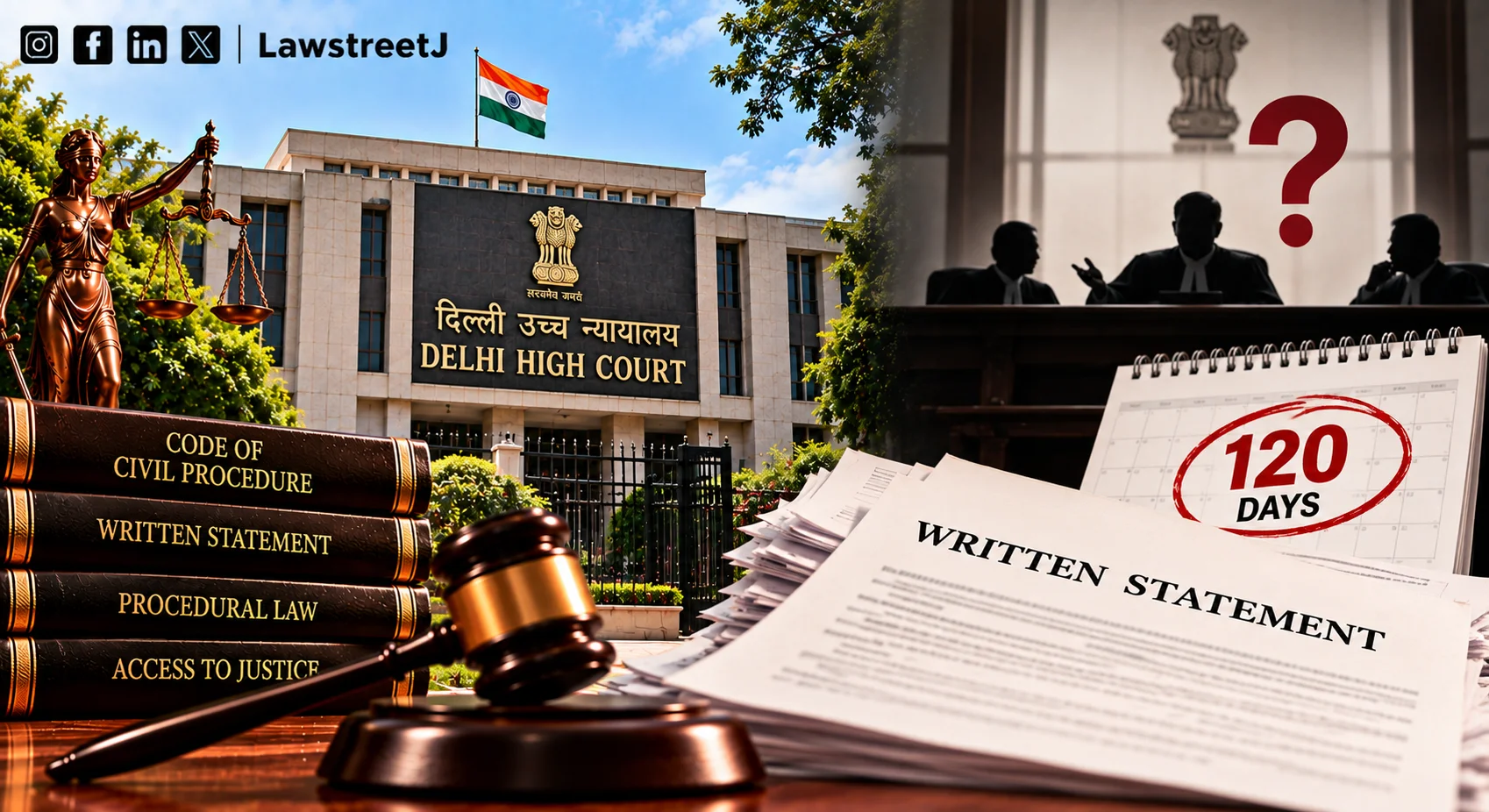
New Delhi: A Division Bench of the Delhi High Court has expressed its inability to agree with three earlier Division Bench judgments holding that Rule 4 of Chapter VII of the Delhi High Court (Original Side) Rules, 2018 is mandatory and that the 120-day period for filing a written statement cannot be extended, taking the prima facie view that the Rule is directory in the same way as Order VIII Rule 1 of the Code of Civil Procedure, and has referred three questions to a Larger Bench through the Chief Justice.
The bench and the appeal
Justice Vivek Chaudhary and Justice Renu Bhatnagar passed the order on 08.10.2026, after reserving it on 03.09.2026, in FAO(OS) 93/2026, along with CM APPL. 55377/2026 and CM APPL. 55376/2026, titled Yogesh Taneja (since deceased through LRs) v. Vijay Taneja (since deceased through LRs). The appeal was heard with Mr. Anshul Sharma and Mr. Vishesh Tomar appearing for the appellant, along with Mr. Anuj Taneja, a legal representative of the appellant, in person, and Mr. Ishaan Seth appearing for the respondent.
Background
The appeal arises out of a suit initially filed as a commercial suit, CS (COMM) No. 236/2024. By an order dated 05.05.2025, the learned Single Judge held that the dispute was not a commercial dispute and directed that it proceed as an ordinary civil suit, which was renumbered CS(OS) No. 367/2025. The written statement was not filed within the prescribed period, and on 20.01.2026 the Joint Registrar (Judicial) closed the appellants' right to file it. The appellants challenged that order by a chamber appeal, which the learned Single Judge dismissed on 23.07.2026, holding that the written statement had not been filed even within the outer limit of 120 days reckoned from 05.05.2025. The present appeal challenges that order.
The question and the rival contentions
The question before the court was whether it has the power to extend the time for filing a written statement under Rule 4 of Chapter VII of the Delhi High Court (Original Side) Rules, 2018 [DHC Rules], which provides that, if the court is satisfied that the defendant was prevented by sufficient cause for exceptional and unavoidable reasons in filing the written statement within 30 days, it may extend the time by a further period not exceeding 90 days, but not thereafter, with costs, the written statement not being taken on record unless costs are paid, and the Registrar being empowered to close the right if no written statement is filed within the extended time.
Counsel for the appellant submitted that the Rule is a rule of procedure which should be interpreted liberally, and that the parallel provision in Order VIII Rule 1 of the Code of Civil Procedure has been interpreted by the Supreme Court as conferring, in appropriate cases, a power to extend the time beyond the prescribed period. Counsel for the respondent relied on the Division Bench judgments in Ram Sarup Lugani & Anr. v. Nirmal Lugani & Ors. (2020), Delhi Gymkhana Club Ltd. v. Col. Ashish Khanna Sm. Retd. & Ors. (2024) and Manhar Sabharwal v. High Court of Delhi & Ors. (2024), which hold Rule 4 to be mandatory, with the total period of 120 days being an outer limit that cannot be extended.
The Supreme Court's view on Order VIII Rule 1
The court compared the two provisions and noted that both deal with the filing of a written statement in a civil suit, prescribe an initial period of 30 days and a further period not exceeding 90 days extendable by the court, with Rule 4 using the words "but not thereafter" and Order VIII Rule 1 providing that the extended period "shall not be later than 90 days". It then reviewed the Supreme Court decisions holding Order VIII Rule 1 to be directory, namely the three-Judge Bench decisions in Kailash v. Nanhku (2005) 4 SCC 480 and Salem Advocate Bar Association v. Union of India (2005) 6 SCC 344, followed in Rani Kusum v. Kanchan Devi, Sambhaji v. Gangabai and Desh Raj v. Balkishan, the only exception being J.J. Merchant (Dr.) v. Shrinath Chaturvedi, which Kailash held to be obiter.
It extracted from those decisions the reasoning that the provision is procedural, that its object is to expedite hearing and curb dilatory tactics and not to scuttle it, that procedure is the handmaid and not the mistress of justice, that the use of the word "shall" is not conclusive, and that Order VIII Rule 10, which gives the court discretion to pronounce judgment or make such other order as it thinks fit when no written statement is filed, must be read harmoniously with Rule 1 so that the 90-day limit is directory. The court noted the Supreme Court's caution that time can be extended only in exceptionally hard cases and not routinely, and its reliance on Topline Shoes Ltd. v. Corpn. Bank, on Raza Buland Sugar Co. Ltd. v. Municipal Board, Rampur on the test for mandatory or directory provisions, and on Sangram Singh v. Election Tribunal, Kotah.
The earlier Division Bench judgments
The court summarised the earlier decisions. Ram Sarup Lugani, dealing with the period for a replication, held that wherever the phrase "but not thereafter" is used in setting a deadline, the intention is to make the provision peremptory, that the DHC Rules prevail over the Code in case of inconsistency, and that inherent powers cannot be used to circumvent the limit. Manhar Sabharwal held that Rule 4 is framed under Section 129 of the CPC and Section 7 of the Delhi High Court Act, that the Original Side Rules, as special law, prevail over the CPC, and that Kailash and Salem Advocate, concerning Order VIII Rule 1, are inapplicable. Delhi Gymkhana Club followed Manhar Sabharwal, holding that the Rule applies to all suits including non-commercial suits and the court can extend the time only up to 120 days.
Why the bench disagreed
The bench held that the language of Rule 4 and Order VIII Rule 1 is parallel and that the minor difference is only cosmetic, with the intent and purpose of both being the same, so that there is no reason for not applying to Rule 4 the principle adopted by the Supreme Court for Order VIII Rule 1, and the only possible interpretation is that Rule 4 is also directory. It accepted that, to the extent the High Court Rules provide a different procedure, the CPC does not apply, but held that where there is no High Court Rule providing a different procedure, the CPC prevails, and that the DHC Rules contain no provision replacing Order VIII Rule 10, which must therefore be read along with Rule 4. It held that merely because the High Court has power to frame its own rules under Section 129 does not mean that the same language is to be interpreted differently.
It held that Ram Sarup Lugani's reliance on Union of India v. Popular Construction Co., which interpreted Section 34(4) of the Arbitration Act, 1996, was misplaced because the procedural law applicable to a tribunal, which under Section 19 of the Arbitration Act is left to the arbitrator's discretion subject to fairness, is vastly different from that for a suit, and because words used in a statute must be understood in their context, citing Naresh Kumar Madan v. State of M.P. on the same term being used in different statutes for different purposes.
The bench also reasoned that the DHC Rules came in 2018, after the 2016 amendment to Order VIII Rule 1 for commercial courts which provided a 120-day limit with forfeiture of the right and a direction that the court shall not allow the written statement to be taken on record, language that is on its face mandatory. Since both the Supreme Court judgments holding Order VIII Rule 1 directory and the mandatory commercial courts proviso were before the High Court, the court reasoned that, in framing the DHC Rules, it did not choose the commercial courts' language but knowingly adopted the language already interpreted by the Supreme Court as directory, so that no different interpretation can now be given.
The Registrar's power and the chamber appeal
On whether the power exercised by the Registrar under Rule 4 is judicial or ministerial, the bench noted that the Rule has two parts, the first using the word "court" for extending time by up to 90 days and the second empowering the "Registrar" to close the right if no written statement is filed within the extended time. It held that the power to extend time vests only with the court, that the Registrar can accept a written statement only within the period provided or extended by the court and, after that, can only close the matter and send it to the court, so that the Registrar's power is ministerial with no attributes of judicial power, and that, consequently, no chamber appeal arises.
The bench noted that the Division Bench in Rahul Gupta v. Pratap Singh & Ors. (2013) had held that a chamber appeal under the Original Side Rules is a misnomer and is in substance a power of review or re-examination of the Registrar's order by the Single Judge. It found that view to be in the teeth of the Supreme Court's decision in State of Orissa v. Commissioner of Land Records and Settlement, Cuttack (1998) 7 SCC 162, which holds that an order of a delegate is treated as an order of the principal, that a review lies before the same authority or Judge who passed the order and not another, and that neither a revision nor a review would lie before the learned Single Judge.
The reference to the Larger Bench
Stating that it was humbly unable to agree with the earlier Division Bench judgments, the bench referred three questions to a Larger Bench. First, whether the Supreme Court judgments on Order VIII Rule 1 in Kailash v. Nanhku, Salem Advocate Bar Association v. Union of India and subsequent decisions declaring it directory apply while interpreting Rule 4 of Chapter VII of the DHC Rules, and whether Ram Sarup Lugani, Delhi Gymkhana Club and Manhar Sabharwal, taking a contrary view, do not lay down correct law. Second, whether, under Rule 4, it is the court alone that can extend the time for filing the written statement, the Registrar having merely ministerial power and no judicial power to receive the written statement within the initial 30 days or the period extended by the court, or whether the Registrar has any power to extend the time for accepting the written statement. Third, whether the law laid down in Rahul Gupta v. Pratap Singh & Ors. is contrary to the law settled in State of Orissa v. Commissioner of Land Records and Settlement, Cuttack and is therefore liable to be overruled.
The court directed that the matter be placed before the Chief Justice for considering the constitution of a Larger Bench on these questions. The order does not decide the appellants' challenge to the closure of their right to file the written statement, which will depend on the answer of the Larger Bench.
Appearances
For the Appellant: Mr. Anshul Sharma and Mr. Vishesh Tomar, Advocates, along with Mr. Anuj Taneja, legal representative of the appellant, in person.
For the Respondent: Mr. Ishaan Seth, Advocate.
Case Title: Yogesh Taneja (since deceased through LRs) vs. Vijay Taneja (since deceased through LRs), FAO(OS) 93/2026


![Delhi High Court Sets Aside Arbitral Tribunal's Award Against NHAI in Highway Project Delay Case [Read Judgment]](/secure/uploads/2023/07/lj_9605_23374c2e-392c-4491-a2fe-f2f12fc5272f.jpg)
![Delhi Court Rejects Stay Request in Defamation Case Against Rajasthan CM Ashok Gehlot [Read Order]](/secure/uploads/2023/08/lj_5208_80de1ddc-d76a-4f7f-b180-408e3ae14fb4.jpg)