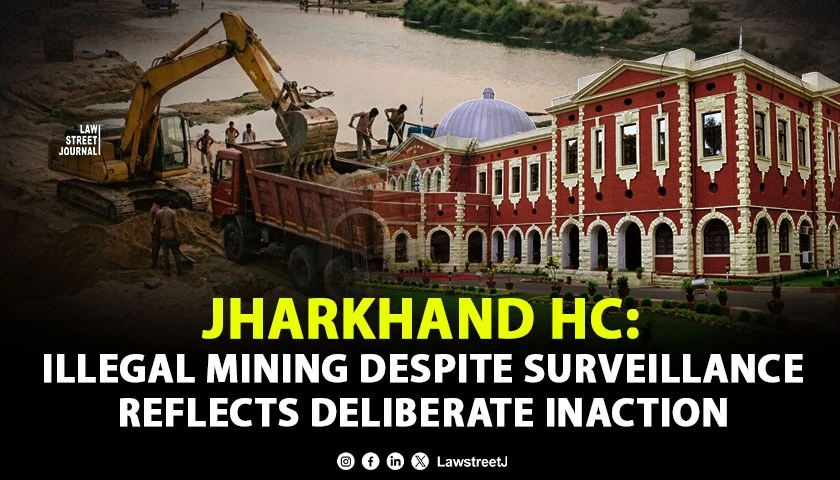
Jharkhand: The Jharkhand High Court has disposed of a decade-old Public Interest Litigation concerning rampant illegal stone mining and the operation of non-compliant crusher units in the Ichak region of Hazaribagh district, issuing fifteen comprehensive directions to the State administration, the District Mining Officer, the Superintendent of Police, and the Jharkhand State Pollution Control Board.
The Division Bench of Chief Justice M.S. Sonak and Justice Rajesh Shankar found that despite the availability of sophisticated surveillance infrastructure, including satellite imagery, geo-tagging, GIS mapping, and GPS-based vehicle tracking, the authorities had persistently failed to curb illegal extraction activities. The Court observed that this continued failure, despite the technological capacity to detect and prevent such activities, could only be interpreted as a deliberate and wilful closing of institutional eyes.
The petition was filed by Hemant Kumar Shikarwar in 2013, seeking, inter alia, directions to stop illegal mining in and around the Siwane River in the Ichak Police Station area, to direct the Jharkhand State Pollution Control Board to submit a status report on pollution, and to take effective coercive action against stone crusher units operating without valid explosive licences, mineral dealer registrations, or mandatory environmental clearances. The petitioner alleged that these units were operated by local mafias in active collusion with the District Mining Officer, and that residents who raised complaints were threatened with dire consequences.
The Court opened its judgment with an evocative account of Hazaribagh’s historical identity as a “city of a thousand gardens,” noting that the region’s name derives from the Persian words “Hazar” (thousand) and “Bagh” (garden). Once a pristine expanse of biodiversity on the Chotanagpur plateau, its forests had been meticulously preserved by local rulers and served as a sanctuary for tigers, leopards, and bears. The Court observed that while the colonial era initiated the depletion of these woodlands through the construction of military roads and railways, rampant illegal stone mining in the Ichak region has today scarred the very hills that once formed a sanctuary, replacing gardens with craters.
On the constitutional framework, the Court reiterated that the right to a clean, healthy, and pollution-free environment is an integral part of the fundamental right to life under Article 21, relying on Subhash Kumar v. State of Bihar, (1991) 1 SCC 598; M.C. Mehta v. Union of India, (1987) 4 SCC 463; and Virender Gaur v. State of Haryana, (1995) 2 SCC 577. The Court further noted that Articles 48A and 51A(g) of the Constitution have been read harmoniously with Article 21 to impose a constitutional obligation upon the State to prevent environmental degradation, as crystallised in Vellore Citizens Welfare Forum v. Union of India, (1996) 5 SCC 647, wherein the doctrines of sustainable development and the precautionary principle were incorporated into Indian environmental jurisprudence.
The Court rejected the petitioner’s claim that Village Tepsa falls within a designated Eco-Sensitive Zone, noting that under Notification No. 2775(E) dated 01.08.2019 issued by the Ministry of Environment, Forest and Climate Change, Tepsa does not appear in the list of eco-sensitive villages within the Ichak administrative block.
The Court held that the plea for an absolute ban on mining solely on that basis could not be sustained. However, it clarified that the absence of a “protected” label does not grant a licence for ecological destruction, and that the State’s overarching duty to prevent environmental degradation remains undiminished. The Court further reiterated that the one-kilometre buffer zone from the boundary of the Hazaribagh Wildlife Sanctuary, mandated by the Supreme Court in T.N. Godavarman Thirumulpad v. Union of India, (2022) 10 SCC 544, would continue to apply, with any larger prescribed buffer zone taking precedence.
The Court also reiterated the directions issued in W.P. (PIL) No. 3950 of 2024, holding that the Jharkhand State Pollution Control Board shall not grant Consents to Establish or Consents to Operate within 500 metres of forest boundaries for stone mining operations, and within 400 metres for stone crusher units. These restrictions, the Court directed, must be strictly enforced across Hazaribagh district.
On the enforcement record, the Court found a significant disconnect between paper compliance and field reality. While the respondent authorities had cited the registration of multiple FIRs against defaulters, no material was placed before the Court to indicate that any of these FIRs had culminated in actual prosecutions or trials. The District Mining Officer had also failed to apprise the Court of a single complaint initiated under Section 22 of the Mines and Minerals (Development and Regulation) Act, 1957. Further, the affidavits remained conspicuously silent on whether confiscation proceedings had been initiated before the jurisdictional Magistrate.
The Court relied on State (NCT of Delhi) v. Sanjay, (2021) 2 SCC 670, wherein the Supreme Court held that prosecutions under the Indian Penal Code and the MMDR Act are simultaneously maintainable, since dishonestly removing minerals from State property constitutes theft independent of MMDR violations. The Court observed that the failure to invoke the full breadth of statutory powers undermined any claim of effective intervention.
The Court was particularly critical of the Jharkhand State Pollution Control Board. As the apex nodal body for environmental management in the State, its submissions were notably silent on whether stone crusher units complied with the national guidelines issued by the Central Pollution Control Board. Invoking the Polluter Pays Principle as recognised in Indian Council for Enviro-Legal Action v. Union of India, (1996) 3 SCC 212, and the recent Supreme Court judgment in Delhi Pollution Control Committee v. Lodhi Property Co. Ltd., (2026) 2 SCC 670, the Court noted that Pollution Control Boards are empowered to impose restitutionary or compensatory damages under Section 33A of the Water Act and Section 31A of the Air Act independently of criminal proceedings. The Court held that the Board’s inaction amounted to a clear abdication of its statutory duties.
Perhaps the most harrowing aspect highlighted by the Court concerned the human cost of abandoned mining pits. Photographs annexed to the counter-affidavit filed by the District Mining Officer, along with the report submitted by the Secretary, District Legal Services Authority, Hazaribagh following a surprise inspection conducted in August 2025, depicted mining pits left open and filled with stagnant rainwater. The Court described these pits as deceptive “death traps” situated within village precincts.
The Court held that a mining pit left open and filled with water is not merely an environmental violation but a ticking time bomb, and that the State’s duty under Article 21 necessarily extends to preventing such avoidable fatalities.
The Court was scathing in its assessment of official complicity, observing that large-scale unauthorised quarrying involving heavy earth-moving machinery, extensive labour deployment, and transportation through public roads and checkpoints could not have continued without the knowledge of the authorities entrusted with preventing it. The Court remarked that enforcement agencies appeared to have developed expertise in issuing paper assurances, shifting blame, and avoiding meaningful enforcement, secure in the belief that such dereliction rarely results in disciplinary consequences or impacts promotions and career progression. While declining to adjudicate allegations of collusion for extraneous considerations within the present proceedings, the Court observed that such allegations could not be entirely dismissed given the scale of the violations and the lukewarm official response.
In its operative directions, the Court mandated the District Level Task Force, chaired by the Deputy Commissioner, to hold monthly meetings and upload the minutes of each meeting within seven days. The Court further directed that all statutory permissions granted in the affected area be comprehensively reviewed within eight weeks, and ordered that no mining activity or operation of stone crusher units shall recommence without a specific and reasoned clearance certifying full statutory compliance.
The Court also directed the establishment of a technology-driven enforcement mechanism within twelve weeks, including the installation of high-resolution Wi-Fi-enabled CCTV cameras along transit routes, mandatory GPS tracking of heavy machinery, and geo-fencing protocols capable of generating automated alerts. Directions were further issued for the creation and wide publicity of a dedicated helpline and official email address within four weeks for reporting instances of illegal mining.
Additionally, the District Mining Officer was directed to initiate formal complaints under Sections 21 and 22 of the MMDR Act within eight weeks against all persons found involved in illegal extraction activities, and to commence recovery proceedings under Section 21(5) for the value of illegally extracted minerals. The Jharkhand State Pollution Control Board was likewise directed to initiate criminal prosecution against all non-compliant units within four weeks and to assess and impose environmental compensation in accordance with the Polluter Pays Principle within twelve weeks.
The Court further directed the District Mining Officer to ensure reclamation of all closed, abandoned, or illegally operated mines within eight weeks. Finally, individual compliance reports were ordered to be filed before the Court within four months by the Deputy Commissioner, Superintendent of Police, District Mining Officer, and the Regional Officer of the Pollution Control Board, with the Court expressly stipulating personal accountability for any failure or delay in compliance.
For the Petitioner: Mr. Vijay Narayan Singh, Advocate
For the State: Mr. Gaurav Raj, AC to AAG-II
For Respondent Nos. 5–7 (Pollution Control Board): Mr. Prabhash Kumar, Advocate; Mr. Manish Sharma, Advocate
Case Title: Hemant Kumar Shikarwar v. The State of Jharkhand and Others [W.P. (PIL) No. 290 of 2013]


![Supreme Court Collegium approves new Chief Justices for five key High Courts in India [Read Recommendations]](/secure/uploads/2023/12/lj_8000_380d1135-6f3a-4988-a00a-4d5cd5901815.jpg)
!['Arbitrary, impermissible,' SC quashes HC's resolution raising aggregate cut off marks on district judges appointment [Read Judgment]](/secure/uploads/2024/02/lj_3605_Rule-for-Judge-Selection.webp)