


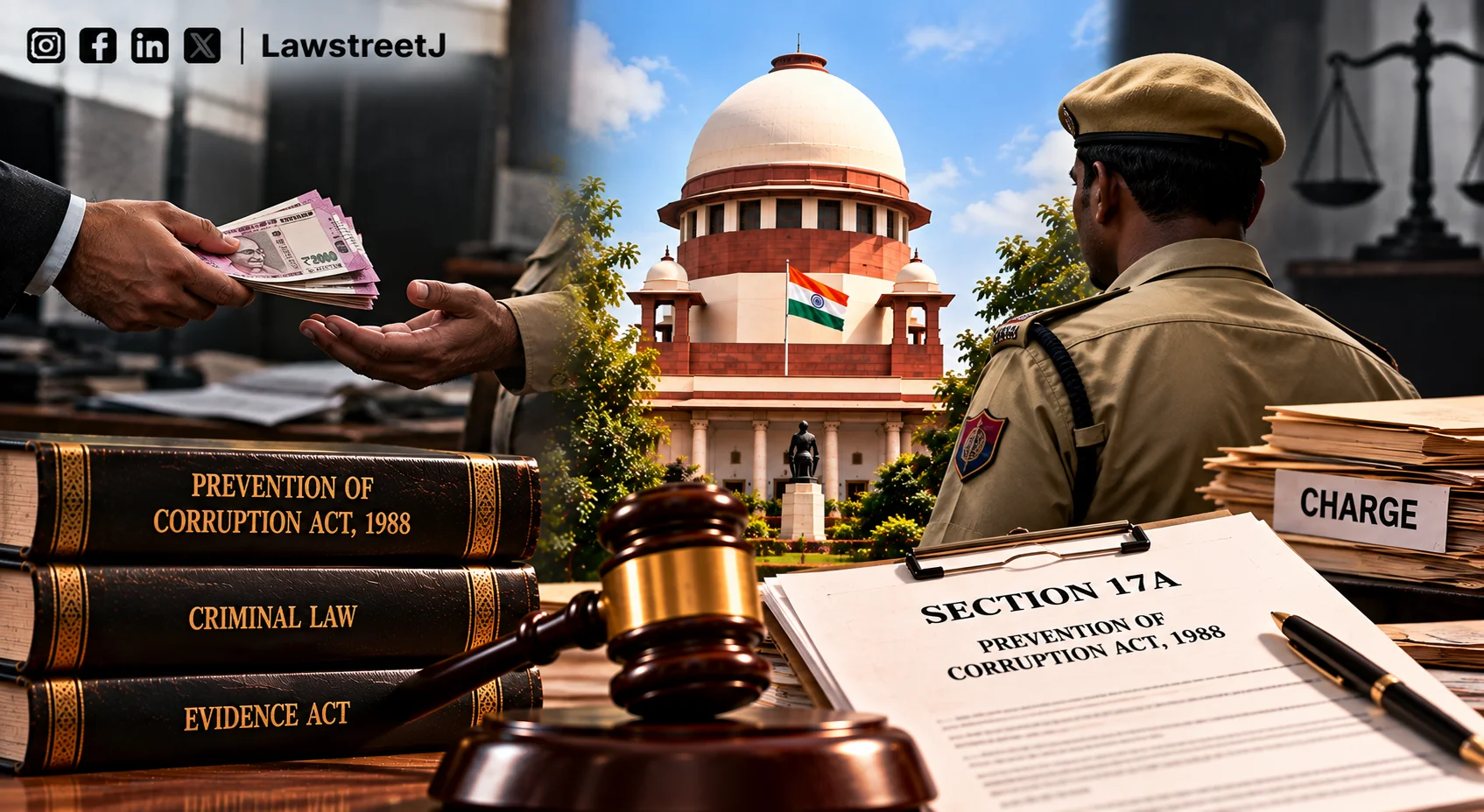
New Delhi: The Supreme Court has held that Section 17A of the Prevention of Corruption Act, 1988, which requires prior approval before investigating a public servant, does not apply to allegations of demanding illegal gratification, as such an act is unconnected with the discharge of official functions, and has dismissed an appeal by a Rajasthan police constable challenging the framing of charge against him.
A Bench of Justice S.V.N. Bhatti and Justice N.V. Anjaria was hearing an appeal by Tejaram against the Rajasthan High Court's judgment dated 26.03.2025, which had dismissed his revision petition against the order dated 12.09.2024 of the Special Judge, Anti-Corruption Bureau, Pali, framing a charge under Section 7 of the PC Act in Sessions Case No. 2 of 2024.
The appellant was a constable posted at the office of the Deputy Superintendent of Police, Sirohi. According to the appellant, he had alleged that a fellow constable, the complainant, had taken illegal gratification to let accused persons escape, and the complainant in retaliation sent a false e-mail dated 22.04.2021 to the Anti-Corruption Bureau alleging that the appellant had demanded a bribe of Rs. 1.5 lakh on behalf of the Superintendent of Police. FIR No. 174 of 2021 was registered on 04.06.2021, and the appellant was arrested on 01.09.2021. Sanction for prosecution under Section 19 of the PC Act was granted on 08.12.2023, and a chargesheet was filed on 19.01.2024.
Senior Advocate Abhimanyu Bhandari, for the appellant, argued that Section 17A is mandatory and bars any enquiry or investigation against a public servant for acts in discharge of official functions without prior approval, and that the lack of approval could not be cured later. He relied on Yashwant Sinha v. CBI and pointed out that the question whether Sections 17A and 19 are procedural or substantive is pending in B.S. Yeddiyurappa v. A. Alam Pasha. He also contended that the High Court wrongly relied on Nara Chandrababu Naidu v. State of Andhra Pradesh.
Additional Advocate General Sansriti Pathak, for the State of Rajasthan, argued that Section 17A gives no blanket immunity and does not protect acts that are criminal in nature or unrelated to official duty. She submitted that the case involved a demand for illegal gratification, which is not relatable to any recommendation or decision in discharge of official duties, and that the appellant had never challenged the FIR. She added that the reference of the validity of Section 17A to a larger Bench on 13.01.2026 in Centre for Public Interest Litigation v. Union of India was irrelevant, as the provision was not attracted at all.
Writing the judgment, Justice Anjaria noted that Section 17A bars a police officer from conducting any enquiry or investigation into an offence alleged against a public servant, where the offence is relatable to any recommendation made or decision taken in discharge of official functions or duties, without previous approval of the competent authority. The first proviso exempts cases of arrest on the spot for accepting or attempting to accept an undue advantage.
The Court relied on its earlier rulings in CBI v. Santosh Karnani, Surendra Dhariwal v. State of Rajasthan and Anil Daima v. State of Rajasthan. In Santosh Karnani, it had held that a person accused of demanding a bribe needed no prior approval, as the accusation did not revolve around any recommendation or decision. In Anil Daima, the Court had held that Section 17A cannot be applied to cases of demand of illegal gratification. The Bench also referred to Kerala High Court rulings holding that offences such as misappropriation, cheating and receiving bribes lie beyond the scope of the provision.
Holding the judicial view to be consistent and categorical, the Court observed that the decisive phrase in Section 17A is “discharge his official functions or duties,” and that the provision cannot have omnibus application. For it to apply, there must be a decision or recommendation by the public servant in discharge of official duties. The Court held that “The act of demanding a bribe is a pure criminal act” unconnected with official functions and not relatable to any decision or recommendation of the appellant, and therefore falls outside the protective umbrella of Section 17A.
On the pending larger Bench reference on the validity of Section 17A, the Court held that it had no connection with the present case, which could be decided without awaiting it since the provision had no applicability at all. It also rejected the argument that the sanction under Section 19 was belated, holding that since it was granted before cognizance was taken, any delay would at most be an irregularity that does not vitiate the proceedings, and that the trial would proceed on merits.
Upholding the High Court's judgment, the Bench ruled that Section 17A would not be attracted in the facts of the case and that want of prior approval under it did not vitiate the initiation of criminal proceedings. The appeal was dismissed, and pending interlocutory applications did not survive.
Appearances:
For the Appellant: Mr. Abhimanyu Bhandari, Senior Advocate.
For the State of Rajasthan: Ms. Sansriti Pathak, Additional Advocate General.
Case Title: Tejaram vs. State of Rajasthan, Criminal Appeal arising out of SLP (Crl.) No. 11709 of 2025


.jpeg)

.jpeg)

