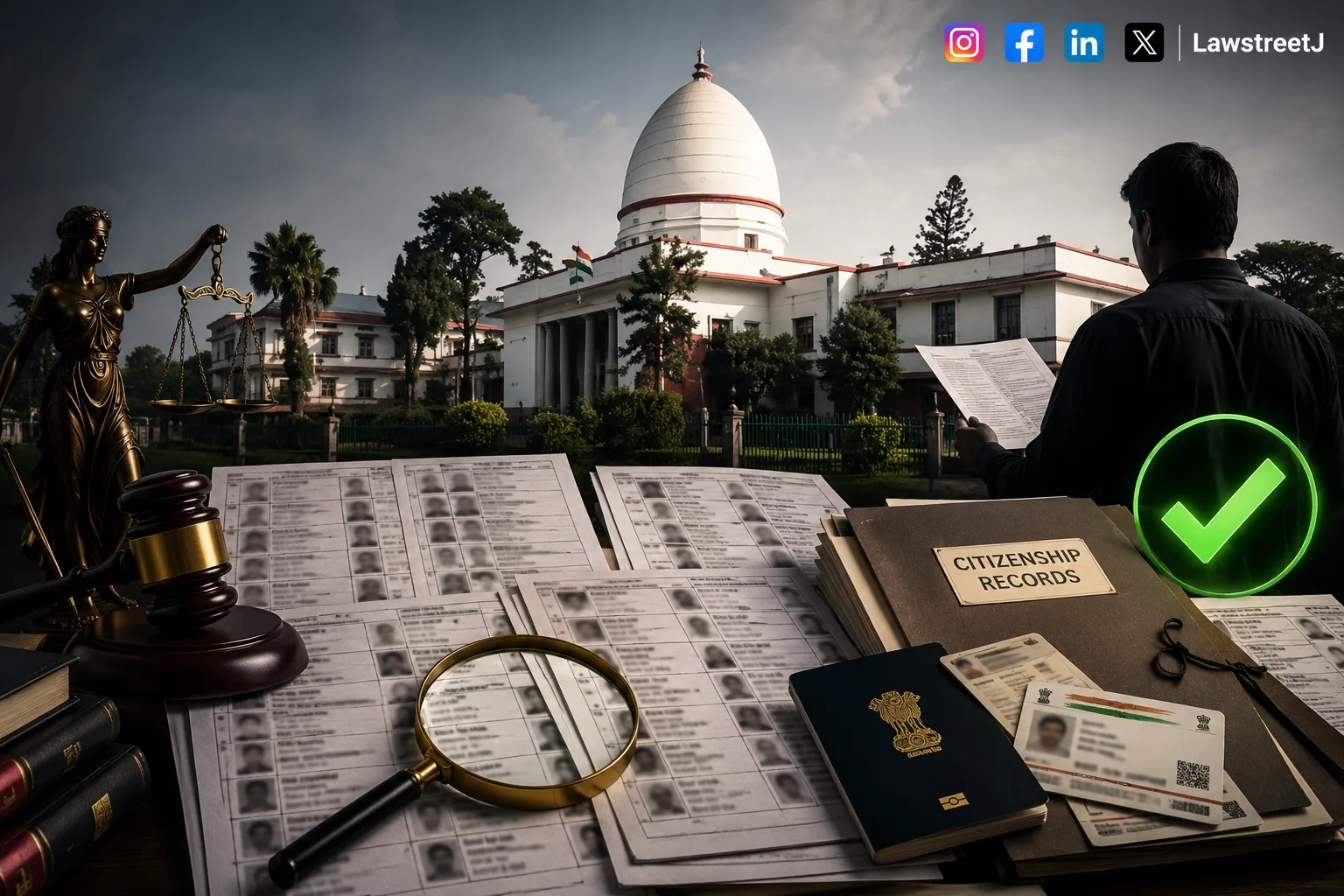
Guwahati: The Gauhati High Court has upheld an opinion of the Foreigners Tribunal declaring a man to be a foreigner, holding that despite exhibiting fifteen documents spanning over six decades, he had failed to discharge his burden under Section 9 of the Foreigners Act, 1946 to prove that he is an Indian citizen and not a foreigner.
A Division Bench of Justices Kalyan Rai Surana and Shamima Jahan was hearing a writ petition filed by Aminul Hoque, challenging the opinion passed by the Member, Foreigners Tribunal No.4, Kamrup (M), Guwahati, which had declared him a foreigner pursuant to a reference forwarded by the Deputy Commissioner of Police, Kamrup (M).
The petitioner had claimed descent from one Pasan Ali, whose name he traced through the NRC of 1951, voter lists spanning 1966 to 2017, a land purchase deed of 1973, a school certificate, his PAN card and Electoral Photo Identity Card, contending that his family had shifted across three villages, Dhobakura, Ghugudoba and Hashdoba, due to river erosion and family separation.
The Tribunal had rejected the NRC of 1951 as an unproved photocopy and computer-generated document, discarded the 1973 sale deed for want of explanation as to why the land never devolved on the petitioner's family, and found recurring age discrepancies in respect of the petitioner's mother across successive voter lists. It further found that the family names did not appear consistently across the three villages claimed, and that the school certificate was never proved by examining its author.
Before the High Court, counsel for the petitioner relied on the Supreme Court's ruling in Sirajul Hoque versus State of Assam, contending that minor discrepancies in the names of ancestors could not be a ground to declare a person a foreigner once the identity of the family stood otherwise established. Reliance was also placed on a Bombay High Court ruling in Shital Krushna Dhake versus Krushna Dagdu Dhake to argue that computer-generated NRC extracts ought not to be disbelieved.
Rejecting this argument, the court held that the Bombay High Court decision was rendered on its own facts and was not an authority for treating computer-generated printouts as admissible evidence without compliance with Section 65-B of the Evidence Act, 1872, corresponding to Section 63(4) of the Bharatiya Sakshya Adhiniyam, 2023, citing the Supreme Court's decision in Anvar P.V. versus P.K. Basheer. The court remarked that the submission “exposes the ignorance of the learned counsel for the petitioner in respect of manner and mode of proof of an electronic and/or computer generated document.”
The court further held, relying on its earlier decisions in Abdul Mojid versus Union of India and Ahitan Nessa versus Union of India, that NRC extracts produced to prove domicile were inadmissible in evidence, being census records protected under Section 15 of the Census Act, 1948, apart from being unproved electronic records.
Examining the voter lists exhibited by the petitioner, the court found no set of family members appearing consistently across the three villages, and noted specific inconsistencies, including in the recorded age of the petitioner's mother, which stood at 25 years in the 1979 list, 39 years in the 1997 list, and 25 years again in the 2005 list. The court held that the petitioner's case of the family repeatedly shifting villages appeared to have been structured around the exhibited voters' lists to fill up the gaps rather than supported by independent evidence.
On the petitioner's PAN card and EPIC, the court reiterated its settled position that these documents are not proof of citizenship, particularly where issued on the basis of self-declaration and unsupported by income tax records, relying on its earlier ruling in Md. Babul Islam versus Union of India. The court also held that the oral testimony of the petitioner's father, examined as DW-2, could not by itself establish the family link, citing its decisions in Basiron Nessa versus Union of India and Bijoy Das versus Union of India, both of which require citizenship claims to rest on admissible documentary evidence.
Reiterating the limited scope of certiorari jurisdiction under Article 226, the court relied on the Supreme Court's ruling in Central Council for Research in Ayurvedic Sciences versus Bikartan Das, and on the Constitution Bench decision in Hari Vishnu Kamath versus Ahmad Ishaque, to hold that only a manifest and patent error of law, not a mere wrong decision, warrants interference in writ jurisdiction.
Finding no such patent error in the Tribunal's appreciation of the pleadings and evidence, the High Court dismissed the writ petition, holding that the consequences of the opinion declaring the petitioner a foreigner would follow, and directed that a copy of the judgment be transmitted to the Tribunal for its record.
Appearances: Mr. M.U. Mahmud, Advocate, appeared for the petitioner. Mr. B. Deka, CGC, appeared for respondent no.1; Mr. A.I. Ali, Standing Counsel, appeared for respondent no.2; Mr. J. Payeng, Standing Counsel, appeared for respondent nos. 3, 4 and 6; and Ms. R.B. Bora, Government Advocate, appeared for respondent nos. 5, 7 and 8.
Case Title: Aminul Hoque versus The Union of India and 7 Ors.


![Justice Nongmeikapam Kotiswar Singh appointed as acting Chief Justice of Gauhati High Court [Read Press Release]](/secure/uploads/2023/01/lj_9707_5c969d0f-570f-400a-ba8b-3b65cf825540.jpg)
![Collegium Recommends Chief Justices of Delhi, Rajasthan, and Gauhati High Courts for Elevation to Supreme Court [Read Order]](/secure/uploads/2023/11/lj_9736_933a94de-bdaf-43de-944b-b0e58e17edb5.jpg)
![Supreme Court Mandates Strict Scrutiny in Sexual Harassment Allegations at Work [Read Judgment]](/secure/uploads/2023/11/lj_3478_eef290f2-6acf-4296-9ee0-adf54f275609.jpg)