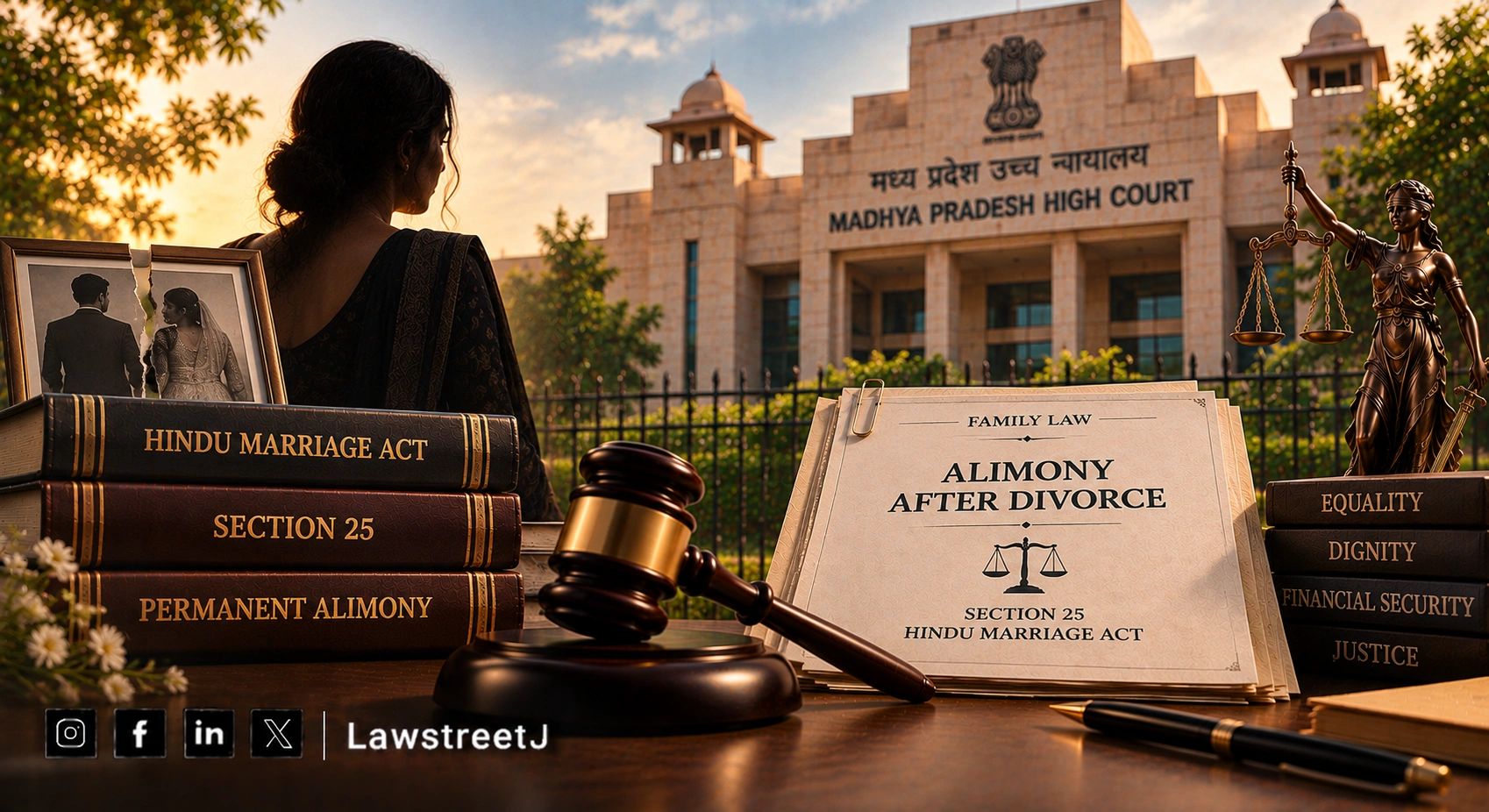
Jabalpur: The Madhya Pradesh High Court at Jabalpur has disposed of an appellant-wife's miscellaneous appeal by granting her liberty to file a fresh application for permanent alimony under Section 25 of the Hindu Marriage Act, 1955, holding that a decree of divorce already passed does not by itself preclude a party from seeking such relief subsequently.
Justice Ramkumar Choubey was hearing a miscellaneous appeal filed by the appellant-wife under Order 43 Rule 1(d) of the Code of Civil Procedure, 1908, against the order passed by the Second Additional District Judge, Waraseoni, District Balaghat, dismissing her application under Order IX Rule 13 of the CPC to set aside an ex-parte judgment and decree passed against her in a matrimonial proceeding instituted by the respondent-husband under the Hindu Marriage Act, 1955.
At the outset, counsel for the appellant submitted that the respondent-husband had already remarried after obtaining the decree of divorce, and that, having regard to the age of the parties and the circumstances, the appellant was not interested in pursuing the matter insofar as the decree of divorce was concerned. It was submitted, however, that the matrimonial Court had not considered the question of alimony in her favour, and that the matter be remitted for consideration of that question. Counsel for the respondent submitted that the respondent had already given some property to the child of the parties and was paying Rs. 5,000 per month pursuant to an order under Section 125 of the Code of Criminal Procedure, and that the appellant could proceed independently before the matrimonial Court for alimony if she was not challenging the divorce.
Since the appellant did not press her challenge to the ex-parte decree of divorce, the Court found no necessity to remit the matter for restoration or further adjudication on that count. However, noting that the question of alimony had not been considered by the matrimonial Court while passing the judgment and decree, the Court examined the scope of Section 25(1) of the Hindu Marriage Act, which empowers the court to order permanent alimony and maintenance “at the time of passing any decree or at any time subsequent thereto.”
Relying on its earlier decision in Surajmal Ramchandra Khati v. Rukminibai d/o Prabhulal, the Court held that the expression "on application made to it" in Section 25(1) cannot be read narrowly, and that a separate formal application is not invariably required, the provision being intended to protect the interest of the spouse against whom a decree has been passed. The Court also drew support from the Gujarat High Court's decision in Patel Dharamshi Premji v. Bai Sakar Kanji, which held that an application for permanent alimony may be made before, at the time of, or at any time subsequent to the passing of the decree, and that the applicant need not continue to occupy the status of wife or husband on the date of the application.
On this basis, the Court held that the passing of the decree of divorce did not, by itself, preclude the appellant from seeking permanent alimony under Section 25, and that the matrimonial Court remained competent to consider such an application and pass an appropriate order after taking into account the relevant factors under that provision.
Accordingly, while declining to remit the matter for restoration or further hearing on the decree of divorce, the Court granted the appellant liberty to file an application under Section 25 of the Hindu Marriage Act before the matrimonial Court, to be decided after hearing both parties, in accordance with law.
The appeal was accordingly disposed of with the aforesaid liberty.
Appearances:
Shri Pradeep Kumar Naveria, Advocate for the appellant; Shri Rahul Kumar Tripathi, Advocate for the respondent.
Case Title: UB vs. LB, Misc. Appeal No. 2136 of 2016


![High Court Prohibits Compulsion of Hijab and Islamic Texts on Students of Different Faiths at Ganga Jamuna School [Watch Video]](/secure/uploads/2023/09/lj_5754_f71da9b5-c632-4d0b-94b8-6f36245eb157.jpg)
.jpeg)