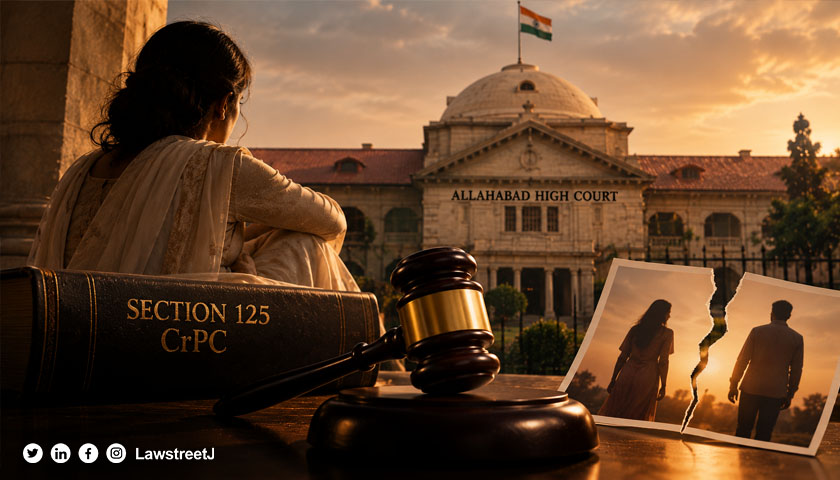
Lucknow: The High Court of Judicature at Allahabad, Lucknow Bench, has set aside an order of the Family Court, Sultanpur rejecting a wife's maintenance claim under Section 125 CrPC, holding that even where a decree of divorce has been passed against a wife on the ground of desertion, she does not cease to be a "wife" for the purposes of Section 125 and remains entitled to maintenance unless she has remarried or is shown to be capable of maintaining herself.
Justice Ram Manohar Narayan Mishra was hearing a criminal revision filed under Section 19(4) of the Family Courts Act, 1984 by Smt. Suneeta against the order dated 22.12.2018 of the Principal Judge, Family Court, Sultanpur, whereby her maintenance petition under Section 125 CrPC, initially filed in 2009 and later transferred as Maintenance Case No. 1304 of 2014, had been dismissed.
As per the revisionist's case, her marriage with the opposite party was solemnized in her childhood, and she was sent to her matrimonial home in a gauna ceremony after nine years, following which her husband, employed in the EME Corps of the Indian Army, began facing her with demands for dowry and, in February 2007, allegedly attempted to set her ablaze. She further alleged that in 2008 her husband began an illicit relationship with another woman, brought her to his parental home, and thereafter refused to maintain the revisionist or their minor son, Ayush. The opposite party denied these allegations, contending that the revisionist herself had deserted the matrimonial home and that a compromise had been executed before the police in 2007.
The Family Court had dismissed the maintenance petition primarily on the ground that the revisionist failed to prove sufficient cause for living separately, noting inconsistencies in her pleadings and the fact that 15% of the opposite party's army salary was already being remitted towards maintenance. Examining the record, the High Court found that this 15% deduction, sanctioned under Army Rule 193 from October 2008, had in fact been credited for the maintenance of the minor son, Ayush, and continued only till the opposite party's discharge from service in December 2018, after which army authorities informed the revisionist that no maintenance could be paid from a pensioner's dues.
The Court also noted that the opposite party had, in the interregnum, obtained an ex-parte decree of divorce dated 25.09.2014 under Section 13 of the Hindu Marriage Act on the ground of the revisionist's desertion, and had subsequently remarried, a fact corroborated by his own brother's testimony and his service records listing a second wife.
Relying on the Supreme Court's decision in Rohtash Singh v. Smt. Ramendri, the Court held that by virtue of Explanation (b) to Section 125(1) CrPC, a woman divorced by her husband continues to enjoy the status of "wife" for the limited purpose of claiming maintenance, and that even a decree of divorce granted on the ground of her desertion does not, by itself, disentitle her to maintenance as a divorced wife, though it may affect her entitlement for the period prior to the decree.
The Court observed: “the revisionist is entitled to receive maintenance from her husband from the date of divorce i.e. 25.09.2014 onwards during her life till she gets remarried.”
Holding that the Family Court's blanket rejection of the maintenance claim was vitiated by legal and factual error, the High Court ruled that the son, Ayush, remained entitled to maintenance till attaining majority, excluding the period during which he had already received maintenance through army authorities, while the revisionist herself was entitled to maintenance from the date of the divorce decree onward, since no independent income had been proved against her. The parties were directed to file affidavits of assets, income and liabilities before the Family Court in compliance with the Supreme Court's directions in Rajnesh v. Neha, (2021) 2 SCC 324.
Accordingly, the impugned order was set aside and the matter remitted to the Family Court for fresh decision within six months, with a direction that the opposite party continue paying Rs.4,000/- per month as interim maintenance pending the rehearing, to be adjusted against any arrears eventually awarded. The revision was allowed in these terms.
Appearances:
For the Revisionist: Mr. Shankar Lal Pandey, Advocate (heard); with Mr. Kanhaiya Lal, Mr. Ajay Kumar and Mr. Saddam Khan, Advocates.
For the Opposite Parties: Learned A.G.A. for the State; Mr. Gaurav Pandey, Mr. Manmohan Singh and Mr. Sandeep Kumar Ojha, Advocates.
Case Title: Smt. Suneeta vs. State of U.P. and Anr., Criminal Revision No. 254 of 2019



!["No Loudspeakers For Azan, No Fundamental Right To Create Noise," Says Allahabad HC To Two Mosques [Read Judgment]](/secure/uploads/2020/01/lj_4995_Allahabad_HC_AZAN.jpg)