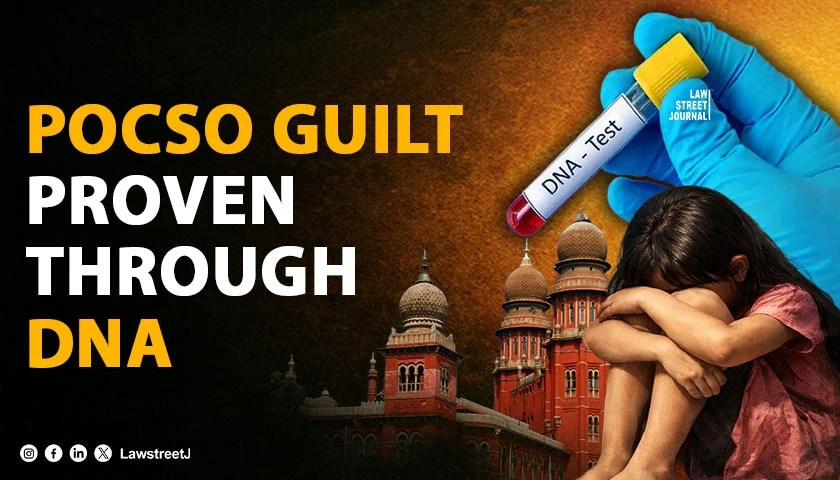
Chennai: The Madurai Bench of the Madras High Court has held that a DNA report conclusively establishing paternity can, by itself, sustain a conviction under the Protection of Children from Sexual Offences Act, 2012 (POCSO Act), even when the victim and her parents turn hostile during trial.
A Division Bench of Justices N. Anand Venkatesh and K.K. Ramakrishnan delivered the judgment on June 5, 2026, while dismissing an appeal filed by a man convicted of sexually assaulting a 13-year-old girl.
According to the prosecution, the appellant, then around 40 years old, committed penetrative sexual assault on the minor victim and threatened her not to disclose the incident. Based on a complaint lodged by the victim’s mother, police registered an FIR under the POCSO Act and the Indian Penal Code.
Medical examination revealed that the victim was five weeks pregnant. Her statement was recorded before a Judicial Magistrate. After the chargesheet was filed, the victim gave birth to a child. As the child was born after the filing of the chargesheet, DNA evidence was not part of the original chargesheet. Following directions from the Child Welfare Committee, blood samples of the accused, the victim, and the child were collected for DNA testing. The report confirmed that the accused was the biological father of the child.
Before the High Court, the appellant argued that the conviction could not be sustained because the victim and her parents had not supported the prosecution during trial. He further questioned the chain of custody of the DNA samples, the manner in which the DNA report was proved, and the non-supply of DNA-related documents under Section 207 of the Code of Criminal Procedure.
Rejecting these submissions, the Court found no material to suggest any tampering with the samples. It noted that the accused had not challenged the chain of custody during cross-examination and had been given sufficient opportunity to question the forensic expert regarding the DNA report. The Court also observed that the accused had access to the DNA-related documents and had relied upon them during cross-examination.
The Bench distinguished the Supreme Court’s decision in Karandeep Sharma v. State of Uttarakhand, relied upon by the appellant, noting that the serious procedural defects present in that case were absent here.
Upholding the conviction, the Court held that the DNA report conclusively established that the appellant was the biological father of the child born to the minor victim.
However, the Court modified the conviction from Section 5(l) of the POCSO Act, which deals with repeated assaults, to Section 5(j)(ii), which applies where penetrative sexual assault results in a child’s pregnancy. The conviction under Section 506 IPC was set aside as the allegation of criminal intimidation was not independently proved after the victim turned hostile.
The Court also reduced the sentence from life imprisonment to rigorous imprisonment for a term of not less than twenty years under Section 6 of the POCSO Act.
Case Title: Murugan v. The State rep. by the Inspector of Police, Bodinayakkanur Taluk Police Station, Theni District (Crl. A(MD) No. 1034 of 2023).



![TN Medical Council declares change of gender identity of LGBTQIA+ as misconduct [Read Notification]](/secure/uploads/2022/12/lj_5268_5cebb05a-97fb-40fb-8045-25cdf8f4207a.jpg)
![Madras High Court Directs Tamil Nadu Government to Ensure Quota for Transgenders in Local Body Elections [Read Order]](/secure/uploads/2023/08/lj_2507_7a03d113-08b1-4670-b6fb-9058aee481d0.jpg)
![Anti Corruption sleuths acted like "puppets in The Muppet Show", HC notice to ex TN CM in disproportionate assets case [Read Order]](/secure/uploads/2023/09/lj_8675_7b37fc02-1b2d-4f4a-9816-3df20545b37e.jpg)