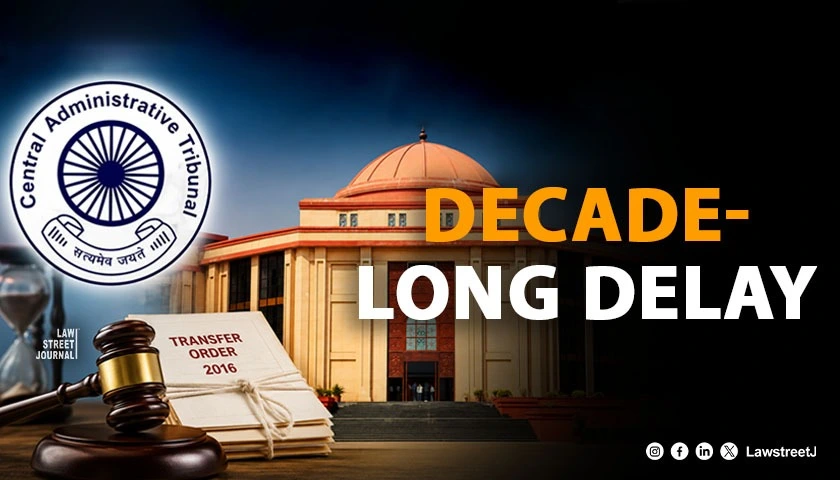
Prayagraj: The Allahabad Bench of the Central Administrative Tribunal has held that a WhatsApp reply of “OK” from a senior officer to a request for additional leave cannot, by itself, be treated as conclusive proof that leave was sanctioned by the competent authority. The Tribunal dismissed a railway employee’s challenge to his transfer from Prayagraj to Fatehpur, holding that it was not punishment in disguise.
Rajnish Kumar Rai, Member (J), was hearing Original Application No. 782 of 2025 under Section 19 of the Administrative Tribunals Act, 1985, filed by Priya Ranjan Kumar, working as CCS/CMI in North Central Railway, Prayagraj, against the Union of India and others. The order was reserved on 24.08.2026 and pronounced on 07.10.2026. He challenged the transfer order dated 25.07.2025 and the relieving order dated 28.07.2025.
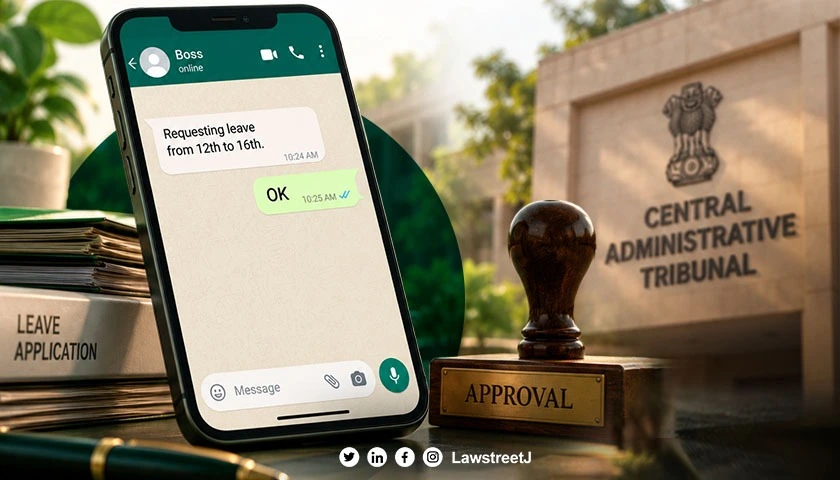
The applicant said that after availing three days’ leave from 14.07.2025 to 16.07.2025, he asked on WhatsApp on 16.07.2025 for two more days, 17 and 18.07.2025, and that Senior Divisional Commercial Manager/Coaching Himanshu Shukla approved it by replying “OK”. He informed the Senior Divisional Commercial Manager/Freight, Atul Yadav, by phone, but was called to his chamber on reporting on 21.07.2025. He argued that the transfer was punitive, arbitrary and mala fide, that disciplinary proceedings were pending, that the transfer would change the disciplinary authority, and that Railway Board instructions were not followed. He relied on Dinesh Kumar v. State of U.P. (Allahabad High Court, Lucknow Bench, 03.11.2023) and Somesh Tiwari v. Union of India, (2009) 2 SCC 592.
The respondents said the transfer was purely administrative, to fill a vacant post at the new entry and booking office at Fatehpur Railway Station, that the applicant had been in the DRM office since 2019 beyond the normal four-year tenure, and that it was made on the Placement Committee’s recommendation with the competent authority’s approval. They said no disciplinary proceeding was pending on 25.07.2025, the charge-sheet being issued on 31.07.2025, and that the disciplinary authority did not change. They added that leave had to be sanctioned through the HRMS portal by the competent authority, and that Mr. Shukla was on training from 14.07.2025 to 25.07.2025, when Mr. Yadav was in charge and the competent authority for sanctioning the applicant’s leave.
The Tribunal framed the issue as whether the transfer was a measure of punishment or an administrative transfer in exigencies of service. On the “OK” reply, it held:
“the alleged WhatsApp response ‘OK’ relied upon by the applicant cannot, by itself, be treated as conclusive proof of sanction of leave by the competent authority.”
The Tribunal reasoned that Mr. Yadav was the competent authority during the relevant period, so the applicant’s allegation of bias against him could not be accepted merely because he was involved in the matter of the applicant’s absence or subsequent disciplinary action. It also noted that the applicant had not obtained sanction through the HRMS portal.
On chronology, the Tribunal noted that although the suspension on 21.07.2025 preceded the transfer, the transfer order was issued on 25.07.2025, the relieving on 28.07.2025 and the charge-sheet only on 31.07.2025, so the transfer could not be inferred to be punitive from later disciplinary action. It distinguished Dinesh Kumar on the ground that the transfer order there itself referred to misconduct and inefficiency, whereas here the respondents had placed specific administrative reasons on record.
Stating the settled position, the Tribunal held that transfer is an incidence of service and courts and tribunals do not ordinarily interfere with transfers made in administrative exigency or public interest, except where the transfer is mala fide, arbitrary, contrary to statutory rules, issued by an incompetent authority, or punitive in disguise without due process. It cited Somesh Tiwari for the distinction between a transfer in administrative exigency and one passed in lieu of punishment, and held that an allegation of mala fide must rest on specific and cogent facts and not on conjecture. It also held that the safeguards applicable to disciplinary adjudication cannot be imported into an administrative transfer merely on such allegations, as the applicant had not shown that the authority lacked competence.
Finding that the respondents had shown an independent, bona fide administrative basis for the transfer, the Tribunal dismissed the Original Application, vacated the interim order dated 19.08.2025, and made no order as to costs.
Appearances:
For the Applicant: Mr. Rakesh Kumar Dixit, Advocate.
For the Respondents: Mr. Anil Kumar, Advocate.
Case Title: Priya Ranjan Kumar vs. Union of India & Ors., Original Application No. 782 of 2025