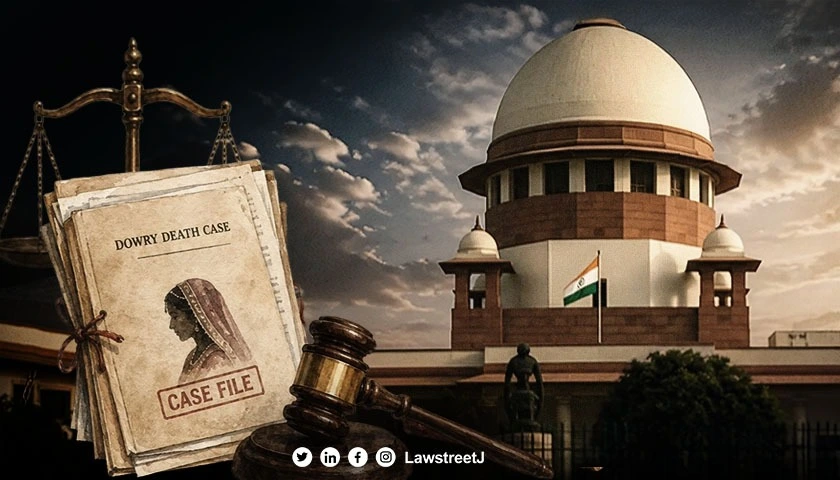
New Delhi: The Supreme Court has dismissed a complainant’s appeal against the acquittalof a husband and others of dowry death and cruelty, holding that the presumption of dowry death under Section 113B of the Evidence Act is not raised unless the foundational facts of dowry demand and harassment soon before death are proved by cogent evidence. It said that the inability of the complainant’s family to meet a dowry demand, though not sufficient by itself to discredit the allegation, is relevant to assess its correctness.
A Bench of Justice Manoj Misra and Justice Vijay Bishnoi was hearing the complainant’s appeal of Neeraj Kumar against the Delhi High Court judgment dismissing his revision against the judgment of the 2nd Additional Sessions Judge, which acquitted Suraj Prakash and others under Section 304B and Section 498A IPC. The deceased died of burn injuries within seven years of marriage. The Trial Court found the evidence of dowry demand and harassment unreliable, and took into account that the complainant’s family had a single earning member, the deceased’s brother, who drew a meagre salary of Rs 2,300 per month, and that there had been differences between the couple after the husband suspected that she was pregnant before marriage, on which he had filed for divorce, later withdrawn.
The High Court noted that none of the deceased’s mother (PW-1), elder brother (PW-2) or younger brother (PW-8) spoke of a dowry demand at the time of marriage, that PW-1’s testimony showed improvements over her statement in investigation, and that documents of an earlier panchayat did not reflect any demand. It found no perversity in the Trial Court’s assessment. The complainant argued before the Supreme Court that the alleged improvements were not pointed out from the earlier statement, that PW-1 consistently spoke of a demand repeated two days before the death, when her daughter asked if she had brought money and wept when she had not, that the inquest report noted an incised wound on the forehead which the courts overlooked, and that capacity to pay is not required to be proved. The respondents replied that the post-mortem and a review opinion found no injury apart from burns, that the autopsy report prevails over the inquest report, and that the findings were a possible view in an acquittal.
The Court noted that before the revisional court the complainant had not pressed the charge of murder and pressed only dowry death and cruelty. It held that although the death was within seven years of marriage, the presumption under Section 113A or Section 113Barises only after the necessary ingredients are proved, and the foundational fact of dowry demand and harassment was not found proved by the Trial Court. It observed that the differences arising from the husband’s suspicion, which got resolved over time and after which two more children were born, were not sufficient to raise a presumption under Section 113A for a conviction under Section 306 IPC.
As to Section 113B, the Court said that cogent evidence of demand and harassment soon before death was required, and the Trial Court had found it lacking and the prosecution witnesses unreliable. On capacity to pay, it observed:
“Lack of capacity to pay dowry, though by itself may not be sufficient to disbelieve the accusation of harassment in connection with demand of dowry, is relevant while assessing the correctness of the allegation. This we say so because why would a person raise a demand when he knows that the person to whom demand is made has no capacity to fulfil it.”
Finding no perversity, and no cogent evidence either to prove murder or to infer it from the circumstances, the Court held that the Trial Court took a possible view, that the State had not appealed against the acquittal, and that a revisional court’s jurisdiction is limited, so that no interference was called for. The appeal was dismissed.
Appearances:
For the Appellant: Mr. Abinash Kumar Mishra, AOR.
For the Respondents: Mr. Rajesh Mahajan, Senior Advocate, with Mr. M.L. Yadav, Mr. Mukesh Kumar, Mr. Srajan Shankar Kulshreshtha, Ms. Adya Nanda, Advocates, and Mr. Vishwa Pal Singh, AOR.
Case Title: Neeraj Kumar vs. Suraj Prakash & Ors., Criminal Appeal No. 1074 of 2015