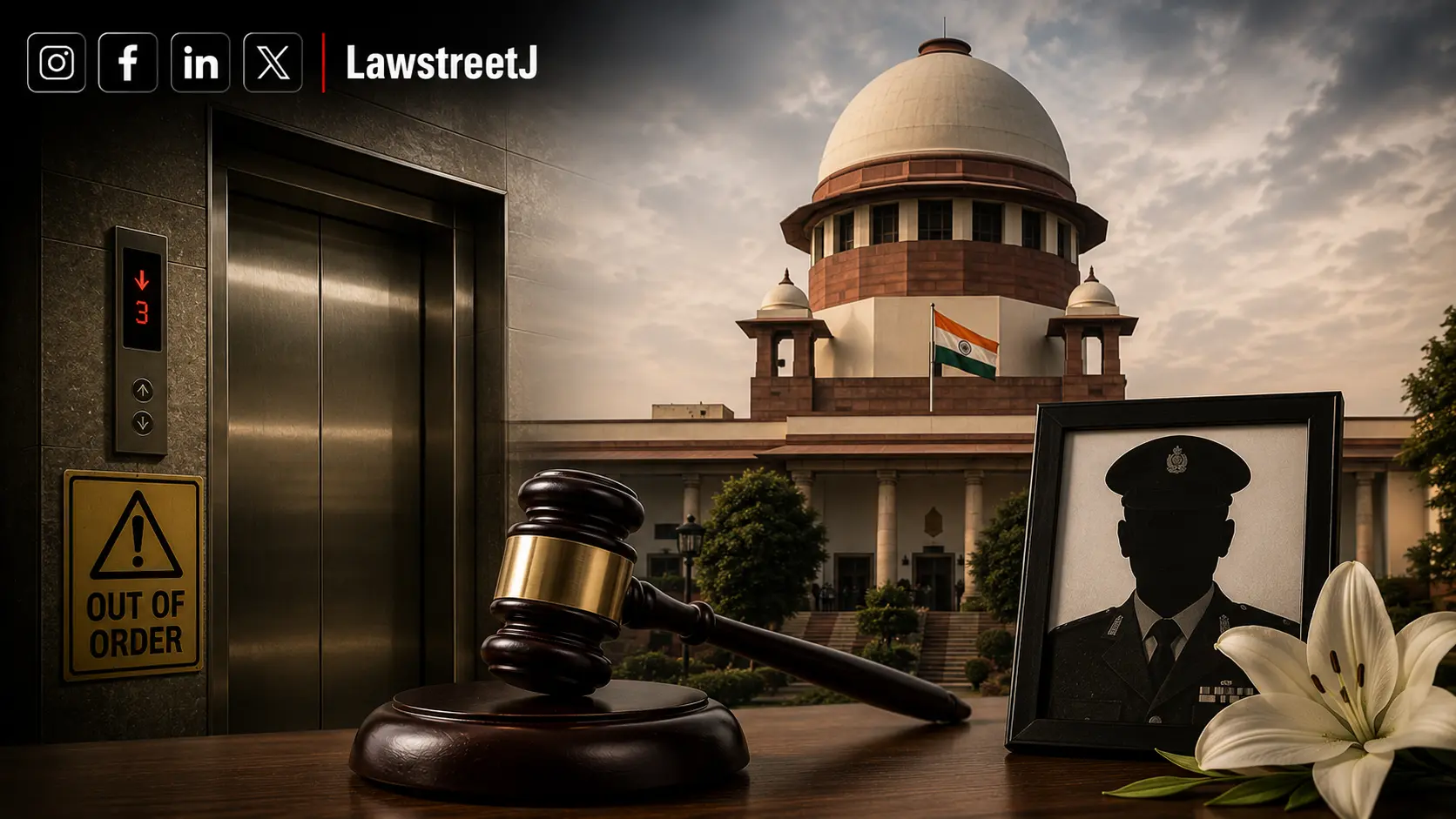
New Delhi: The Supreme Court has held that a passenger elevator must be construed as a 'common carrier', casting a heightened duty of care on its manufacturer, operator and premises owner, akin to the duty owed by common carriers, while dismissing an appeal by M/s Otis Elevator Co. (India) Ltd. against a National Consumer Disputes Redressal Commission (NCDRC) order holding Otis 70% liable for the death of a Research and Analysis Wing (RAW) officer crushed inside a malfunctioning lift in 2003.
A Bench of Justices Pamidighantam Sri Narasimha and Alok Aradhe was dealing with two connected appeals Civil Appeal No. 4081 of 2014, filed by Otis against the NCDRC's finding on liability, and Civil Appeal No. 1602 of 2020, filed by the deceased's widow, Rashmi Handa, against an order of the executing court that had kept execution proceedings pending the outcome of Otis' appeal.
Otis had installed the lift in December 2001 at the RAW office complex on Lodhi Road, New Delhi, reserved for use by officers of the rank of Joint Secretary and above. On 24.05.2002, the Military Engineering Service (MES), in charge of the building's upkeep, entered into a Maintenance and Repair Contract with Otis. On 20.03.2003, following a meeting of senior officers, the lift, carrying thirteen occupants, abruptly stopped between the sixth and seventh floors. Staff manually opened the door on the seventh floor and switched off the main power supply to begin a floor-by-floor rescue. While the deceased officer was being rescued half inside and half outside the cabin the lift suddenly moved downward, crushing his neck between the cabin roof panel and the floor, causing his death. The remaining occupants were rescued safely.
An FIR was registered under Section 304-A IPC, and Prof. C.M. Bhatia of IIT Delhi was deputed to conduct a technical investigation, following which a chargesheet was filed against certain MES officers. The deceased's widow and children approached the NCDRC in 2005, claiming compensation of Rs. 1.89 crores. By its order dated 21.01.2014, the NCDRC allowed the complaint, awarding compensation of Rs. 3,01,48,195/- with interest, and apportioned liability at 70% on Otis, 25% on MES and 5% on RAW, holding Otis deficient in service for operating the lift without a voltage stabiliser despite being aware of the risk, and for its failure to depute site personnel or maintain attendance records.
Appearing for Otis, senior counsel Gopal Sankaranarayanan argued that the technical report of Prof. Bhatia unambiguously attributed the accident to the manual release of the mechanical brakes through the Brake Release Key in the Machine Room a space exclusively controlled by MES and that Otis had, as early as 04.07.2002, flagged voltage fluctuation as the cause of the lift's malfunctioning and recommended a voltage stabiliser, a recommendation MES failed to act upon. He further submitted that no Otis mechanic was required on site at the time of the accident under Clause 3.2 of the Maintenance Contract, and that the police chargesheet had fixed responsibility on MES personnel alone.
Counsel for the respondent-consumers, Saurabh Suman Sinha, pointed to Clauses 3.1 to 3.5 of the Maintenance Contract, which cast a comprehensive and non-delegable duty on Otis, as both manufacturer and maintenance contractor, to keep the lift in sound condition and to maintain attendance and complaint registers records Otis never produced, despite nine recorded breakdowns of the very lift in July and August 2002 alone. He submitted that Otis' own letter of 04.07.2002 showed it was conscious of the danger, yet it took no further steps to ensure the stabiliser was installed or to withdraw certification of the lift's safety.
Tracing the origins of the common carrier doctrine to 19th-century American and English case law, the Court observed that passengers in an elevator have no control over the conveyance and must rely entirely on automation or the operator, making it a legal necessity, and not merely reasonable, to impose a heightened duty of care.
"An elevator must be construed and deemed to be a common carrier and the operator, in the wider sense must undertake greater responsibility to transport passengers from floor to floor and exit safely."
Rejecting Otis' contention that liability rested solely with MES on account of the manual brake release, the Court held that for the purpose of assessing deficiency of service and compensation, a crucial distinction had to be drawn between the immediate 'cause of accident' and the broader 'cause of action' — a distinction it found was lost in Otis' submissions. The correspondence on record, the Court noted, showed that the malfunctioning of the lift was not an isolated occurrence but a continuing failure, with at least three stoppages notified to Otis between April and June 2002, and a further nine breakdowns recorded in July and August 2002 alone.
The Court held that Clause 3.1 of the Maintenance Contract cast a continuing and affirmative duty on Otis, as both manufacturer and comprehensive maintenance contractor, placing it in a position of unique knowledge and control over the lift's safety interlocks, brake mechanism and electrical circuitry a position materially different from that of RAW or MES, neither of whom possessed the technical means to independently assess or rectify the reported defects.
"The contractor shall be responsible for the electrical and mechanical fittings of the lifts and maintenance of the same to keep them in sound condition to avoid risk of accident."
The Court further noted that Otis, having itself identified voltage fluctuation as the cause and proposed a stabiliser as early as July 2002, was obligated either to ensure the remedy was implemented or to decline certifying the lift as fit for continued use pending its installation. Its failure to produce any attendance register, duty chart or log book to establish the presence of its mechanic on the date of the accident, despite being contractually bound to maintain such records, went against it. The stickers posted by Otis warning against interference with the lift's mechanism, the Court held, could not substitute for the affirmative duty to train RAW and MES personnel in correct rescue procedures a duty which the NCDRC had found was never discharged.
While noting that the Technical Investigation Report attributed the accident to human error in releasing the brakes, the Court held this finding did not stand in isolation and had to be read in context, observing:
"Releasing the brakes through the Brake Release Key is the only cause of accident and is due to the human error/factor beyond any element of doubt."
The Court held that the very occasion for a manual brake release arose only because the lift had stopped mid-operation on account of a persistent and unrectified electrical malfunction, directly traceable to Otis' inaction. It found no reason to interfere with the NCDRC's apportionment of liability, holding that RAW's deficiency related to a failure of oversight rather than any direct role in the accident, while MES's lapse in failing to maintain attendance registers and in leaving the Machine Room accessible during the rescue was of a different and subordinate order to Otis' primary responsibility for the underlying defect.
Accordingly, the Court dismissed Otis' Civil Appeal No. 4081 of 2014, affirming the NCDRC's order dated 21.01.2014 in its entirety. Since the sole ground on which the NCDRC had earlier declined to proceed with execution, the pendency of Otis' appeal, no longer survived, the Court allowed Civil Appeal No. 1602 of 2020 and directed the NCDRC to proceed with the widow's execution petition in accordance with law.
Appearances: Mr. Gopal Sankaranarayanan, Senior Advocate, for the Appellant Otis Elevator; Mr. Saurabh Suman Sinha, for the Respondent-Consumers; Ms. Aishwarya Bhati, Additional Solicitor General, for MES
Case Title: M/s Otis Elevator Co. (India) Ltd. v. Rashmi Handa & Ors., Civil Appeal No. 4081 of 2014 with Civil Appeal No. 1602 of 2020