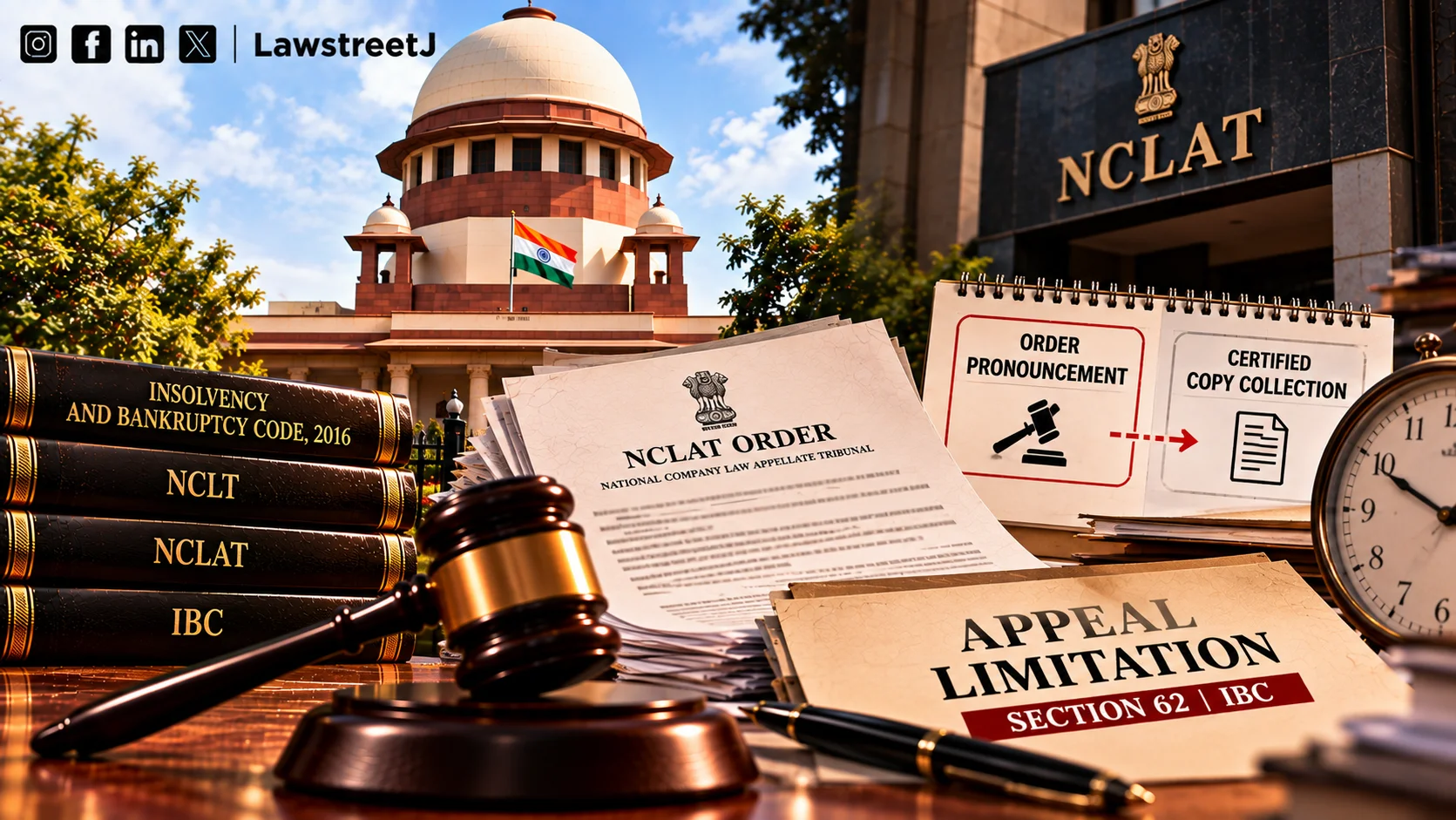
New Delhi: The Supreme Court has upheld the forfeiture of the Earnest Money Deposit and other amounts paid by a successful bidder in a liquidation auction under the Insolvency and Bankruptcy Code, 2016, who failed to pay the balance sale consideration within the stipulated 90 days, holding that the forfeiture clause in the e-auction notice governs and the bidder failed to satisfy the "Triple Test" for relief.
A Bench of Justice J.B. Pardiwala and Justice K. Vinod Chandran dismissed an appeal by M/s ASJ Finsolutions Pvt. Ltd. against an order of the National Company Law Appellate Tribunal, which had reversed the National Company Law Tribunal's direction to refund the amounts.
The appellant had bid at the reserve price of Rs. 25.56 crore for Lot No. 5, land in Village Nangal Khurd, Sonepat, Haryana, offered under an e-auction notice dated 25.10.2021. The notice carried a note that a civil suit was pending regarding the sale deed for a portion of the land, and the sale was on an "as is where is" basis. After the auction on 15.11.2021, the balance was payable within 30 days, or within 90 days with interest at 12 per cent per annum, that is, by 14.02.2022. The appellant had paid Rs. 6.39 crore, comprising the Rs. 2.55 crore EMD, being 10 per cent of the reserve price, and Rs. 3.84 crore towards the balance, without protest.
On 15.12.2021, the appellant emailed the Resolution Professional undertaking to pay the balance of Rs. 19.17 crore by 14.02.2022 with interest, but it never paid. It sought the prior title deeds only on 11.02.2022, a plea rejected by the NCLT, the NCLAT and later the Punjab and Haryana High Court. A fresh auction fetched Rs. 31.10 crore, Rs. 5.54 crore more than the appellant's bid. The appellant then sought annulment of the forfeiture and a refund. The NCLT allowed this, finding the Triple Test satisfied, but the NCLAT reversed it.
Senior Advocate Meenakshi Arora, for the appellant, argued that Schedule I of the Insolvency and Bankruptcy Board of India (Liquidation Process) Regulations, 2016 contains no forfeiture stipulation and caps the EMD at 10 per cent. She submitted that other bidders had been granted extensions and the appellant was discriminated against, and relied on Authorised Officer, Central Bank of India v. Shanmugavelu, where forfeiture had statutory backing under the SARFAESI Act. Alternatively, she urged that forfeiture be limited to 10 per cent of the reserve price. For the Resolution Professional, Advocate Abhishek Anand contended that the appellant bid with open eyes, knowing of the dispute, and cannot resile from an express condition of the auction notice.
The Court noted that the default was admitted, leaving only the question whether the refusal was bona fide. It held that though the Regulations do not expressly provide for forfeiture, the specific clause in the auction notice made forfeiture an inevitable consequence of failing to pay the balance. Depositing the EMD and part of the balance was itself an undertaking to pay the rest within 30 or 90 days, and, the Court held, on cancellation "forfeiture is a necessary consequence".
The Bench agreed with the NCLAT over the NCLT on the Triple Test, which asks whether the bidder acted with a hidden agenda to rig the auction, was not a genuine bidder with adequate financial capacity, or was prevented by extraneous reasons from paying. It held that the request for prior deeds was not permissible so late, since the notice was on an "as is where is" basis and disclosed the non-availability of deeds for a portion of the land, and the appellant had not sought verification before bidding. Proof of financial capacity, it said, lies in materials substantiating the capacity and not in repeated assurances to pay. The higher price in the fresh auction was attributed to the property's inherent value and not to any set-off against expenses.
The Court described the appellant's reliance on the order in the Agarwal Trading Company matter as an afterthought, noting that the company had merely filed an application before the NCLT and later withdrew it. The discrimination plea was rejected as belated, since it could have been raised when the prior deeds were sought, and the orders relied on had been produced only with written submissions, which the Bench declined to consider.
On the 10 per cent argument, the Court relied on Westcoast Infraprojects Private Limited and Potens Transmission & Power Pvt Ltd, both affirmed by this Court, the former upholding forfeiture of the EMD and any other deposit under a similar clause. It observed that the EMD stipulated here was only Rs. 2.55 crore, that the Rs. 6.39 crore was paid voluntarily and without demur, and that the notice allowed forfeiture of the entire amount paid, including the EMD, if the successful bidder failed to pay the balance.
Finding no reason to order a refund or to interfere with the NCLAT's order, the Court dismissed the appeal and rejected pending applications.
Case Title: M/s ASJ Finsolutions Pvt. Ltd. vs. Vikram Bajaj, Civil Appeal No. 13023 of 2025