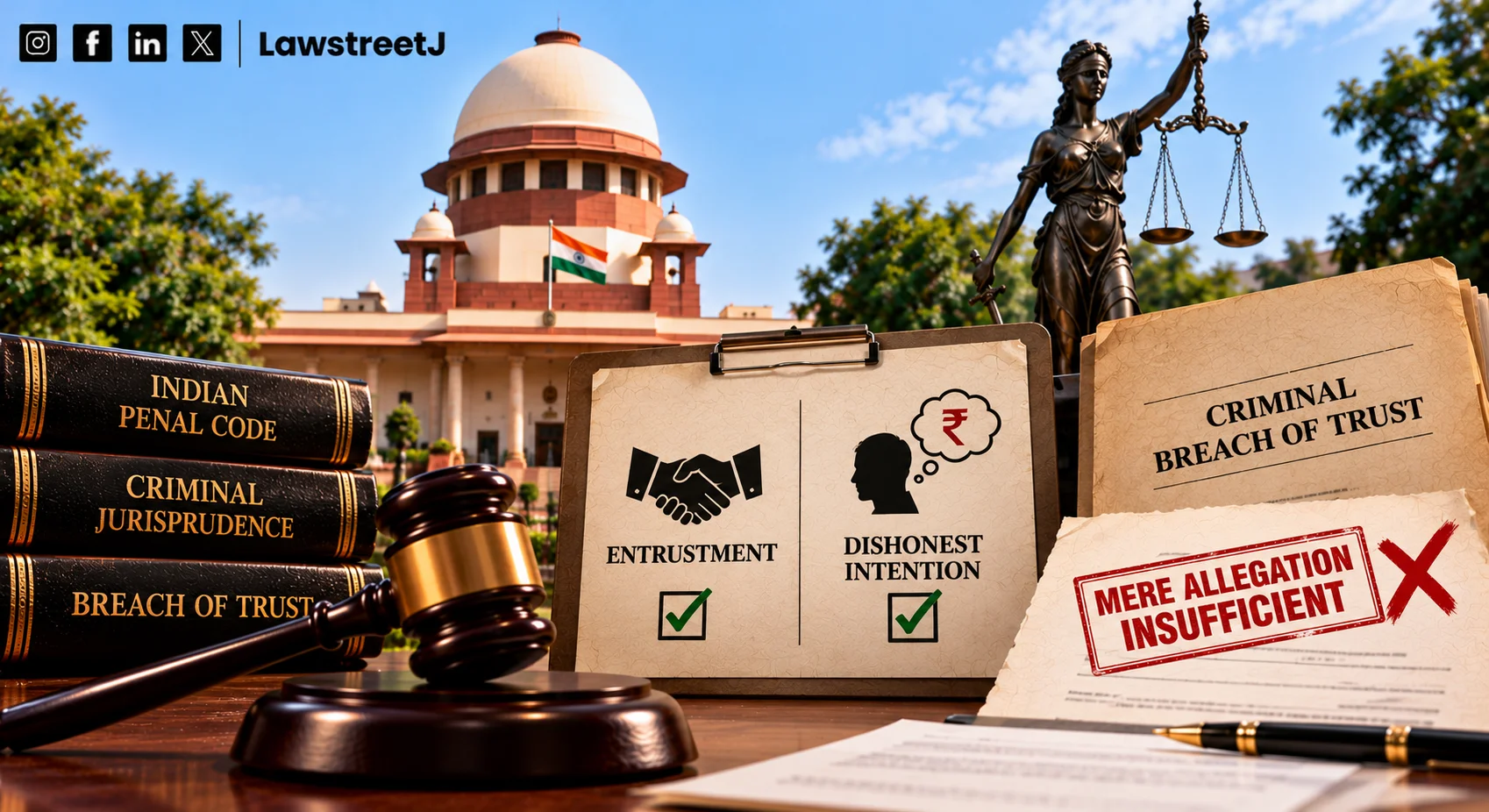
New Delhi: The Supreme Court of India has set aside a Bombay High Court, Bench at Aurangabad judgment that had reversed the acquittal of a former Telephone Department cashier for the offence of criminal breach of trust by a public servant under Section 409 of the Indian Penal Code, 1860, and restored the acquittal recorded by the trial court, holding that the prosecution had failed to prove entrustment of property or dishonest intention.
A Bench of Justice Ujjal Bhuyan and Justice Atul S. Chandurkar delivered the judgment on October 8, 2026 in Criminal Appeal No. 1432 of 2019, filed by Ramkrushna Prahllad Dongardive against the State of Maharashtra, reported as 2026 INSC 1099. The judgment was authored by Justice Chandurkar.
According to the prosecution, the appellant, serving as Cashier-cum-Counter Clerk with the Telephone Department at Aurangabad, collected telephone charges of ₹8,73,737 from customers between 01.07.1993 and 09.10.1993, of which ₹3,88,035 was credited to the Government account belatedly while ₹4,75,702 was not credited at all. On a complaint by the Assistant Accounts Officer on 11.10.1993, offences under Sections 409, 477 and 420 of the IPC were registered, and a charge under Section 409 was framed. The Chief Judicial Magistrate, Aurangabad, acquitted the appellant on 20.02.2002 in RCC No. 80163 of 1996, finding the evidence vague and general, the seized registers unexhibited as witnesses did not support the prosecution, and the procedure under Section 100(7) of the Code of Criminal Procedure not followed in seizing forty-six articles from the appellant's house. The High Court, in Criminal Appeal No. 278 of 2002, reversed the acquittal on 12.10.2017 and sentenced him to rigorous imprisonment for one year and a fine of ₹5,000.
Senior Advocates Mr. B.H. Marlapalle and Mr. Sudhanshu S. Choudhari, for the appellant, argued that the High Court ignored the settled principles governing interference with an acquittal, that entrustment and dishonest intention were not proved, that the trial court rightly drew an adverse inference as the prosecution failed to produce records despite orders, and that the High Court wrongly shifted the burden onto the appellant. Mr. Shrirang B. Varma, for the State of Maharashtra, supported the High Court judgment.
Applying Chelloor Mankkal Narayan Ittiravi Nambudiri v. State of Travancore-Cochin, the Supreme Court reiterated that an appellate court must give proper weight to the trial court's view of credibility, the presumption of innocence strengthened by acquittal, the accused's right to the benefit of doubt, and the advantage the trial judge had in seeing witnesses. Relying on R. Venkatakrishnan v. Central Bureau of Investigation, it noted that dishonest intention is an essential element of the offence under Sections 405 and 409 of the IPC.
The court found that the investigating officer had admitted that the complainant did not produce the original cashbook, daily register, audit report or other documents showing collection of amounts, which formed the basis of entrustment, and that the appellant's requests for the daily cash handover register and the stock register of receipt books were also not met. It held that the trial court was justified in drawing an adverse inference under Section 114(g) of the Indian Evidence Act against the prosecution, and that, in the absence of these documents, it was difficult to hold that entrustment of cash was proved.
On the seizure of forty-six articles from the appellant's house, the court noted that both panch witnesses had turned hostile, that the appellant's signature was not obtained on the panchnama and that no explanation was given for not furnishing him a list of the articles seized, amounting to non-compliance with Sections 100(4) and 100(7) of the CrPC. While citing Sunder Singh v. State of Uttar Pradesh and State of Punjab v. Balbir Singh to observe that such non-compliance by itself does not vitiate a seizure, it held that, assessed cumulatively with the other doubts in the prosecution case, the seizure could not be held proved solely on the investigating officer's testimony. Exhibit-9, a ten-page printed list unsigned by the appellant, was held to have no connection with him.
The court also found a separate infirmity in that, after reversing the acquittal and convicting the appellant for the first time, the High Court sentenced him without hearing him on the quantum of sentence, relying on its recent decision in Mukesh Kumar Yadav v. State (UT of Andaman & Nicobar Islands) on Section 386 of the Code of Criminal Procedure, 1973 (corresponding to Section 427 of the BNSS). It further held, citing Rabindra Kumar Dey v. State of Orissa, that the High Court erred in shifting the burden onto the appellant to explain the seized documents, as the onus of the prosecution never shifts and the accused need only offer a version that competes in probability.
Concluding that the prosecution had failed to prove entrustment, misappropriation or dishonest intention, the court set aside the High Court's judgment dated 12.10.2017, restored the acquittal dated 20.02.2002, acquitted the appellant of the offence under Section 409 of the IPC and cancelled his bail bonds. The criminal appeal was allowed and the pending interlocutory application disposed of.
Appearances:
For the Appellant: Mr. B.H. Marlapalle and Mr. Sudhanshu S. Choudhari, Senior Advocates.
For the Respondent: Mr. Shrirang B. Varma, Advocate, for the State of Maharashtra.
Case Title: Ramkrushna Prahllad Dongardive vs. The State of Maharashtra, Criminal Appeal No. 1432 of 2019 (2026 INSC 1099)