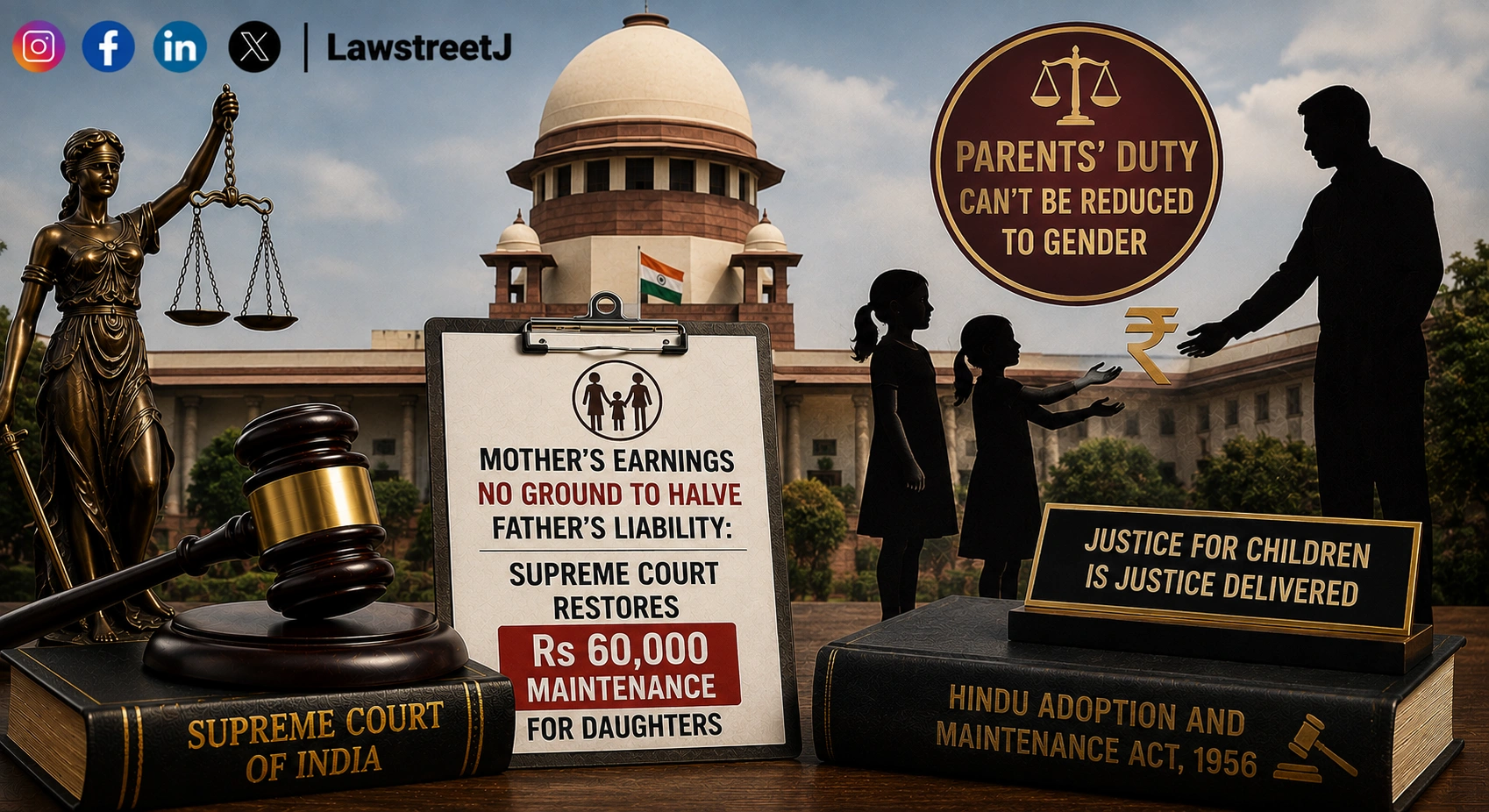
New Delhi: The Supreme Court has restored a Family Court's award of Rs.60,000 per month as interim maintenance for two minor daughters, holding that the mere fact that their mother is also earning is not, by itself, a reason to halve the father's liability, and that the obligation to maintain children, though shared by both parents, cannot be divided by arithmetic alone.
A Bench of Justice Vikram Nath and Justice Sandeep Mehta set aside an order dated 9th February 2026 passed by the Allahabad High Court in Criminal Revision No. 10 of 2025, which had reduced the interim maintenance awarded to each of the two daughters from Rs.30,000 to Rs.15,000 per month, and restored the Family Court's order dated 21st October 2024.
The marriage between the appellant-wife and the respondent-husband was solemnised on 18th June 2006. During its subsistence, two daughters, now aged about 9 and 8 years, were born to the parties. The appellant-wife also gave birth to a son, who unfortunately passed away shortly thereafter. Troubles subsequently arose in the marriage and acrimony grew between the parties, leading the appellants to leave the marital home.
In 2022, the appellants filed a petition, being Case No.355/2022, under Section 125 of the CrPC, seeking maintenance of Rs.2,50,000 per month from the husband. The wife, an M.B.B.S., D.G.O. qualified gynaecologist, stated that she earns Rs.1,50,000 per month working at a hospital in Greater Noida, while the husband, an M.B.B.S., M.D. qualified consultant paediatrician, stated his income as Rs.2,00,000 per month, though the wife contended that he in fact owns his own nursing home.
The Family Court, by order dated 21st October 2024, declined interim maintenance to the wife, holding that both parties were earning sufficiently and that interim maintenance was meant to protect a party from unemployment or an immediate inability to meet daily needs. It, however, noted that the responsibility of educating and raising the daughters lay upon both parents and, after considering the details of their expenses furnished by the wife, awarded Rs.30,000 per month to each daughter from the date of filing of the petition until they attain majority.
On revision by the husband, the High Court proceeded on the footing that Rs.60,000 per month was sufficient for both daughters, but held that this burden could not be fastened solely upon the husband, and accordingly halved the award to Rs.15,000 per month for each daughter.
Counsel for the appellants submitted that the High Court had erred in reducing the amount despite acknowledging the tender age of the children and their need for proper care, that the expenses of their education and upbringing could not be met from the wife's income alone, and that the husband in fact earned far in excess of Rs.2,00,000 per month, and that the Family Court had rightly appreciated the material on record. Counsel for the husband supported the High Court's order, submitting that the responsibility of maintaining the daughters rested on both parents, that the wife, being gainfully employed, was equally placed to bear a share of the expenses, and that the amount awarded by the Family Court was excessive.
The Supreme Court found itself unable to sustain the High Court's reasoning, observing that the impugned order gave no reason for interfering with the Family Court's order beyond the fact that the wife was also earning, and that the High Court had neither found the Family Court's assessment perverse nor found Rs.60,000 per month excessive in fact holding that sum to be sufficient for the two daughters, having regard to the status of their parents.
“That the appellant-wife earns is not, by itself, a reason to halve the father’s liability,” the Court held, observing that the daughters live with the wife, who looks after their daily needs and upbringing while also working, and that such care, while not measurable in money, is a real contribution and often the greater one. The Court further held that even leaving the wife's earnings out of account, the reduction could not stand, since the husband, a qualified doctor earning Rs.2,00,000 per month on his own showing, could reasonably bear Rs.60,000 per month towards the upbringing and education of two school-going daughters aged about nine and eight years.
The Court held that the Family Court had correctly appreciated the status of the parties and the needs of the daughters after considering the income affidavits and expenses on record, and found the award of Rs.30,000 per month to each daughter, aggregating to Rs.60,000 per month, to be just and reasonable, calling for no interference in revision. It also noted that the main petition under Section 125 CrPC remained pending before the Family Court and that the present proceedings concerned only interim maintenance, which was an additional reason not to interfere with the quantum determined by the Family Court.
Accordingly, the Court set aside the High Court's order, restored the Family Court's order dated 21st October 2024, and directed that any arrears be paid by the husband to the wife within three months from the date of the judgment. It clarified that the main maintenance application would be decided on its own merits, uninfluenced by the findings recorded in the orders under challenge in the present proceedings.
Case Title: Sujata Kumari & Ors. vs. Rahul Kumar & Anr., Criminal Appeal (Arising out of SLP (Criminal) No. 9661 of 2026)