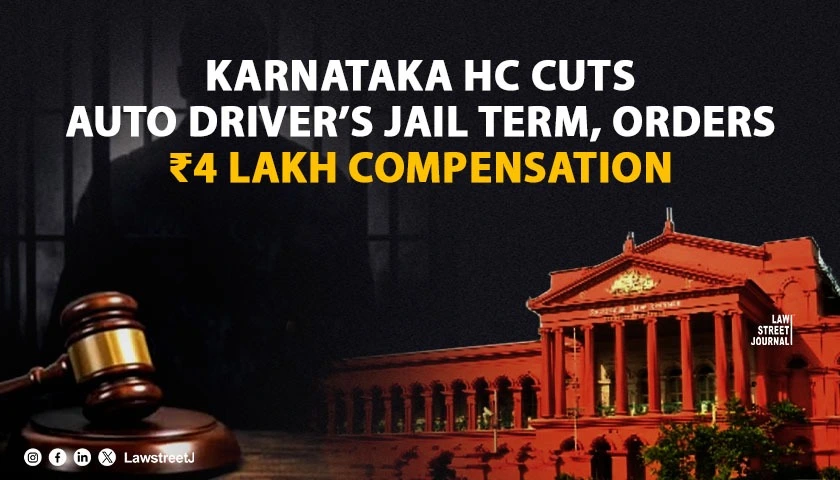
Bangalore: The High Court of Karnataka at Bengaluru, in an order passed by Justice V. Srishananda on 26th March 2026, has partly allowed a criminal revision petition filed by an auto-rickshaw driver convicted under Section 394 of the Indian Penal Code for robbing a lone woman passenger and causing her hurt, by modifying the sentence of five years’ rigorous imprisonment imposed by the First Appellate Court.
Upholding the conviction, the Court directed that the 15 months’ custody already undergone by the accused shall be treated as the period of imprisonment and, in lieu of the remaining sentence, the accused was directed to pay an enhanced fine of Rs. 4,00,000/-, to be disbursed as compensation to the victim.
The Court invoked the principle that every sinner has a future and that courts in criminal jurisprudence are required to hate the crime and not the criminal.
The petitioner, Sri Tabrez Pasha, was the driver of an autorickshaw. The incident occurred when the victim, a lone woman passenger, was travelling in the vehicle. The accused stopped the autorickshaw at a lonely spot and attempted to rob her gold chain with black beads (karimani). When she resisted, the accused overpowered her by causing fist injuries to her lips, forehead, and face. He successfully snatched the gold chain from her neck. A case was registered, an FIR was issued, and upon thorough investigation, the accused was apprehended and the stolen gold chain was recovered from his custody.
A charge sheet was filed for offences under Sections 392 and 394 of the Indian Penal Code. After framing of charges, the accused pleaded not guilty and trial was held before the 1st Additional Senior Civil Judge and Chief Judicial Magistrate, Kolar, in CC No. 628/2015. The prosecution examined twelve witnesses and placed thirteen documents on record, including the complaint, seizure mahazar, spot mahazar, photographs, wound certificate, and FIR. The Trial Magistrate, noting contradictions among prosecution witnesses and a serious lacuna in the investigation, recorded an order of acquittal.
The State challenged the acquittal before the Principal District and Sessions Judge, Kolar, in Criminal Appeal No. 9/2020. The First Appellate Court, upon re-appreciation of the evidence, allowed the appeal, convicted the accused for the offence under Section 394 IPC, and sentenced him to undergo rigorous imprisonment for five years and to pay a fine of Rs. 30,000/- with a default sentence of six months. The accused thereafter filed a criminal revision petition before the High Court of Karnataka.
At the outset, the High Court noted that a revision petition is not the correct remedy against a conviction recorded by the First Appellate Court upon reversal of an acquittal, and that the accused ought to have filed an appeal. However, since the revision petition had been pending since 2022 and directing the accused to file a fresh appeal would cause further delay and miscarriage of justice, the Court, by consent of both parties, treated the revision petition as an appeal and heard it with a wider scope of re-appreciation.
The petitioner’s counsel contended that the Trial Magistrate had correctly noted serious contradictions in the prosecution witnesses and a lacuna in the investigation, and that the First Appellate Court ought not to have reversed the acquittal. It was argued that where two views are possible, the view favouring the accused must be preferred, and that the prosecution must establish its case beyond reasonable doubt; mere suspicion cannot take the place of proof.
The High Court Government Pleader for the State supported the First Appellate Court’s conviction, emphasising the recovery of the stolen gold chain from the accused’s custody, the absence of any prior enmity or animosity between the parties which could explain a false implication, and the failure of the accused to offer any explanation under Section 313 CrPC for his possession of the stolen article or the seizure of the autorickshaw.
On the question of the appellate court’s power to reverse an acquittal, the High Court referred to the principles laid down by the Supreme Court in Chandrappa and Others v. State of Karnataka, (2007) 4 SCC 415, which held that an appellate court has full power to review and re-appreciate the evidence forming the basis of an acquittal without any restriction under the Code of Criminal Procedure, that the double presumption of innocence operating in favour of an accused upon acquittal does not curtail the appellate court’s powers of review, and that the appellate court should not disturb an acquittal when two reasonable conclusions are equally possible on the evidence. The Court also relied on Babu v. State of Kerala, (2010) 9 SCC 189, which held that interference in a routine manner where another view is possible should be avoided, but where the trial court’s view is perverse or unsustainable, the appellate court is duty-bound to interfere.
Applying these principles, the High Court found that the First Appellate Court had rightly re-appreciated the evidence, particularly the testimony of the victim, which was cogent, consistent, and corroborated by the wound certificate, the seizure of the gold chain, the seizure of the autorickshaw, and photographs. The Court held that the identity of the accused and the recovery of the robbed article were clearly established, and that all three essential ingredients of Section 394 IPC were made out—namely, commission of robbery, causing of hurt, and voluntariness of the hurt—and that the accused had offered no explanation for his possession of the stolen article. The First Appellate Court’s finding of guilt was accordingly upheld, and no legal infirmity or perversity was found in it.
On the question of sentence, the petitioner’s counsel made an alternate submission that since the accused was a first-time offender, the 15 months’ custody already undergone may be treated as the period of imprisonment with enhancement of the fine. The State opposed any leniency, arguing that the gravity of the offence—an auto-rickshaw driver exploiting a lone woman passenger—warranted the full sentence, and that leniency would encourage similarly placed offenders.
The High Court, however, took into account the fact that the accused was a first-time offender, that the incident was isolated and occurred over a decade ago, that the accused was now married with two children and a wife to support, and that he continued to earn his livelihood by driving an autorickshaw. Invoking the principle that courts are required to hate the crime and not the criminal, and that every sinner has a future with scope for reformation, the Court held that the ends of justice would be met by treating the 15 months’ custody already undergone as the period of imprisonment and by directing the accused to pay an enhanced fine of Rs. 4,00,000/- as compensation to the victim.
The fine was directed to be paid in two instalments of Rs. 2,00,000/- each—the first on or before 30th April 2026 and the second on or before 31st May 2026—before the Trial Magistrate. It was further directed that failure to pay the enhanced fine would result in automatic restoration of the five-year rigorous imprisonment ordered by the First Appellate Court.
For the Petitioner: Sri Venkateshamouni K.M., Advocate
For the Respondent/State: Sri K. Nageshwarappa, High Court Government Pleader
Case Title: Sri Tabrez Pasha v. The State of Karnataka, Criminal Revision Petition No. 826 of 2022, NC: 2026:KHC:17268


![Karnataka High Court: Cabinet Rank Status Not Equivalent to Ministerial Position [Read Order]](/secure/uploads/2023/09/lj_2318_fc1b99b7-aeed-472b-836e-33750bedb394.jpg)


![Woman living in adultery cannot claim maintenance: Karnataka High Court [Read Order]](/secure/uploads/2023/10/lj_3083_Women_living.jpg)