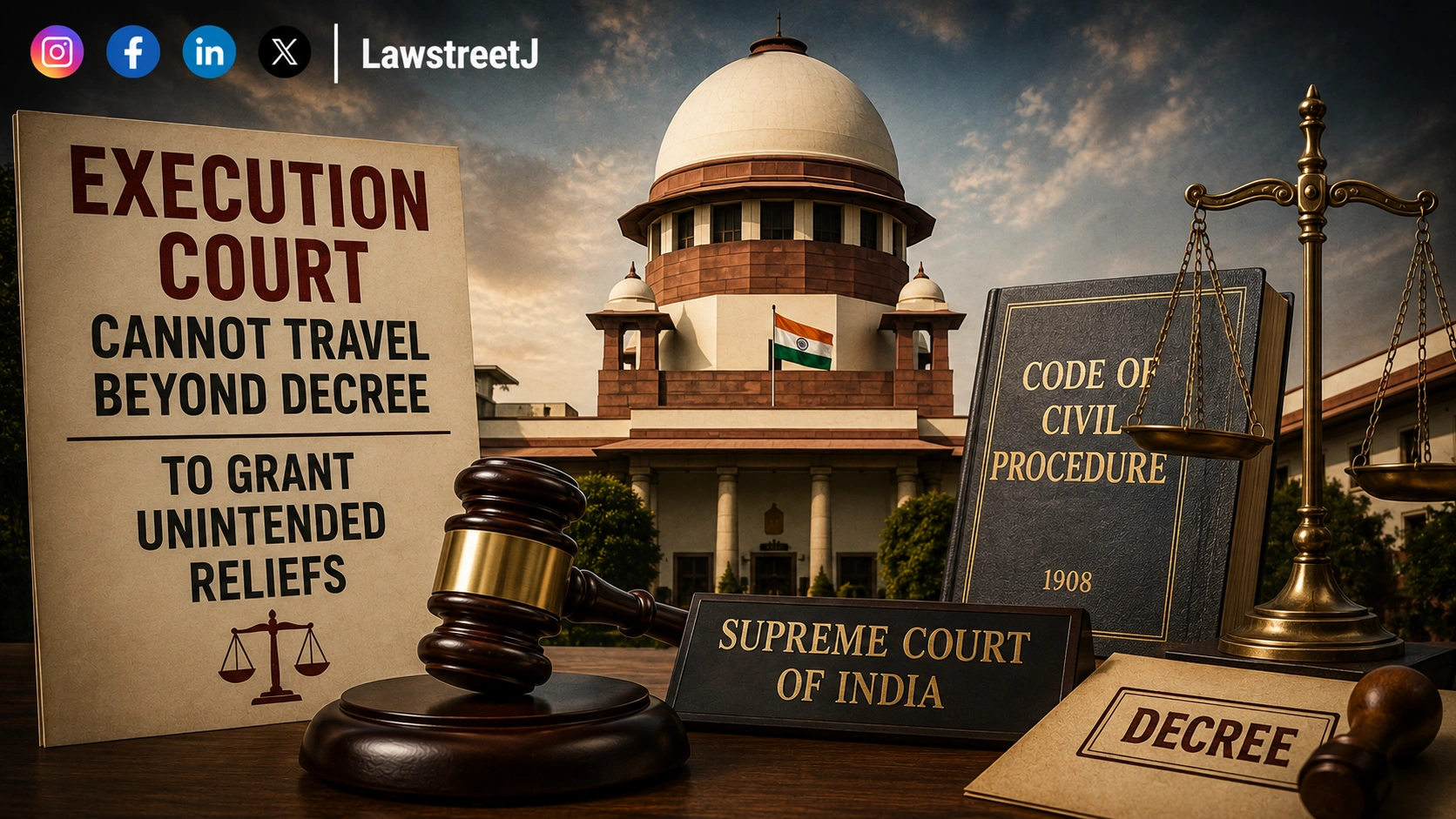
New Delhi: The Supreme Court has set aside an order of the Himachal Pradesh High Court passed in execution proceedings, holding that an Executing Court cannot travel beyond the decree sought to be implemented or reinterpret its terms, even while accepting the underlying entitlement of the decree-holders to a revised pay scale.
A Bench of Justices Ahsanuddin Amanullah and R. Mahadevan was hearing a batch of twelve appeals filed by the State of Himachal Pradesh against a common order dated 12.08.2024 passed by a Division Bench of the High Court in a batch of execution petitions. The execution petitions had been filed by School Lecturers appointed on contract basis between 1998 and 2000, seeking implementation of an order dated 10.01.2013, whereby their writ petition had been disposed of with a direction that if they were found similarly situated to the petitioners in State of Himachal Pradesh v. Rakesh Chand and Others, they would be extended the same treatment.
The Advocate General for the State submitted that the High Court, in execution, had granted the respondents the benefit of admissible allowances on the mistaken premise that the principle laid down in a separate appeal, LPA No.108 of 2012, which concerned JBT Teachers, applied equally to School Lecturers. It was argued that the respondents had never pleaded before the High Court that they should be granted the relief later upheld in LPA No.108 of 2012, and that the impugned order had misread a communication dated 06.08.2024 issued by the Director, Higher Education, which had extended relief only subject to the outcome of the State's legal remedies. It was further submitted that the respondents, having approached the Court more than a decade after their cause of action arose, were fence-sitters who could not claim parity with diligent litigants, and that condoning such delay would impose a financial burden running into hundreds of crores of rupees on the State Exchequer.
Counsel for the respondents submitted that the batch of cases culminating in the judgment dated 13.12.2012 had categorically recorded that the State's appeal, LPA No.108 of 2012, arising from a decision granting JBT Teachers the revised pay scale along with allowances, stood dismissed, and that the principle regarding entitlement to fixed basic pay and allowances had accordingly already attained finality. It was submitted that the respondents ought not to be visited with adverse consequences merely because the order in their favour may not have been happily worded, particularly when persons covered by the earlier judgment had themselves been granted the benefit of admissible allowances by the State.
Examining the impugned order, the Court found that the High Court had recorded that the judgment dated 30.11.2010, as affirmed in LPA No.108 of 2012, had already been implemented by the State by releasing salary to contract JBTs on the minimum of the revised pay scale along with allowances and consequential benefits. The Court clarified that the Division Bench, in its judgment dated 13.12.2012 in LPA No.105 of 2010 and analogous cases, had held that JBT Teachers appointed on contract would be entitled to the initial of the revised pay scale, and had further clarified that the same principle would apply with equal force to School Lecturers appointed on contract. The confusion in the impugned order, the Bench noted, lay in conflating LPA No.108 of 2012, which related to JBT Teachers, with the position of the respondents, who were School Lecturers.
On the question of delay, the Court considered the appellants' objection that fence-sitters cannot ordinarily claim the benefit of a subsequent favourable development merely because they are similarly placed to litigants who diligently pursued their claims. It noted that the respondents' cause of action had arisen between 1998 and 2000, yet they had made no representation and initiated no proceedings until after the judgment in LPA No.105 of 2010 and analogous cases was delivered on 13.12.2012.
Observing that the respondents had approached the Court after more than twelve years without explanation, the Bench held that such conduct "cannot be regarded as bona fide conduct."
The Court nevertheless found that since the Division Bench, while disposing of the respondents' writ petition, had itself granted relief in terms of the judgment in LPA No.105 of 2010 and analogous cases, there was no ambiguity regarding the intent of the order dated 10.01.2013, which was required only to be implemented in accordance with that judgment.
Faulting the manner in which the Executing Court had proceeded, the Bench held that the Execution Court "could not have travelled beyond the order sought to be executed" or gone behind its interpretation, particularly when the order itself required no further or special interpretation.
Allowing the appeals, the Court set aside the impugned order dated 12.08.2024 and held that the respondents would be entitled to the initial of the pay scale attached to the posts of JBT Teachers, as revised from time to time, that is, the pay scale of Rs.6,400/- prior to 31.12.2005 and Rs.10,300/- with effect from 01.01.2006, in terms of the judgment dated 13.12.2012 passed in LPA No.105 of 2010 and its analogous cases. Pending applications, if any, were disposed of.
Appearances:
For the Appellants: Mr. Anoop Kumar Rattan, Advocate General, Mr. Nishant Kumar, AoR, and other Advocates.
For the Respondents: Ms. Radhika Gautam, AoR.
Case Title: State of Himachal Pradesh & Anr. vs. Jameet Singh & Anr., SLP(C) Nos. 33813-33824 of 2025 (with connected matters)