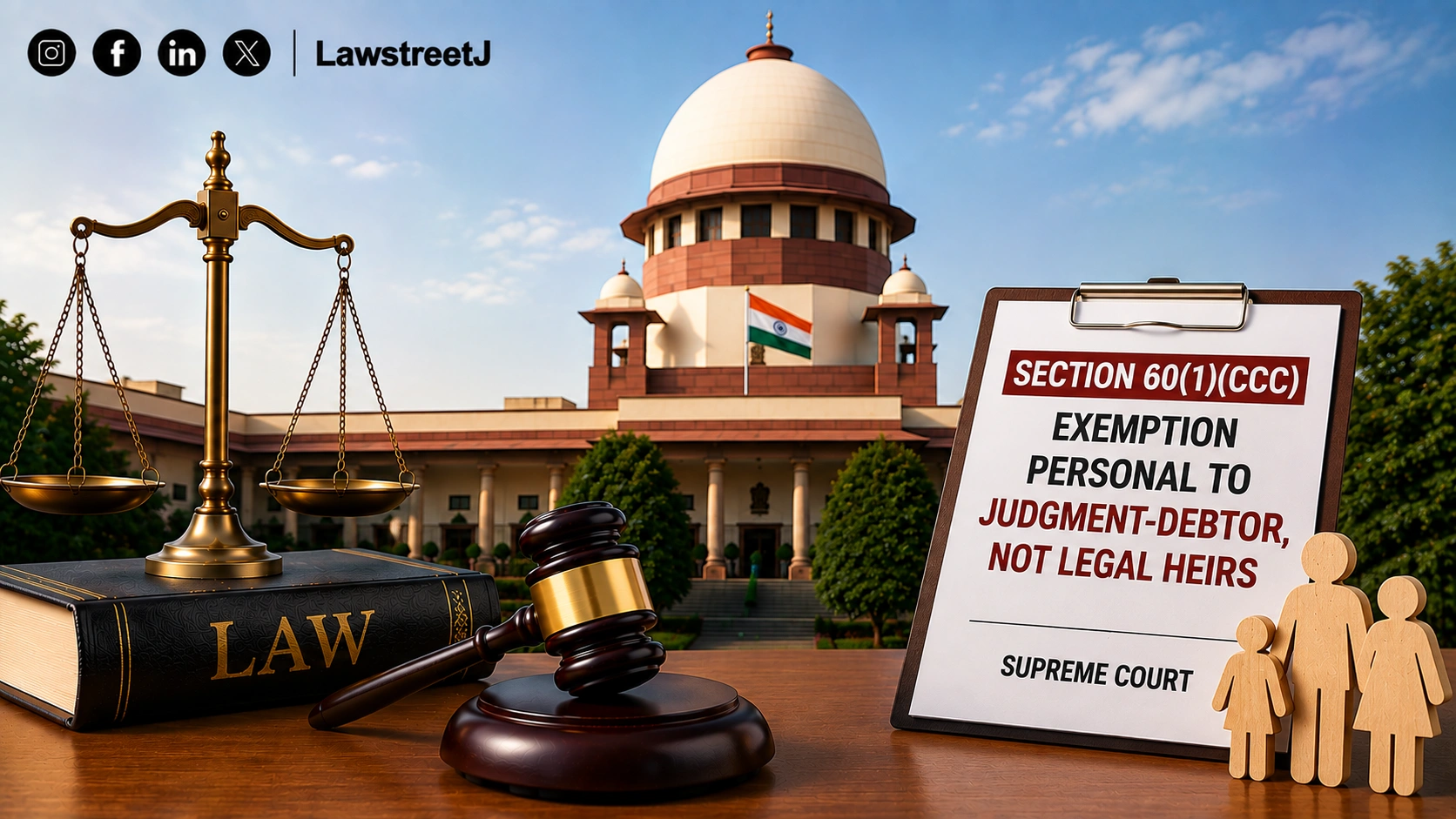
New Delhi: The Supreme Court has held that the exemption from attachment and sale available to a judgment-debtor's main residential house under Section 60(1)(ccc) of the Code of Civil Procedure, 1908, as applicable to Delhi, is personal to the judgment-debtor and cannot be claimed by his legal representatives, while setting aside a High Court order that had remitted a decades-old bank recovery execution for a fresh factual inquiry.
A Bench of Justices Pamidighantam Sri Narasimha and Alok Aradhe was hearing a batch of appeals arising out of the judgment of the High Court of Madhya Pradesh at Jabalpur, which had set aside an order of the Debts Recovery Appellate Tribunal, Allahabad, and remitted execution proceedings against a Delhi property to the Debts Recovery Tribunal, Jabalpur, for inquiry into questions of service of notice and exemption from attachment.
The dispute traced back to credit facilities availed by a malt manufacturing company from Punjab & Sind Bank, secured by personal guarantees of its directors, including the deceased husband of Respondent No. 1. Following defaults, the Bank obtained a compromise decree in 1991 before the District Court, Morena, under which title deeds of a Delhi property furnished as collateral were released, though the judgment-debtor's personal liability for the decretal amount continued. After further defaults and the judgment-debtor's death in 1994, execution proceedings against Respondent No. 1 and her children were eventually transferred to the Debts Recovery Tribunal, Jabalpur, in 1998, pursuant to the Recovery of Debts and Bankruptcy Act, 1993.
The Delhi property was ultimately attached and auctioned in 2006, with the sale confirmed in favour of the Auction-Purchaser. Respondent No. 1's challenges before the Debts Recovery Tribunal and Appellate Tribunal met with mixed results, culminating in the High Court's 2009 judgment which held that the omission of notice under Order XXI Rule 22 of the Code and Rule 2 of the Second Schedule to the Income Tax Act, 1961 went to the root of jurisdiction, and remitted the matter for a fresh inquiry into prejudice and the claim of exemption under Section 60(1)(ccc) of the Code.
The Auction-Purchaser, the Bank, and the son of the judgment-debtor separately appealed to the Supreme Court. The Court framed three questions: whether non-compliance with Order XXI Rule 22 of the Code affected the auction; whether failure to serve notice under Rule 2 of the Second Schedule to the 1961 Act rendered the sale void; and whether the Delhi property was exempt from attachment under Section 60(1)(ccc) of the Code.
On the first question, the Court held that once execution proceedings were transferred to the Debts Recovery Tribunal under Section 31 of the 1993 Act, the procedure under the Code of Civil Procedure stood superseded by the procedure prescribed under the Second Schedule to the 1961 Act, rendering Order XXI Rule 22 of the Code inapplicable to the sale. The Court also noted that, even otherwise, the Morena Court's prolonged and unsuccessful attempts to serve notice over more than two years would have justified proceeding without notice, and that under the proviso applicable to Delhi, failure to record reasons for dispensing with such notice amounted only to an irregularity, not a jurisdictional defect.
On the second question, the Court held that although no notice under Rule 2 of the Second Schedule to the 1961 Act was served on Respondent No. 1 or her children, they were already parties to the execution proceedings and had actual knowledge of the auction, including having filed an application before the Tribunal seeking release of the property's title deeds. In the absence of substantial injury and given that the legal representatives never invoked the remedy under Rule 61 of the Second Schedule to set aside the sale, the Court held that the absence of notice did not render the execution or sale void.
On the third question, the Court held that Section 60(1)(ccc) of the Code, introduced through the Punjab Relief of Indebtedness Act, 1934 and extended to Delhi in 1956, protects only a judgment-debtor's main residential house occupied by him, and that the protection is personal to the judgment-debtor and does not extend to his legal representatives. Concurring with a consistent line of authority from the Delhi and Punjab & Haryana High Courts spanning nearly four decades, the Court held that a legal representative's liability is limited to the estate in his hands and cannot be equated with the personal exemption available to a judgment-debtor.
The Court further held that the claim of exemption, being a mixed question of law and fact, could not be raised for the first time in a writ petition without having been pleaded or proved before the Recovery Officer, noting that Respondent No. 1 had raised the plea only belatedly, after having failed to urge it at any of the earlier stages of the execution proceedings.
Accordingly, the Court held that “the High Court erred in entertaining and in remitting the matter to the Recovery Officer, DRT to decide the same after giving an opportunity to the parties to lead evidence.” The impugned judgment of the High Court was quashed and set aside.
The appeals filed by the Auction-Purchaser and the Bank were allowed, while the appeal filed by the son of the judgment-debtor was dismissed. The Court directed that there shall be no order as to costs.
Appearances:
For the Appellant in C.A. No. 182 of 2016: Dr. A.M. Singhvi, Senior Advocate.
For the Appellant-Bank in C.A. No. 190 of 2016: Mr. D.N. Goburdhun, Senior Advocate.
For the Appellant in C.A. No. 191 of 2016: Mr. Rajiv Shakdher, Senior Advocate.
For Respondent No. 1: Mr. Shekhar Naphde, Senior Advocate.
Case Title: Sheela Gehlot vs. Mohini Hardayal Singh & Ors., Civil Appeal No. 182 of 2016 with connected Civil Appeal Nos. 190 of 2016 and 191 of 2016