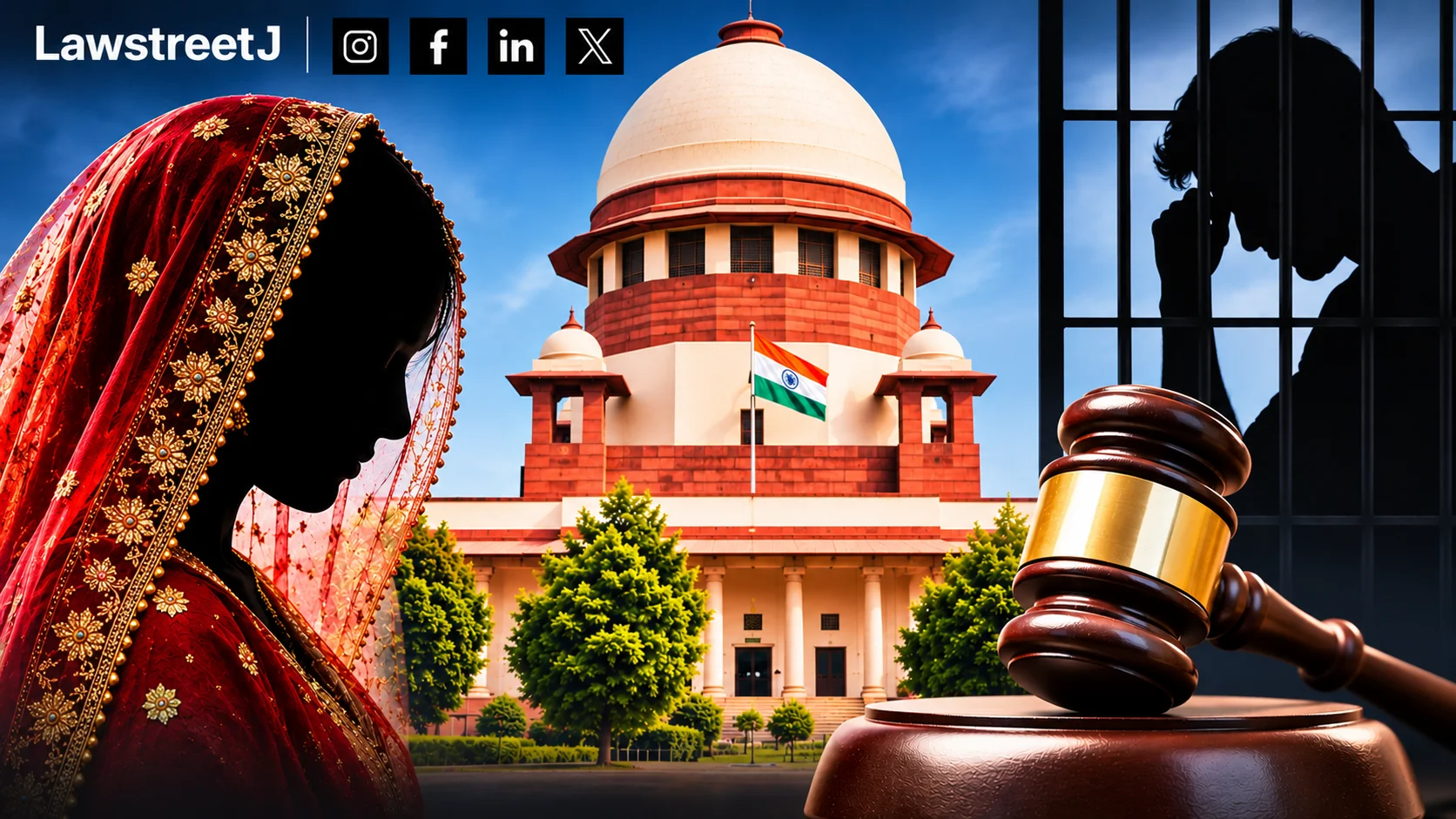
New Delhi: The Supreme Court has upheld the life sentence of a man for the murder of his wife and the dowry-death convictions of the accused in a 1996 case from Maharashtra, holding that the husband, who was in exclusive company of his wife in the matrimonial home when she was strangled, failed to offer a plausible explanation under Section 106 of the Evidence Act.
A Bench of Justice Sandeep Mehta and Justice Devendra Kumar Upadhyaya dismissed the appeals on 2 November 2026 (2026 INSC 1187) and directed the appellants to surrender within four weeks.
The Court was hearing Criminal Appeal No. 1849 of 2013, filed by Ramkishan Digambar Jadhav, and Criminal Appeal No. 962 of 2014, filed by his father and brother, against the Bombay High Court (Aurangabad Bench) judgment dated 3 July 2013. The appeal of the father, Digambar, abated because he died during its pendency, leaving the husband and his brother Venkat as the appellants.
The marriage took place on 12 May 1995, and the wife died at the matrimonial home on 1 February 1996, within nine months. The prosecution alleged that she was harassed for dowry, comprising a television set, a tape deck, a plot in the MIDC area and ₹50,000, so that the husband could get employment. Her brother, the complainant, said she had told him of being beaten, starved and, on one occasion, tied with a rope and lowered into a well with a threat to her life.
The husband had informed the police at 8 AM that his wife died accidentally of a sudden seizure, while the family of the deceased lodged a complaint of murder. The post-mortem opinion was that the cause of death was “asphyxia due to throttling”, with injuries including a fractured hyoid bone and haemorrhage in the neck.
The trial court at Biloli, on 21 September 1998, convicted the husband, his father and his brother under Sections 498-A and 304-B read with Section 34 IPC, sentencing each to seven years’ rigorous imprisonment under Section 304-B. It acquitted all six accused of murder and acquitted the three women relatives of all charges. On appeal, the High Court upheld the dowry-death convictions and, in the State’s appeal, set aside the husband’s acquittal, convicting him of murder under Section 302 IPC and sentencing him to life imprisonment.
Before the Supreme Court, the appellants argued that the case rests on circumstantial evidence with no complete chain, that the death was accidental, and that the father and brother had been roped in only because of their relationship, with no specific role. They also sought parity with the three relatives acquitted. The State contended that the death was homicidal and took place in the husband’s exclusive custody, and that the foundational facts for the presumption under Section 113-B of the Evidence Act were established.
The Court accepted the medical evidence, noting that the doctor denied the possibility of an epileptic fit causing the injuries and that there was no lock-jaw or displacement of the tongue. It held that the defence theory was false and concocted, and that none of the accused denied their presence in the house.
Relying on Trimukh Maroti Kirkan v. State of Maharashtra, the Court held that where an offence occurs inside a house, the prosecution’s burden is lighter and the inmates must give a cogent explanation. It held that the husband, instead of discharging this burden, set up “a demonstrably false and concocted defence”, which provided an additional link completing the chain of circumstantial evidence and proving murder beyond reasonable doubt.
On dowry death, the Court found that the wife was strangled within about nine months of the marriage, well within the seven-year period under Section 304-B, and that there was clear, consistent and corroborative evidence of persistent cruelty and starvation over the dowry demands, from her brother, her father, the mediator of the marriage and two independent neighbours. The accused, it held, failed to rebut the presumption under Section 113-B.
Finding no reason to interfere, the Court dismissed both appeals, cancelled the bail bonds of the appellants and directed them to surrender before the trial court within four weeks to serve out the remaining sentences, failing which the trial court will take steps including non-bailable warrants to secure their arrest.
Case Title: Ramkishan Digambar Jadhav v. The State of Maharashtra, Criminal Appeal No. 1849 of 2013, with Criminal Appeal No. 962 of 2014