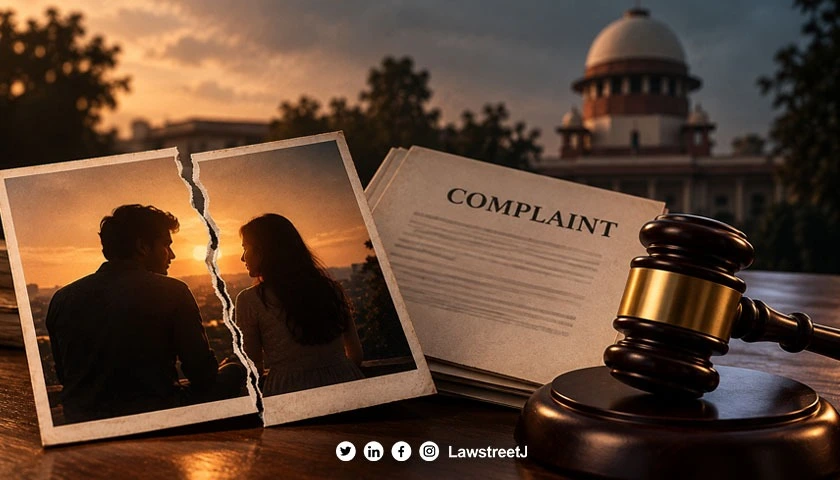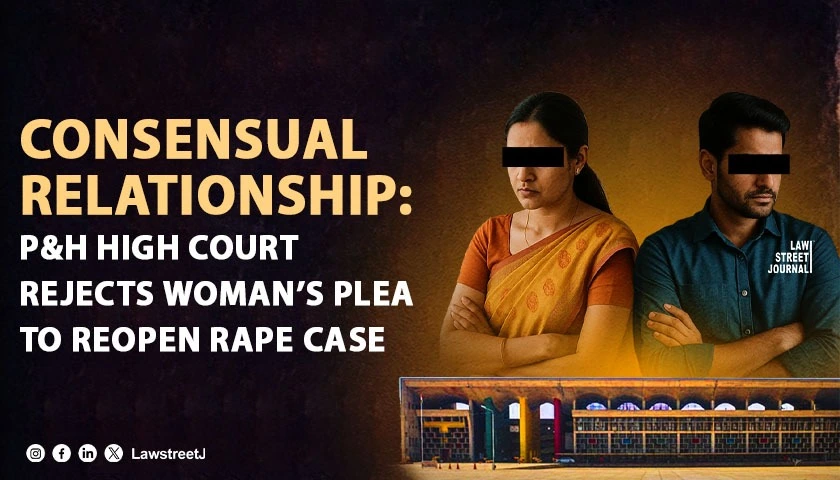
Punjab: The Punjab and Haryana High Court has dismissed an application seeking recall of its earlier order that had quashed an FIR registered for offences including rape, criminal intimidation and administering an intoxicating substance, holding that the alleged failure of the accused to solemnize marriage after a compromise between the parties cannot revive criminal proceedings that have already been quashed on merits.
The order was passed by Justice Manisha Batra on March 7, 2026 while rejecting an application seeking recall of the Court’s order dated February 29, 2024, which had quashed FIR No. 89 of 2023 registered at Police Station Bhargo Camp, District Jalandhar.
The factual backdrop of the case traces its origins to the registration of the said FIR, in which the complainant alleged that the petitioner, an officer in the Indian Army, had repeatedly committed rape upon her on the pretext of a promise to marry. The petitioner was charge-sheeted under Sections 506, 376 and 328 of the IPC. He thereafter filed a petition under Section 482 of the Code of Criminal Procedure before the Punjab and Haryana High Court seeking quashing of the FIR. During the pendency of the petition, it was stated before the learned Trial Court on January 20, 2024 that the parties had voluntarily arrived at a compromise, a position confirmed by statements recorded before the Trial Court.
By its order dated February 29, 2024, the Court allowed the petition and quashed the FIR. Critically, the order was not grounded merely on the compromise between the parties. The Court had independently examined the allegations in the FIR against the legal framework governing the offence of rape under Section 375 IPC and returned a categorical finding that even assuming all the allegations in the FIR to be correct, the essential ingredients of the offences under Sections 506, 376 and 328 IPC were not prima facie made out. It was specifically held that the relationship between the parties appeared to be consensual in nature and that there was nothing on record to indicate that the promise to marry allegedly made by the petitioner was false at the very inception so as to vitiate the consent of the prosecutrix. The Court had further noted that both parties were major, and that the continuance of the proceedings was likely to cause greater prejudice to the complainant herself.
Following the quashing of the FIR, the petitioner subsequently came to learn that the complainant had previously registered a similar FIR against another person on analogous allegations. On the basis of this information and other grounds set out in his reply to the recall application, the petitioner declined to solemnize the marriage. Thereupon, the complainant filed the present application under CRM-29714-2024 seeking recall of the order dated February 29, 2024 on the ground that the petitioner had not complied with the terms of compromise and had flatly refused to perform the marriage despite her repeated requests.
In reply to the recall application, learned counsel for the petitioner raised two distinct contentions. First, it was argued on merits that the petitioner’s refusal to marry was attributable to his subsequent discovery that the complainant had previously lodged a similar FIR bearing rape allegations against another individual, and that in light of these circumstances it was not possible for him to proceed with the marriage. Second, a legal objection was raised to the maintainability of the application itself, namely, that review of the order dated February 29, 2024 is not maintainable in view of the statutory bar created under Section 403 of the Bharatiya Nagarik Suraksha Sanhita, 2023, which corresponds to Section 362 of the Code of Criminal Procedure.
The Court, after hearing rival submissions, proceeded to dismiss the application on both grounds. On the question of the legal effect of the quashing order, the Court held that the order dated February 29, 2024 was not solely predicated upon the compromise between the parties but was primarily grounded on a merits-based finding that no prima facie offence under the relevant sections of the IPC was made out against the petitioner. Once such a finding had been returned and the criminal proceedings quashed, the Court held that subsequent conduct of the parties or the alleged breach of any understanding between them could not revive the criminal prosecution, nor could it confer jurisdiction upon the Court to recall the final order.
On the question of maintainability, the Court held that it is well settled that once a criminal court has signed its judgment or final order disposing of a case, it becomes functus officio and is precluded from altering or reviewing the same, except for correction of clerical or arithmetical errors. This statutory embargo, the Court held, is embodied in Section 403 of the BNSS (corresponding to Section 362 of CrPC), which clearly mandates that no Court shall alter or review its judgment after it has been signed, save for clerical or arithmetical mistakes.
In support of this position, the Court placed reliance upon the recent judgment of the Hon’ble Supreme Court in Raghunath Sharma v. State of Haryana, 2025 SCC OnLine SC 1148, wherein it was categorically held that once criminal proceedings have been quashed by a final order, the High Court cannot subsequently recall or revive the same by invoking its inherent powers, as such recall would amount to an impermissible alteration or review of the judgment. The Supreme Court had further held in that case that subsequent disputes between parties or alleged violation of compromise terms cannot constitute a ground to recall an order quashing criminal proceedings, and that the only limited exceptions to this bar arise in extraordinary circumstances such as where the order was obtained by fraud, where there has been a violation of principles of natural justice, or where the order is a nullity for want of jurisdiction. The Court found that no such circumstance had been demonstrated in the present case.
The Court further observed that the grievance of the applicant essentially pertained to an alleged breach of an understanding regarding marriage and that even if such allegation were to be assumed to be correct, it may give rise to such civil or other remedies as may be available to the applicant in accordance with law. However, it categorically held that an alleged breach of a matrimonial understanding cannot be a ground for recalling a final judicial order by which the criminal proceedings had already been quashed on merits. The Court accordingly held that upon the order dated February 29, 2024 attaining finality, and upon the finding having been recorded that no prima facie case was made out against the petitioner, the Court had become functus officio and lacked jurisdiction to reopen or review the said order in view of the statutory bar under Section 403 of the BNSS.
Before parting with the matter, the Court took care to clarify that it had neither examined nor expressed any opinion on the allegations made by the petitioner in his reply regarding the character or past conduct of respondent No. 2. The Court specifically recorded that those assertions had been noticed only for the purpose of recording the submissions advanced on behalf of the parties and that nothing contained in the order shall be construed as casting any aspersion upon the character of respondent No. 2.
The application was accordingly dismissed.
The petitioner was represented by Mr. Atul Goyal, Advocate, of Tripaksha Litigation, with the petitioner also being advised by Ekam Nyaay Foundation. The State of Punjab was represented by Ms. Sakshi Bakshi, Additional Advocate General, Punjab, while Respondent No. 2 was represented by Mr. S. K. Kanojia, Advocate.
Case Title: Petitioner v. State of Punjab and Another, CRM-29714-2024 in CRM-M-1192-2024.



![Police protection to fund manager alleging threat from Kirron Kher & aide: Punjab & Haryana HC [Read Order]](/secure/uploads/2023/12/lj_9007_Police_Kirron_Kher.jpg)
![Most interested witness being the father of deceased, SC upholds acquittal of 6 accused for murder [Read Judgment]](/secure/uploads/2023/12/lj_9904_df2c02a2-d8c5-4dd6-8b58-a59e17b8635b.jpg)
![Supreme Court Collegium approves new Chief Justices for five key High Courts in India [Read Recommendations]](/secure/uploads/2023/12/lj_8000_380d1135-6f3a-4988-a00a-4d5cd5901815.jpg)