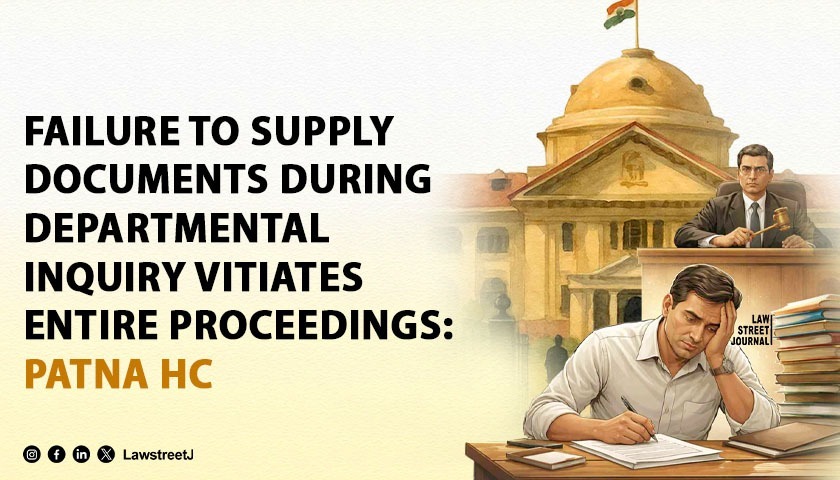
Patna: The Patna High Court has set aside the dismissal of an Assistant Godown Manager of the Bihar State Food and Civil Supplies Corporation Limited, holding that the failure to supply documents sought by him during the departmental inquiry violated the principles of natural justice, thereby vitiating the entire proceedings, and directed that all consequential benefits, including retiral benefits, be extended to him within four months.
A Division Bench of Justice Sudhir Singh and Justice Sunil Dutta Mishra passed the order on April 16, 2026, in Letters Patent Appeal No. 410 of 2022, allowing the intra-court appeal filed by Ganesh Pandey against a judgment dated July 18, 2022, passed by a learned Single Judge of the Patna High Court in Civil Writ Jurisdiction Case No. 11956 of 2005, which had dismissed his writ petition.
Ganesh Pandey was working as an Assistant Godown Manager in the Bihar State Food and Civil Supplies Corporation Limited at Madhubani when he was subjected to an audit. The audit alleged that he was liable for defalcation of Rs. 5,32,948, and he was placed under suspension by a memo dated May 9, 1995. On July 11, 1996, the appellant sought recalculation of the alleged liability on the ground that the audit report had been prepared beyond the relevant records. Respondent No. 4 thereafter reassessed the matter and found Rs. 2,56,936.01 due, subject to verification by the auditor.
The suspension was revoked on August 30, 1999, but the appellant was again placed under suspension on October 19, 2001, and a charge memo dated December 14, 2001, was served upon him. The appellant alleged that the documents said to be enclosed with the charge memo were not supplied to him despite repeated requests.
A letter dated October 29, 2002, was thereafter issued for initiation of civil and criminal proceedings. This, along with the second suspension order, was challenged by the appellant in Civil Writ Jurisdiction Case No. 1459 of 2003, which was dismissed on March 27, 2003, on the ground of pending investigation. Departmental proceedings were initiated on February 27, 2003, and though the appellant was directed to collect documents from the District Office, Madhubani, he was informed that the records had already been sent to the head office and had not been returned. Despite this, a second show cause notice, along with the enquiry report recommending punishment, was issued on July 7, 2003, and punishment of dismissal was imposed by memo dated August 22, 2003.
The appellant challenged this punishment in Civil Writ Jurisdiction Case No. 13124 of 2003, which was disposed of on March 7, 2005, granting liberty to file a review. The review application filed on May 14, 2005, was dismissed on May 26, 2005. The appellant thereafter filed Civil Writ Jurisdiction Case No. 11956 of 2005, which was also dismissed by the Single Judge on July 18, 2022, holding that the disciplinary authority and reviewing authority had examined the material on record and had not straightaway accepted the inquiry officer’s recommendation.
Counsel for the appellant submitted that the Single Judge had misinterpreted the facts and grounds of the case. It was pointed out that the appellant was not actually provided with the required documents; rather, the authorities merely issued directions to the District Office to make the documents available, which were never furnished. It was submitted that it is settled law that where any material is proposed to be relied upon in a departmental proceeding, a copy must be supplied to the charge-sheeted employee to ensure a fair opportunity to rebut it, failing which the entire process stands vitiated for violation of the principles of natural justice.
Counsel for the respondents submitted that there was no defect in the departmental proceeding and that the order passed by the Single Judge required no interference.
The Division Bench, upon being directed to produce the original records of the departmental proceedings by its order dated March 31, 2026, perused the same and found that there was nothing on record to demonstrate that the documents specifically demanded by the appellant during the course of the departmental inquiry were ever furnished to him. The record was found to be conspicuously silent not only as to the actual supply of such documents nor any communication or acknowledgment indicating that the appellant was made aware of or provided access to the material relied upon against him.
The court held that the limited issue before it was whether the failure to supply the documents had caused prejudice to the appellant, thereby vitiating the proceedings as contrary to the principles of natural justice.
Relying on the Supreme Court’s decision in State of Uttaranchal and Others v. Kharak Singh, reported in (2008) 8 SCC 236, the court reiterated the governing principles of a fair departmental inquiry, including that, upon receipt of the inquiry report and before proceeding further, the disciplinary or punishing authority is under an obligation to supply a copy of the inquiry report and all connected materials relied on by the inquiry officer to the delinquent employee to enable him to offer his views.
The court also placed reliance on State of U.P. and Others v. Saroj Kumar Sinha, reported in (2010) 2 SCC 772, which had held that a government employee facing a departmental inquiry is entitled to all relevant statements, documents, and materials to enable him to have a reasonable opportunity to defend himself. It further relied on Kashinath Dikshita v. Union of India, reported in (1986) 3 SCC 229, wherein the Supreme Court had observed that unless copies of the documents and statements sought to be relied upon are furnished to the delinquent employee, it would be virtually impossible for him to meet the charges in an effective manner, and any such denial would amount to denial of reasonable opportunity. Reference was also made to State of Punjab v. Bhagat Ram, reported in (1975) 1 SCC 155.
The Bench held that the observance of the principles of natural justice, particularly the rule of audi alteram partem, is not a mere procedural formality but an essential requirement to ensure fairness in any disciplinary proceeding. It held that the right of a delinquent employee to be supplied with all documents and materials relied upon by the employer is an integral facet of a fair opportunity of defence.
The court further held that the non-availability of documents at the field level could not be treated as a valid explanation for the lapse. The record did not indicate that any effective steps were taken by the authorities to ensure that the documents were made accessible to the appellant. Such a situation, being entirely attributable to the respondents, cannot be allowed to prejudice the rights of the delinquent employee. An employee, the court held, cannot be made to suffer on account of lapses attributable to the employer in ensuring availability of material required for his defence.
The court concluded that the opportunity purportedly afforded to the appellant was illusory and not in conformity with the principles of natural justice, and that the entire departmental proceeding stood vitiated. The Single Judge had not appropriately appreciated the effect of non-supply of documents on the fairness of the inquiry, and the impugned order accordingly could not be sustained.
The order of the Single Judge was set aside, the appeal was allowed, and the respondents were directed to extend all consequential benefits to the appellant, including retiral benefits, within four months from the date of receipt or production of a copy of the judgment.
Case Details
- Case Title: Ganesh Pandey v. The State of Bihar through the Managing Director, Bihar State Food and Civil Supplies Corporation Limited and Others
- Case Number: Letters Patent Appeal No. 410 of 2022 in Civil Writ Jurisdiction Case No. 11956 of 2005
- Court: High Court of Judicature at Patna
- Bench: Justice Sudhir Singh and Justice Sunil Dutta Mishra
- Date of Order: April 16, 2026
- Appellant’s Advocates: Mr. Abhinav Shrivastava, Senior Advocate; Mrs. Shashi Priya Pathak, Advocate; Ms. Antra Azad, Advocate
- Respondents’ Advocate: Mr. Shailendra Kumar Singh, Advocate

![Immediately stop caste-based survey: Patna High Court to Bihar Government [Read Order]](/secure/uploads/2023/05/lj_2614_70fde4fe-1b94-4360-a3d2-e162d6022c46.jpg)

![Supreme Court refuses pre arrest bail to IPS officer accused of creating fake WhatsApp account of HC's CJ [Read Order]](/secure/uploads/2023/11/lj_1575_Fake_WhatsApp_account_of_Patna_HC_Chief.jpg)