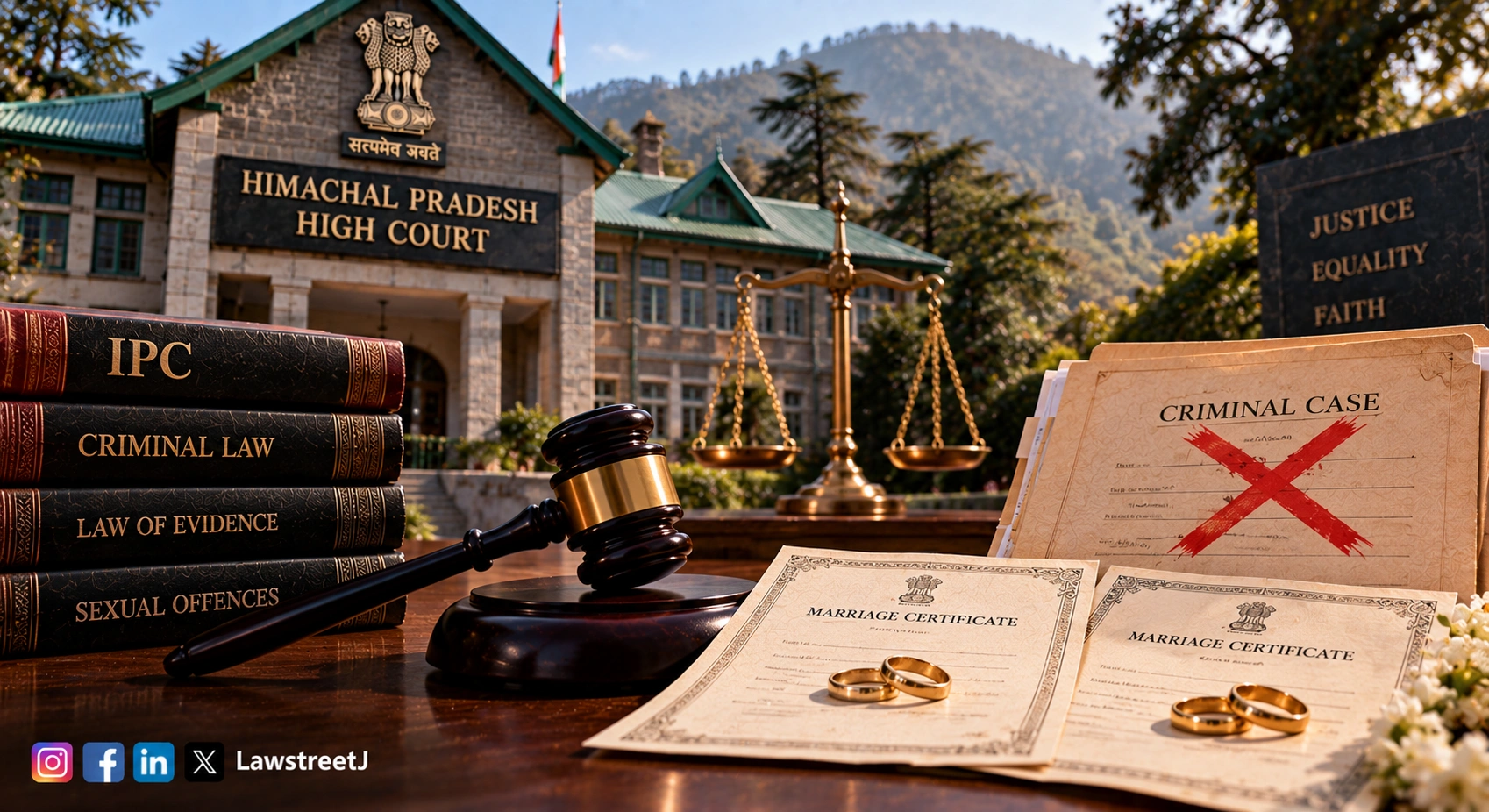
Shimla: The Himachal Pradesh High Court has granted regular bail to a man accused of sexually assaulting a woman on the pretext of marriage and of offences under the Scheduled Castes and Scheduled Tribes (Prevention of Atrocities) Act, holding that the complainant had of her own volition and without any external pressure joined the petitioner’s company, and that no case of a false promise to marry was prima facie made out.
Justice Sandeep Sharma was hearing a bail application filed under Section 483 of the Bharatiya Nagarik Suraksha Sanhita, 2023, seeking regular bail in connection with an FIR registered at the Women Police Station, Bilaspur, for offences under Sections 64 and 69 of the Bharatiya Nyaya Sanhita and Sections 3(1)(r) and 3(1)(s) of the SC/ST (Prevention of Atrocities) Act.
The prosecution case was that the complainant, aged 31 years and already married, had come into contact with the petitioner, an astrologer by profession, in 2022 after facing matrimonial discord. She alleged that the petitioner, taking advantage of her innocence, persuaded her to divorce her husband on the pretext that her horoscope showed no prospect of a good family life with him, and promised to marry her himself since he too was estranged from his wife. It was alleged that the petitioner thereafter sexually assaulted her against her wishes on the pretext of marriage, and subjected her to beatings when she objected to his relations with other women.
The State opposed bail, submitting that the petitioner was a habitual offender with 23 prior criminal cases registered against him, that overwhelming evidence including the complainant’s statement recorded under Section 183 of the BNSS supported the allegation of sexual assault on the pretext of marriage, and that he had been threatening the complainant’s life. It was further alleged that the petitioner had made casteist remarks while causing injury to her. The complainant, who appeared in person and chose not to engage counsel, also opposed the grant of bail, submitting that there was a threat to her life and that the petitioner had spoiled the lives of several other women.
Examining the complainant’s own statement, the Court found that she had, of her own volition and without any external pressure, joined the petitioner’s company, and was not persuaded to accept the State’s submission that the petitioner had taken undue advantage of her innocence. The Court noted that despite the alleged physical relations continuing since 2022, no complaint was made until the FIR was lodged on 22.06.2026, and that she had, during this period, been living with the petitioner of her own volition.
The Court further held that since the factum of both parties’ subsisting marriages was known to each of them, and neither had obtained a divorce, there could have been no promise of marriage capable of being acted upon, and that the complaint itself suggested any promise to marry was conditional upon the complainant first obtaining a divorce. On this basis, the Court held that prima facie no case, much less one under Section 69 of the Bharatiya Nyaya Sanhita, was made out against the petitioner. On the allegation of casteist remarks, the Court noted that no such complaint featured in the complainant’s initial statement under Section 154 Cr.P.C., and that this aspect appeared for the first time only in her statement under Section 183 BNSS, though it left this issue to be determined by the trial court.
On the petitioner’s antecedents, the Court noted that of the 23 cases cited by the State, the majority were registered under the Excise Act, and that as per the record furnished by the police, the petitioner already stood acquitted in 21 of them. Observing that a person is presumed innocent until proven guilty, the Court held that indefinite incarceration during trial, when guilt was yet to be established, would violate the petitioner’s fundamental right under Article 21 of the Constitution.
Relying on the Supreme Court’s decisions in Dataram Singh v. State of Uttar Pradesh, Sanjay Chandra v. Central Bureau of Investigation, Manoranjana Sinh alias Gupta v. CBI, and Prasanta Kumar Sarkar v. Ashis Chatterjee, the Court reiterated that the normal rule is of bail and not jail, that gravity of allegation alone cannot be a decisive ground to deny bail, and that the object of bail is to secure the accused’s presence at trial rather than to punish or prevent.
Holding that the petitioner had made out a case for bail, and that the apprehension of his fleeing from justice could be addressed through stringent conditions, the Court allowed the petition and directed that the petitioner be enlarged on bail on furnishing a personal bond of Rs.2,00,000/- with two local sureties in the like amount, subject to conditions including that he make himself available for interrogation and regularly attend trial, not tamper with evidence or influence witnesses, and not leave India without the Court’s prior permission.
The Court clarified that its observations were confined to the disposal of the bail application and would not reflect on the merits of the case.
Appearances:
For the Petitioner: Mr. Imran Khan, Advocate.
For the Respondent: Mr. Rajan Kahol & Mr. Vishal Panwar, Additional Advocates General, with Mr. Ravi Chauhan and Mr. Anish Banshtu, Deputy Advocates General, for State.
Case Title: Vinod Kumar vs. State of Himachal Pradesh, Cr. MP(M) No. 1590 of 2026


![Himachal HC Grants Bail to Man Accused of Unnatural Acts with Cow [READ ORDER]](/secure/uploads/2020/11/lj_8855_Himachal_Pradesh_High_Court.jpeg)
![Remaining in India after expiry of visa is offence, Himachal Pradesh HC reiterates while denying bail [Read Petition]](/secure/uploads/2023/12/lj_3841_e40384f4-2611-4a51-b179-97824c5e53c7.jpg)

![Supreme Court Stays Himachal Pradesh HC Order, Sanjay Kundu to Remain as State DGP Amid Businessman's Complaint [Read Order]](/secure/uploads/2024/01/lj_5499_5a926c6d-aa3b-4344-b54d-2c7fc5145ace.jpg)