

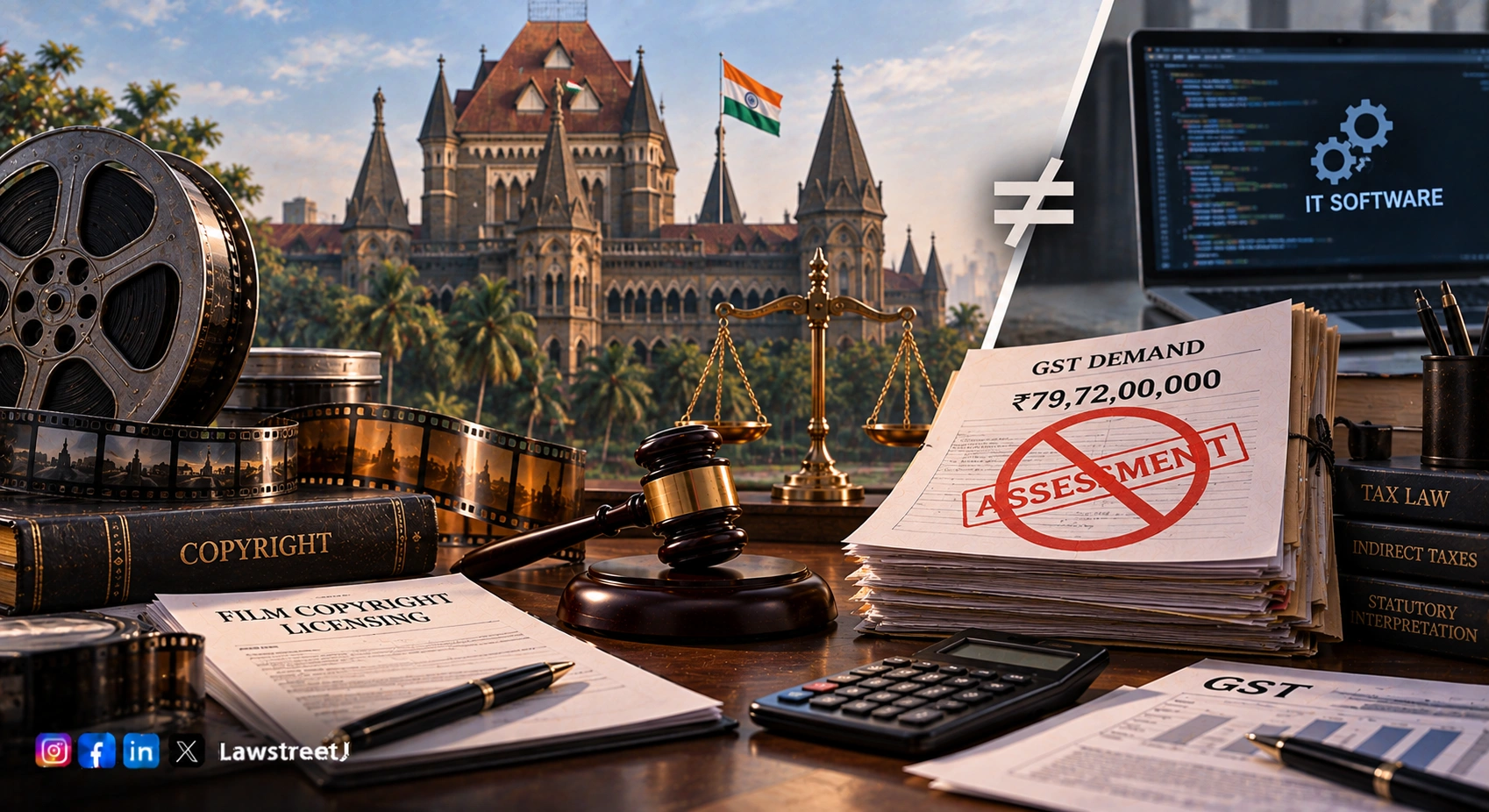
Mumbai: The Bombay High Court has quashed orders confirming a GST demand of over Rs. 79.72 crore against Dharma Productions Pvt. Ltd. and its group company, holding that licensing of copyright in cinematographic films is correctly classifiable as licensing of intellectual property rights in goods other than Information Technology Software, taxable at 12% GST under Entry 17(i) of the applicable Rate Notification, and not as licensing of "Information Technology Software" taxable at 18% under Entry 17(ii), as the tax authorities had held.
A Division Bench of Justices M.S. Karnik and Sandesh D. Patil was hearing Writ Petition No. 2029 of 2025, filed by Dharma Productions Pvt. Ltd., along with connected Writ Petition No. 2184 of 2025, filed by Dharmatic Entertainment Pvt. Ltd., against the State of Maharashtra and GST authorities, both petitions raising common issues and disposed of by a common judgment.
The petitioner, a film production company and original copyright owner of its cinematographic films, licenses its intellectual property, including theatrical, satellite and digital rights, to distributors under Rights License Agreements, classifying the supply under SAC 997332 (licensing for the right to broadcast and show original films) and paying GST at 12% under Heading 9973 for the period FY 2017-18 to 2020-21, prior to the entry being harmonised to a uniform 18% from 01.10.2021. The GST Department issued show cause notices under Sections 73 and 74 of the CGST Act alleging that the petitioner had misclassified the supply, relying partly on a statement of the petitioner's Post-Production Head that digital delivery of films involved a "software format" link, and by Orders in Original dated 05.04.2021 and 06.04.2021 (later revised by Rectification Orders dated 09.08.2021), confirmed a differential demand of Rs. 79,72,68,337 with interest and penalty, treating the licensing as taxable at 18% as licensing of Information Technology Software. The petitioner's appeals were rejected by Orders in Appeal dated 17.03.2025 and 19.03.2025, prompting the present writ petitions under Article 226 challenging both the original and appellate orders.
Senior Advocate Mr. Darius Shroff, for the petitioners, submitted that the show cause notices and impugned orders proceeded on the fundamentally erroneous premise that licensing copyright in cinematographic films amounted to licensing "Information Technology Software," an error of law going to the root of jurisdiction rather than a disputed question of fact, relying on Godrej Sara Lee Ltd. v. Excise & Taxation Officer to argue that an authority acting on a legally unsustainable premise exceeds its jurisdiction, warranting writ interference despite an alternate remedy. It was submitted that the Scheme of Classification of Services maintains a clear distinction between SAC 997331 (licensing of computer software and databases) and SAC 997332 (licensing for broadcasting and showing films), with the Explanatory Notes to 997332 mapping precisely onto film-licensing transactions without any reference to software, and that the impugned orders neither engaged with the statutory definition of "information technology software" nor explained why the two distinct SAC entries were being collapsed into one. Reliance was also placed on CBIC Circular No. 236/30/2024-GST dated 11.10.2024 regularising such disputes on an "as is" basis, on the Prasar Bharati precedent, and on the minutes of the 54th GST Council meeting, to argue that the orders merely reproduced the show cause notices without independent reasoning and were unsustainable.
The learned Additional Government Pleader, for the State, raised a preliminary objection that the writ petitions were not maintainable given the alternate remedy of appeal to the GST Appellate Tribunal under Section 112 of the CGST/MGST Act, relying on Whirlpool Corporation v. Registrar of Trade Marks and Magadh Sugar and Energy Ltd. v. State of Bihar to argue that classification disputes involve disputed questions of fact and mixed questions of law and fact unsuited to writ jurisdiction, and that any error was merely one of appreciation of evidence, not a "fundamental error" warranting interference. On merits, it was submitted that Entry 5(c) of Schedule II to the CGST Act creates an express legal fiction treating temporary transfer of any intellectual property right as a supply of service, that the Rights License Agreements granted only limited, time-bound rights while the petitioner retained ultimate ownership, and that the petitioner had misclassified its supply under Heading 9973 attracting 12% GST when the correct rate was 18%, a position supported by the statement of the Post-Production Head that digital delivery involved a software-format link.
On maintainability, the Court held that the challenge raised not a disputed question of fact but an error of law going to the root of jurisdiction, since an authority that taxes a transaction by misconstruing the governing statutory entry and definition acts without jurisdiction, rendering the resultant proceedings void ab initio, following Godrej Sara Lee. It accordingly entertained the writ petitions despite the existence of an appellate remedy, also noting the absence of a functional GST Appellate Tribunal at the time the petitions were filed.
On merits, the Court held that Entry 17 of Heading 9973 of the Rate Notification creates two distinct entries, 12% for IP rights in goods other than Information Technology Software and 18% for Information Technology Software, the latter statutorily defined as machine-readable instructions, data, sound or image capable of being manipulated or providing interactivity via a computer or similar device. It found that the impugned orders never engaged with this definition at all, and recorded no finding on how a cinematographic film, a passive audio-visual work incapable of execution, manipulation or interactivity, could satisfy it. The Court held that the Scheme of Classification of Services and its Explanatory Notes confirm a clear distinction between SAC 997331 for software licensing and SAC 997332 for licensing the broadcast and showing of films, sound recordings and similar content, the latter squarely covering the petitioner's transactions, and that the impugned orders neither analysed this distinction nor explained collapsing the two SACs into one, amounting to a manifest and unreasoned error of law.
The Court further noted that the rate differential was itself harmonised to a uniform 18% only with effect from 01.10.2021, confirming that a genuine 12%/18% distinction existed for the period in dispute, and that subsequent CBIC circulars and GST Council deliberations supported regularising such classification disputes rather than treating them as settled against the assessee. It held that the Orders in Original substantially reproduced the show cause notices verbatim without independent analysis of the petitioner's detailed submissions, and that the Orders in Appeal did not cure this defect, since the appellate authority failed to engage with the specific grounds raised, including the correct tariff entry and the statutory definition of information technology software, merely affirming the adjudicating authority's conclusions. The Court held that mere reproduction of facts, submissions or case law does not amount to reasoned adjudication.
Rather than remitting the matter for fresh adjudication, the Court held that since the impugned orders suffered from jurisdictional errors apparent on the face of the record, not requiring adjudication of disputed questions of fact, and given the absence of a functional Tribunal at the relevant time, it was appropriate to finally allow the writ petitions in terms of prayer clause (a) of the petitions, with no order as to costs.
Appearances:
For the Petitioners: Mr. Darius Shroff, Senior Advocate, with Adv. Prasad Paranjape and Adv. Kevin Gogri, instructed by Lumiere Law Partners.
For the Respondent-State: Smt. Jyoti Chavan, Additional Government Pleader, with Mr. Amar Mishra, AGP.
Case Title: Dharma Productions Pvt. Ltd. vs. State of Maharashtra & Ors., Writ Petition No. 2029 of 2025, with Dharmatic Entertainment Pvt. Ltd. vs. State of Maharashtra & Ors., Writ Petition No. 2184 of 2025


![Husband Can Also Claim Alimony/Maintenance From Wife: Bombay High Court Orders Woman To Pay Alimony To Ex-Husband [Read Order]](/secure/uploads/2022/04/lj_2823_Divorce.jpg)