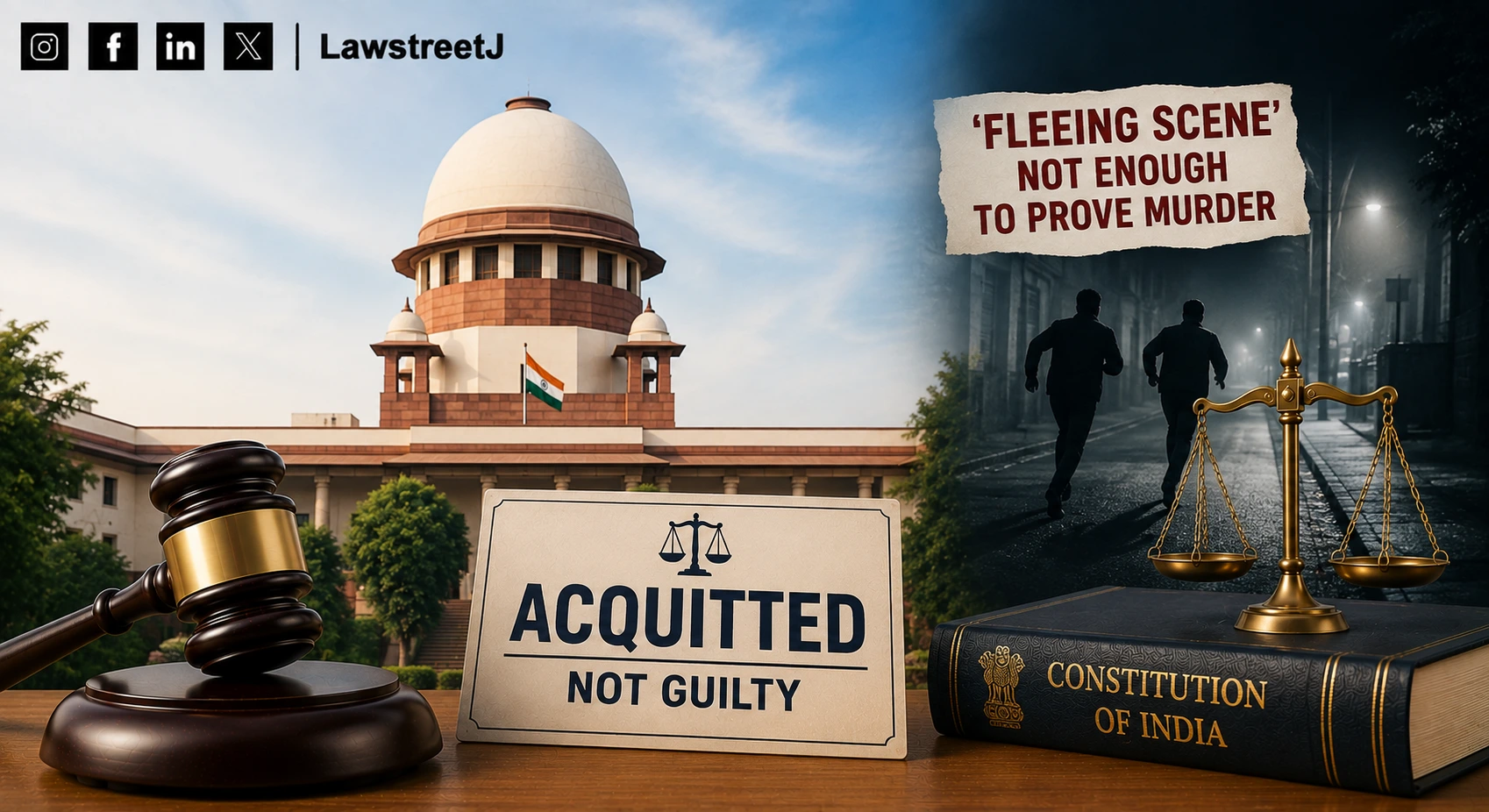
New Delhi: The Supreme Court has acquitted two men convicted for the murder of their friend, who was found drowned in a river in Gujarat in 2006, holding that the prosecution failed to prove that the death was homicidal and that the evidence on record pointed more probably to an accidental drowning.
The Bench of Justices J.B. Pardiwala and K. Vinod Chandran set aside the concurrent findings of the Trial Court and the Gujarat High Court and ordered the appellants' release.
As per the prosecution case, the deceased was taken from his house in the early morning of 17th July, 2006 by the two accused, ostensibly to play volleyball at Ankleshwar. When he did not return by evening, his family began searching for him, and the accused, when contacted, claimed he had been dropped off elsewhere. Wet clothes were later found on the riverbank and identified by the deceased's brother, and the body was recovered the next morning. The post-mortem recorded the cause of death as cardio-respiratory arrest due to asphyxia from drowning. A First Information Statement alleging a motive against the accused was recorded only about four months later, on 3rd November, 2006.
The Trial Court convicted both accused under Sections 302, 34 and 201 read with Section 120B of the Indian Penal Code, sentencing them to life imprisonment with fine, along with substantive sentences for criminal conspiracy and causing disappearance of evidence. The Gujarat High Court confirmed the conviction in appeal.
Before the Supreme Court, senior counsel for the appellants argued that there was no evidence to establish a homicidal death, and that the case, at worst, involved a misadventure that turned fatal, with the accused fleeing the spot in panic. It was submitted that the belated FIR, filed four months after the incident on the basis of an alleged motive, ought to be disbelieved, and that the doctor who conducted the post-mortem had conceded that the injuries were consistent with the body coming into contact with rocks while bathing or being dragged by the river's current. Counsel for the State, on the other hand, argued that the injuries were consistent with a blow from a soda bottle, that fragments of a broken bottle were found at the scene, and that the accused's conduct in returning only three of four purchased bottles, while inebriated and wet, indicated premeditation.
Examining the post-mortem report alongside the doctor's testimony, the Court found no basis to conclude that the death was homicidal, noting that no broken soda bottle or glass fragments had actually been seized from the scene or sent for forensic examination despite the suggestion put to the doctor. The Court observed:
"A reading of the post-mortem report, juxtaposed with the testimony of the Doctor who conducted the post-mortem, PW-1, cannot lead to a finding that the death was homicidal. There is nothing to indicate that the victim was hit on the head, rendered unconscious and then drowned deliberately in the river, as the prosecution propounded before the Trial Court. The post-mortem report leans in favour of the defense version of an accidental drowning."
On the alleged motive, the Court noted that the deceased's family had, on their own testimony, permitted him to leave with the accused on the morning of the incident despite the motive now being attributed to a purported relationship between the deceased and one accused's sister and a prior quarrel over a cricket match. The gross delay of four months in levelling the specific allegation, coming only after the accused had already confessed to the family that the deceased had drowned accidentally while bathing, further weakened the prosecution's motive theory. The Court also found the in-court identification of the accused by the shop owner and pan-parlour vendor, who were previously unacquainted with them and had not been put through a test identification parade, to be of little evidentiary value.
Addressing the High Court's reliance on the accused's subsequent conduct, including going to a movie and returning the soda bottles, as indicative of guilt, the Court cautioned against drawing such inferences from human behaviour under stress:
"The human mind, as has often been held by this Court, is at the same time fickle, manipulative and imaginative and the actions, the result of a deprived or a foolish mindset, especially in the face of adversities, which cannot be predicted."
Concluding that none of the circumstances relied upon by the prosecution had been established and that the hypothesis of an accidental drowning was more plausible than that of a premeditated murder, the Court held that while the accused's conduct in fleeing the scene without attempting to rescue their friend was reprehensible, it could not be treated as an incriminating circumstance establishing murder.
The Court accordingly allowed the appeal, set aside the conviction and sentence, and directed that the accused be released forthwith if not wanted in any other case, with their bail bonds standing cancelled if already on bail.
Appearances
For the Appellants: Mr. Iqbal Syed, Senior Counsel
For the Respondent-State: Ms. Swati Ghildiyal, Counsel
Case Title : Taher Vajiyuddin Rangwala & Anr. v. The State of Gujarat, Criminal Appeal No. 76 of 2020, 2026 INSC 859