


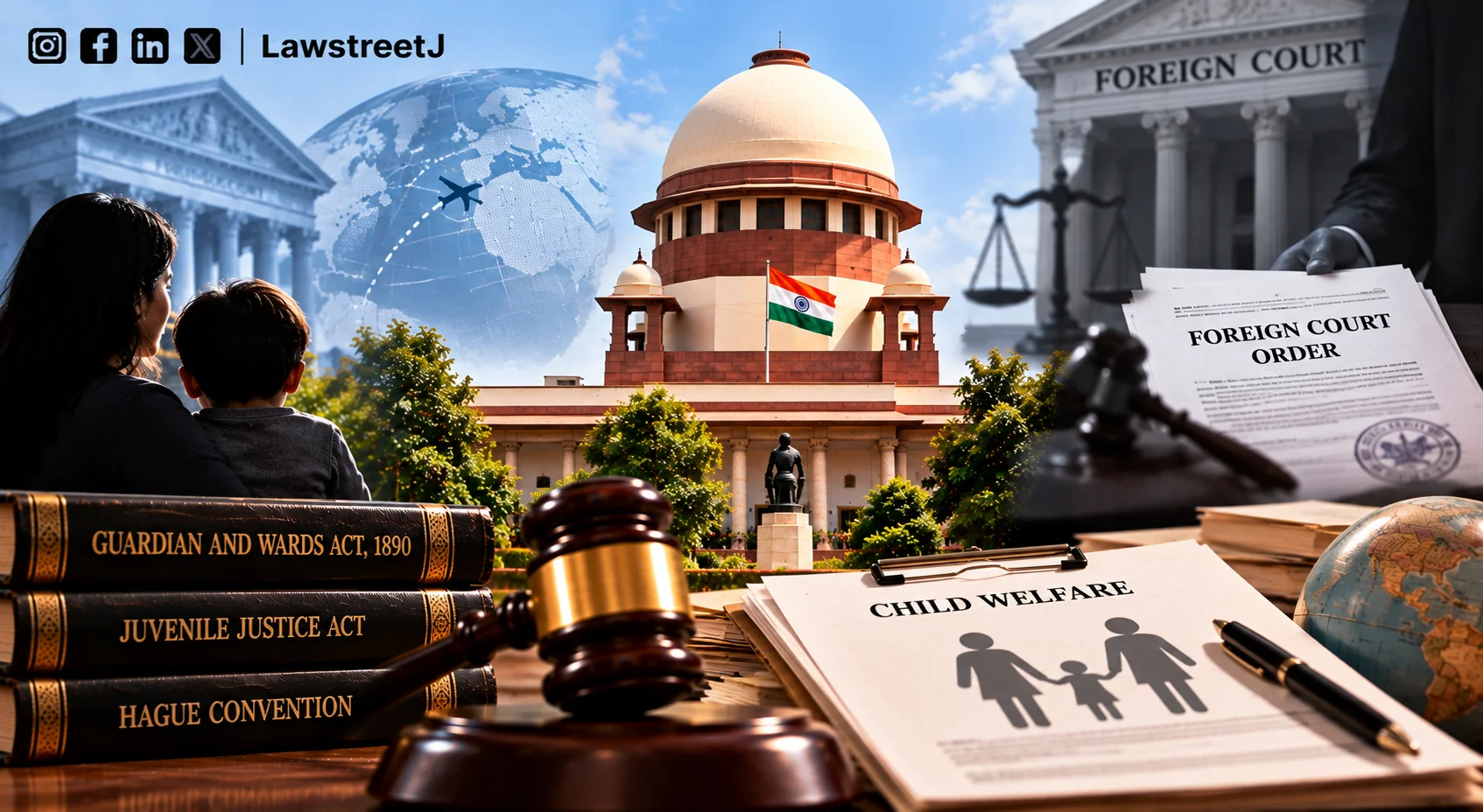
New Delhi: The Supreme Court has allowed a father's appeal and directed that his minor daughter, a citizen of the United States who was brought to India by her mother in breach of a California custody order, be returned to the USA, holding that the welfare of the child is paramount and that a foreign court's order must yield to it, though it deserves proper weight under the comity of courts.
A Bench of Justice J.B. Pardiwala and Justice K.V. Viswanathan was hearing an appeal by Vayu Kishore against the Karnataka High Court's judgment dated 20.12.2023, which had dismissed his habeas corpus petition seeking the child's custody and return. The parties married in New Jersey in 2018 and set up their home in California. A daughter was born in the USA in 2019. After the relationship broke down, the mother approached the Superior Court of California, Contra Costa County, seeking dissolution of marriage and later custody.
By an order dated 25.08.2022, the California court granted joint custody and shared parenting on a 50:50 basis, and barred removal of the child from California without written consent or a court order. Barely two weeks later, on 08.09.2022, the mother left for India with the child. On 02.12.2022, the California court recorded the violation, directed the child's immediate return, and ordered supervised visitation for the mother. The father moved the High Court about eight months after the child was brought to India.
The High Court had held that the mother's custody was not illegal, as Section 6 of the Hindu Minority and Guardianship Act, 1956 treats the mother as the natural guardian of a child under five. It also relied on the child's comfort with her mother, the eight-month delay and the absence of harm. The Supreme Court noted that it had attempted mediation, taking up the matter in the Committee Room on not less than ten occasions, but the parties could not reach a consensus.
Senior Advocates Mukul Rohatgi and Meenakshi Arora, appearing for the father, argued that the mother surreptitiously left in violation of an order she herself had obtained, and that the child, as a US citizen, should be raised and educated there. The father offered undertakings, including separate accommodation, restoration of the mother's lapsed Green Card and monthly support of USD 3,200. Opposing the appeal, Ms. Malavika Rajkotia argued that the child had been in India for almost four years and that India is not a signatory to the Hague Convention.
Setting out the approach for such cases, the Court held that in a contest between two parents, the threshold for a habeas corpus petition need not be illegal detention, and may be the wrongful deprivation of one parent's right to custody. Once that is crossed, the decision rests not on parental rights but on the child's welfare. The Court stated that “an order of a foreign court must yield to the welfare of the child.” Disobedience of a foreign order does not by itself require automatic enforcement, and habeas corpus cannot be used merely to execute it.
At the same time, the Court held that a foreign order must be given proper weight, depending on whether the foreign court examined the child's best interests on merits, who instituted the proceedings, the time elapsed and changed circumstances. It explained the distinction between summary and elaborate inquiries, and held that welfare must be understood in its widest sense, not by money or comfort alone. It also said that a wrongdoer should not ordinarily benefit from his or her wrong, but clarified that this is not balanced against welfare and may be considered only after welfare has been fully examined, when the scales are otherwise evenly poised.
Applying these principles, the Court held that the case called for an elaborate inquiry, given that the child had been in India for nearly four years. It found the High Court's reasons insufficient. The child's demeanour merely reflected four years of living with her mother, her tender age made her wishes impossible to ascertain, no material showed she would be harmed with her father, and eight months was not long enough to establish firm roots in India. The Court said the child, as a US citizen, should grow up and be educated in the USA.
The Court noted that the mother herself had instituted both the divorce and custody proceedings in California, that the 25.08.2022 order was passed after hearing both sides, and that nothing showed circumstances so grave that she had no option but to leave. It held that comity of courts and the principle that a party should not benefit from their own wrong tilted the scales, but only to support its conclusion on welfare.
The Court clarified that it could not and did not wish to compel the mother to move to the United States or continue the marriage, but she could not insist that the child remain in India. On a statement by her counsel that she would accompany the child, the Court directed her to travel to the USA with the child on or before 31.12.2026, and the father to cooperate in renewing the child's expired passport. The father's undertakings are to be filed by affidavit, and he must furnish security of Rs. 1 crore by way of a fixed deposit in the name of the Registrar, Supreme Court, within two weeks.
The Court clarified that its observations will not affect the custody and divorce proceedings pending in the USA, and listed the matter on 05.01.2027 for a report. A connected special leave petition by the wife against the Jharkhand High Court's affirmation of the rejection of her custody petition before the Family Court, Jamshedpur, was dismissed.
Appearances:
For the Appellant: Mr. Mukul Rohatgi and Ms. Meenakshi Arora, Senior Advocates, with Mr. Prabhjit Jauhar, Advocate.
For Respondent No. 4: Ms. Malavika Rajkotia, Advocate.
Case Title: Vayu Kishore vs. State of Karnataka & Ors., Civil Appeal No. 13785 of 2026 (@ SLP (C) No. 4163 of 2024)





.jpeg)


.jpeg)

